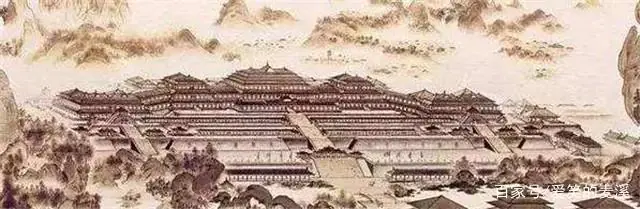
The Lithic Megalomania of Imperial Extraction: Geological Catastrophe, Olfactory Excess, and the Demographic Arithmetic of Tyranny in Du Mu's "On the Ah Fang Palace"
The Geological Catastrophe and the Lithic Megalomania of Territorial Unification
Du Mu's A Fang Gong Fu (阿房宫赋)—composed in 825 (Baoli 1st year) during the reign of Emperor Jingzong of Tang, when the twenty-three-year-old poet, witnessing the adolescent emperor's frenzy of palace construction and sensual indulgence, resurrected the Qin dynasty's architectural catastrophe as a forensic allegory for imminent Tang collapse—opens with a devastating geological and political event: Liu wang bi, si hai yi, shu shan wu, a fang chu. (六王毕,四海一,蜀山兀,阿房出。). The "six kings finished" (liu wang bi) is not merely historical reportage but a biopolitical liquidation: the six Warring States are not defeated but "finished" (bi), a terminal verb that reduces sovereign polities to completed projects of annihilation. The "four seas unified" (si hai yi) establishes a hydrographic totalitarianism, the empire's waters forcibly integrated into a single liquid jurisdiction. The "Shu mountains bald" (shu shan wu) is the poem's masterful geological catastrophe: the mountains of Sichuan are not merely logged but stripped of their vegetal hair, a mass deforestation that converts geological topography into architectural raw material. The "Ah Fang emerges" (a fang chu) is the catastrophic birth of the palace, the "emergence" (chu) implying not construction but geological eruption, as if the palace were a volcanic event forced from the earth by the pressure of imperial will. The subsequent "covering and pressing three hundred li" (fu ya san bai yu li) that "separates and isolates sky and sun" (ge li tian ri) transforms the palace from architecture into a meteorological system, a built environment so vast that it generates its own climatological regime. The "Li Mountain north construction then west turning" (li shan bei gou er xi zhe) that "straight runs to Xianyang" (zhi zou xian yang) is a topographical violence that bends geological formation to imperial vector, the palace not adapting to terrain but commanding it. The opening passage thus establishes a regime of lithic megalomania: the six kings are finished, the seas are unified, the mountains are bald, the palace emerges as a geological catastrophe, and the entire landscape has been re-engineered as an extension of autocratic will.
The Olfactory Excess and the Acoustic Surveillance of the Harem
The second passage delivers a devastating inventory of feminine abduction and the sensory pathology of imperial consumption: Fei pin ying qiang, wang zi huang sun, ci lou xia dian, nian lai yu qin. Zhao ge ye xian, wei qin gong ren. (妃嫔媵嫱,王子皇孙,辞楼下殿,辇来于秦。朝歌夜弦,为秦宫人。). The "concubines, attendants, and ladies" (fei pin ying qiang) and "princes and royal grandsons" (wang zi huang sun) are not merely prisoners but genealogical trophies, the feminine and juvenile bodies of the defeated states transported as war booty to serve the Qin harem. The "bidding farewell to towers, descending from halls" (ci lou xia dian) that "carriage-come to Qin" (nian lai yu qin) is a kinetic pathology of forced mobility, the palanquin not a vehicle of dignity but a rolling prison that transfers sovereign bodies into sexual servitude. The "morning songs, evening strings" (zhao ge ye xian) that "become Qin palace women" (wei qin gong ren) is a chronobiological incarceration of aesthetic labor, the voices and instruments converted into instruments of imperial pleasure. The subsequent "bright stars glittering" (ming xing ying ying) that "open makeup mirrors" (kai zhuang jing ye), the "green clouds turbulent" (lü yun rao rao) that "comb morning hair coils" (shu xiao huan ye), the "Wei River swelling with grease" (wei liu zhang ni) that "discard cosmetic water" (qi zhi shui ye), and the "smoke slanting, mist horizontal" (yan xie wu heng) that "burn pepper and orchid" (fen jiao lan ye) constitute a devastating olfactory and hydrological excess: the palace does not merely house women but processes them as an industrial system of cosmetic consumption, the river transformed into a sewer of imperial abjection, the air saturated with the incense of feminine preparation for an absent sovereign. The "thunderclap suddenly startling" (lei ting zha jing) that "palace carriage passes" (gong che guo ye), the "rumbling rumbling heard from afar" (lu lu yuan ting) that "distantly unknown where it goes" (yao bu zhi qi suo zhi ye) is the acoustic surveillance of the harem: the women stand in "slow standing, distant gazing" (man li yuan shi) "hoping for favor" (wang xing yan), and the "thirty-six years" (san shi liu nian) of "some not seeing" (you bu jian zhe) is a chronobiological atrocity, the feminine body aging in perpetual waiting for a sovereign who never arrives. The passage thus establishes a regime of olfactory excess: the women are abducted, the mirrors are stars, the hair is clouds, the river is grease, the air is incense, the thunder is a carriage, and the waiting is a lifetime.
The Demographic Arithmetic and the Material Ontology of Tyrannical Extraction
The third passage abandons description entirely and plunges into the demographic arithmetic of imperial extraction: Jie hu! Yi ren zhi xin, qian wan ren zhi xin ye. Qin ai fen she, ren yi nian qi jia. Nai he qu zhi jin zi zhu, yong zhi ru ni sha? (嗟乎!一人之心,千万人之心也。秦爱纷奢,人亦念其家。奈何取之尽锱铢,用之如泥沙?). The "one person's heart" (yi ren zhi xin) that is "the heart of ten thousand thousand people" (qian wan ren zhi xin ye) is a devastating ontological equivalence: the emperor's desire for luxury is not unique but universally shared, yet the Qin transforms this universal human aspiration into a monopoly of extraction. The "Qin loves profuse luxury" (qin ai fen she) that "people also think of their homes" (ren yi nian qi jia) establishes a regime of comparative consumption: the sovereign's luxury is purchased by the destruction of domestic economies. The "taking it to the last zi and zhu" (qu zhi jin zi zhu)—the smallest units of weight and currency—that "using it like mud and sand" (yong zhi ru ni sha) is the poem's masterful economic pathology: the extraction is absolute, the expenditure is waste, and the ratio between the two is the measure of tyrannical irrationality. The subsequent comparative catalog—"beams supporting the roof, more than the farmers in the southern fields; rafters spanning the beams, more than the working women at the looms; nail heads gleaming, more than the grain in the granaries; roof tiles uneven, more than the silk threads on the body; straight rails and horizontal thresholds, more than the city walls of the nine provinces; pipes and strings squawking, more than the speech of market people"—is a devastating demographic inversion: the palace does not merely consume resources but consumes people, its architectural elements quantitatively exceeding the populations that produced them. The "making the people of the world" (shi tian xia zhi ren) "not daring to speak but daring to be angry" (bu gan yan er gan nu) is the biopolitical climax of extraction: the body is silenced, the anger is internalized, and the "solitary man's heart" (du fu zhi xin) that "daily grows more arrogant and fixed" (ri yi jiao gu) is the ontological diagnosis of the tyrant who mistakes silence for consent and anger for irrelevance. The passage thus establishes a regime of demographic arithmetic: the palace is a machine for consuming farmers, weavers, grain, silk, cities, and voices, and the tyrant's arrogance is the mathematical product of this consumption.
The Pyrotechnic Catastrophe and the Genealogy of Unlearned Mourning
The poem achieves its terminal resolution through a devastating historical and genealogical proposition that converts the Qin catastrophe into a universal warning: Wu hu! Mie liu guo zhe liu guo ye, fei qin ye; zu qin zhe qin ye, fei tian xia ye. Qin ren bu xia zi ai, er hou ren ai zhi; hou ren ai zhi er bu jian zhi, yi shi hou ren er fu ai hou ren ye. (呜呼!灭六国者六国也,非秦也;族秦者秦也,非天下也。秦人不暇自哀,而后人哀之;后人哀之而不鉴之,亦使后人而复哀后人也。). The "destroying the six states were the six states themselves" (mie liu guo zhe liu guo ye) that "not Qin" (fei qin ye) is a devastating historical ontology: the six states are not victims but agents of their own destruction, their failure to love their people converting them into prey for Qin predation. The "exterminating the Qin clan was the Qin itself" (zu qin zhe qin ye) that "not the world" (fei tian xia ye) is the symmetrical proposition: Qin is not destroyed by rebellion but by its own tyranny, the "clan extermination" (zu) a legal punishment for treason that the Qin dynasty inflicted upon itself through its own policies. The "Qin people had no leisure to mourn themselves" (qin ren bu xia zi ai) that "later people mourn them" (er hou ren ai zhi) is a genealogical pathology of mourning: the dead cannot mourn, the living must mourn, but the "later people mourning them without taking them as mirror" (hou ren ai zhi er bu jian zhi) that "also makes later people again mourn later people" (yi shi hou ren er fu ai hou ren ye) is the poem's crushing cyclical logic. The "later people" (hou ren) is not a single generation but an infinite regress, each generation mourning the previous while replicating its crimes, each "again" (fu) marking another iteration of the same catastrophe. The poem thus concludes as a manifesto of unlearned mourning: the six states destroyed themselves, Qin destroyed itself, the Tang emperor is constructing palaces, the poet is writing a warning, and the warning will be ignored until the next generation mourns the Tang as the Tang mourns the Qin. The poem stands as the definitive monument to the archaeological cycle of imperial hubris: the mountains are stripped, the palace burns, the ashes are mourned, the mourning is forgotten, and the stripping begins again.