The Avian Thanatopolitics of the Lost Formation: Migratory Annihilation, Hydrometeorological Suspicion, and the Ballistic Paranoia of the Solitary Subject in Cui Tu's "A Solitary Wildgoose"
The Dissolved Formation and the Interrogative Ontology of the Straggler
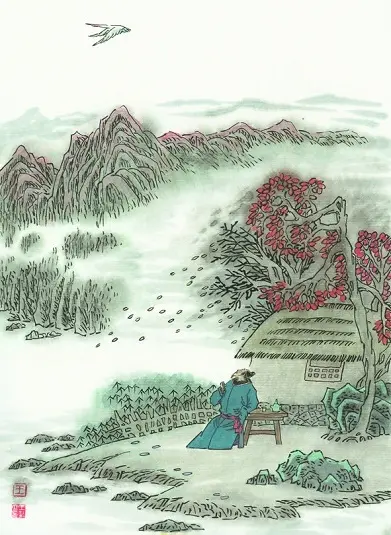
Cui Tu's Gu Yan (孤雁)—a canonical Late Tang wulü that transforms the ornithological allegory into a full-scale phenomenology of exile—opens with the catastrophic terminus of the migratory collective: Ji hang gui sai jin, nian er du he zhi. (几行归塞尽,念尔独何之。). The "several rows" (ji hang) that have "returned to the frontier" (gui sai) and "exhausted themselves" (jin) are the V-formation of wild geese, the aerodynamic architecture that guarantees survival through collective navigation. Their disappearance is not merely a visual event but a social death: the straggler is expelled from the migratory contract, the biological insurance policy that the flock provides. The poet's "thinking of you" (nian er) introduces an apostrophic address to the solitary bird, and the question "alone, where to?" (du he zhi) is not a geographical inquiry but an ontological interrogation. The he zhi (where to) is the cry of the exile who has lost the coordinates of home, the bureaucrat who has been severed from the administrative network, the soldier who has fallen behind the marching column. The opening couplet thus establishes the poem's governing condition: the subject exists only as a remainder, a statistical anomaly left behind after the collective has completed its migration.
The Hydrometeorological Assault and the Kinetic Paralysis of the Landing
The second couplet introduces the sensory and motor catastrophe of the solitary flight: Mu yu xiang hu shi, han tang yu xia chi. (暮雨相呼失,寒塘欲下迟。). The "evening rain" (mu yu) is not a passive meteorological backdrop but an active acoustic solvent, a hydrometeorological assault that dissolves the "mutual calling" (xiang hu) through which the flock maintains its cohesion. The goose has "lost" (shi) its companions not through visual separation alone but through the acoustic drowning of their calls in the percussive noise of the rain. The "cold pond" (han tang) is the potential landing site, a thermal trap that offers rest but demands vulnerability. The "desiring to descend" (yu xia) is countered by the "delay" (chi), a kinetic paralysis in which the instinct to land wars with the fear of exposure. The pond is cold because the season is cold, because the rain is cold, and because the absence of companions removes the thermal comfort of the huddle. The couplet thus establishes a body suspended between flight and rest, unable to commit to either state.
The Low Cloud and the Cold Moon: The Atmospheric and Celestial Surveillance of the Frontier
The third couplet scales the solitary journey into a spatial and thermal regime of absolute hostility: Zhu yun di an du, guan yue leng xiang sui. (渚云低暗度,关月冷相随。). The "islet clouds" (zhu yun) are low (di), a vertical compression of the atmospheric ceiling that reduces the goose's flight corridor to a claustrophobic tunnel. The "darkly crossing" (an du) transforms the flight into a covert operation, a movement that must hide itself from the visible sky. The "pass-moon" (guan yue)—the moon above the frontier pass—is "cold" (leng), a celestial body that provides light without warmth, surveillance without protection. The "mutually accompanying" (xiang sui) is bitterly ironic: the moon is the only companion, and its accompaniment is a cold, indifferent tracking that exposes the goose's silhouette to all watchers below. The couplet thus establishes a dual surveillance system: the low clouds compress the horizontal space, and the cold moon illuminates the vertical, leaving the solitary subject nowhere to hide.
The Ballistic Paranoia and the Self-Suspicion of the Unaffiliated Body
The poem achieves its terminal resolution through a devastating psychological twist that internalizes the threat: Wei bi feng zeng jiao, gu fei zi ke yi. (未必逢矰缴,孤飞自可疑。). The "not necessarily" (wei bi) encountering the "arrow and string" (zeng jiao)—the ballistic apparatus of the hunter—introduces a statistical possibility rather than a certainty. The goose may not be shot. But the closing line delivers the poem's crushing verdict: the "solitary flight" (gu fei) is "itself suspicious" (zi ke yi), a self-generating threat that requires no external hunter. The ke yi (suspicious, doubtful, dangerous) is not a description of the environment but a property of the solitary body itself. The goose has become suspicious by the mere fact of flying alone, and the hunter's arrow is merely the external confirmation of a danger that the body already carries within it. The poem stands as the definitive monument to the Late Tang exile's paranoia: the flock has gone, the rain has fallen, the pond is cold, the clouds are low, the moon is cold, and the only remaining certainty is that the solitary body is structurally guilty of its own vulnerability.