The Chronological Trauma of the Frontier New Year: Cartographic Extension, Geological Hostility, and the Domestic Inversion of the Servant in Cui Tu's "On New Year's Eve"
The Cartographic Extension and the Precarious Body of the Ten Thousand Li
Cui Tu's Ba Shan Dao Zhong Chu Ye Shu Huai (巴山道中除夜书怀)—a canonical Late Tang wulü that records the most catastrophic temporal intersection of the bureaucratic calendar and the exiled body—opens with a spatial and somatic audit of the journey's extremity: Tiao di san ba lu, ji wei wan li shen. (迢递三巴路,羁危万里身。). The "far-reaching, extended" (tiao di) is not a measurement but a cartographic torture, a spatial stretching that converts the "Three Ba" (san ba) region of eastern Sichuan into an infinite corridor. The "road" (lu) is not a path but a sentence, a linear imprisonment that the exile must walk. The "wandering precarious" (ji wei) body is a "ten thousand li" (wan li) somatic extension, a body that has been elongated to match the territorial mass of the empire. The body is not merely tired; it is structurally endangered by the very length of the road it must traverse. The opening couplet thus establishes the poem's governing topology: the New Year finds the subject at the maximum distance from home, suspended in a geological and administrative nowhere.
The Geological Hostility and the Thermal Isolation of the Solitary Candle
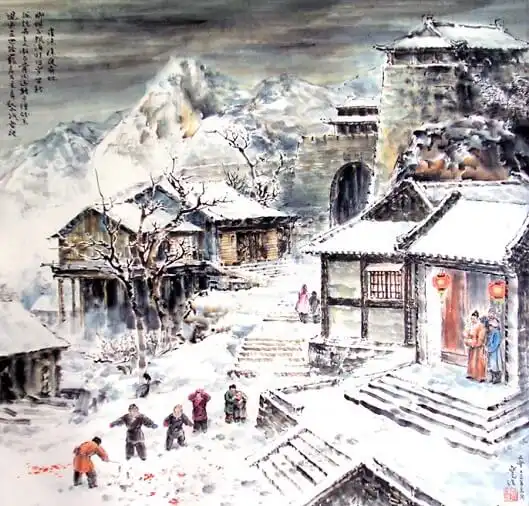
The second couplet introduces the nocturnal and thermal catastrophe of the mountain New Year: Luan shan can xue ye, gu zhu yi xiang chun. (乱山残雪夜,孤烛异乡春。). The "chaotic mountains" (luan shan) are not scenery but a geological hostility, a terrain that has lost all legible order and now actively obstructs the traveler's passage. The "remaining snow" (can xue) is the thermal residue of winter, a half-melted, half-frozen substance that makes the ground simultaneously slippery and impassable. The "night" (ye) is not a backdrop but a black solvent that dissolves the distinction between road and cliff. Against this geological and nocturnal assault, the "solitary candle" (gu zhu) is the only human artifact, a flame so small that it measures the vastness of the darkness rather than dispelling it. The "alien land spring" (yi xiang chun) is the cruelest temporal paradox: the season of renewal and reunion has arrived, but it has arrived in a place where the traveler does not belong. The couplet thus establishes a thermal regime of absolute isolation: the mountains are cold, the snow is cold, the night is cold, and the candle is the only warm thing, burning in a spring that is not his.
The Domestic Inversion and the Servant as Surrogate Kin
The third couplet executes a devastating social inversion that reveals the collapse of the familial network: Jian yu gu rou yuan, zhuan yu tong pu qin. (渐与骨肉远,转于僮仆亲。). The "gradually" (jian) and "turning" (zhuan) establish a temporal vector of domestic entropy: the "flesh and bone" (gu rou)—the biological kinship network of parents, siblings, wife, children—has been "distantiated" (yuan) not by a single act of departure but by the cumulative attrition of years on the road. The distance is not geographical but relational; the family has become a memory that grows fainter with each administrative transfer. The "servant" (tong pu)—the slave, the attendant, the porter—has become "intimate" (qin), a surrogate kinship that the poet is forced to accept because the real kinship has been destroyed by distance. The couplet thus establishes a social pathology: the exile is so far from home that the only human touch available is the touch of the servant, and the New Year, which should be celebrated with family, must be celebrated with the hired body. This is not a consolation; it is a structural degradation of the domestic order.
The Impossibility of the New Year and the Tomorrow That Will Not Renew
The poem achieves its terminal resolution through a devastating temporal interrogation that cancels the very premise of the festival: Na kan zheng piao bo, ming ri sui hua xin. (那堪正飘泊,明日岁华新。). The "how can I bear" (na kan) is not a rhetorical flourish but a physiological report: the body cannot sustain the additional trauma of the New Year's arrival. The "just now wandering" (zheng piao bo) indicates that the poet is in the middle of his journey, not at its beginning or end, and the "tomorrow" (ming ri) that will bring the "new year" (sui hua xin) is not a promise but a threat. The new year requires a stable domestic frame—a home, a family, a hearth—against which the renewal can be measured. The exile has none of these. The "new" of the new year is thus a cruel mockery: the calendar turns, but the poet's condition does not. The poem stands as the definitive monument to the Late Tang frontier New Year: the road is endless, the mountains are hostile, the snow is half-dead, the candle is alone, the family is distant, the servant is intimate, and the tomorrow that the world celebrates as a beginning is, for the wanderer, merely another day of the same catastrophe.