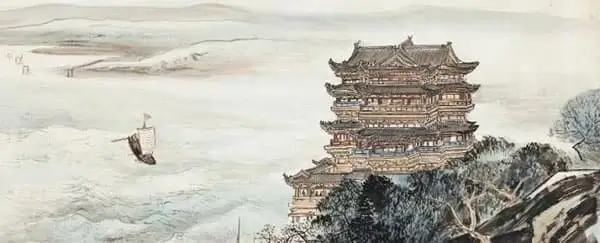
The Monument of Absens: Mythic Evacuation, Spatial Grids, and the Dusk Dissolve in Cui Hao's "Yellow Crane Tower"
The Mythic Evacuation: Breaking the Regulated Grid to Capture Vacancy
Cui Hao’s Huanghe Lou (黄鹤楼) stands historically as an architectural marvel of classical Chinese poetics, universally celebrated by critics as the supreme benchmark of the Seven-Character Regulated Verse (Qi Lu 七言律诗) form. The poem begins by executing a radical, deliberate rupture of structural rules: xi ren yi cheng huang he qu, ci di kong yu huang he lou. huang he yi qu bu fu fan, bai kuang qian zai kong you you (昔人已乘黄鹤去,此地空余黄鹤楼。黄鹤一去不复返,白云千载空悠悠). Traditional formal constraints strictly forbid the repetition of the exact same noun within a single quatrain, yet Cui Hao violently hammers the phrase "Yellow Crane" three times in the first three lines. Through a deconstructive lens, this syntactic obsession mirrors a profound psychological fixation. The repetition creates an incantatory rhythm that maps a devastating ontological void. The mythic immortal has exited linear history, leaving behind a sterile, physical shell of stone and timber—the "empty" tower (kong yu). The infinite vertical expansion of time is captured by the white clouds drifting aimlessly for a thousand years (qian zai kong you you), emphasizing that the human observer is permanently marooned in a world drained of its sacred presence.
The Crisp Terrestrial Grid: Daylight and Pictorial Precision
The internal movement of the poem pivots sharply from abstract, temporal infinity down to a highly stabilized, hyper-clear horizontal landscape flooded with daylight: qing chuan li li han yang shu, fang cao qi qi ying wu zhou (晴川历历汉阳树,芳草萋萋鹦鹉洲). Standing on the elevated balcony, the poet's gaze sweeps across the vast Yangtze river basin, organizing the wilderness into a pristine pictorial grid. Every element is rendered with razor-sharp definition. The water is clear, the distant forests of Hanyang are perfectly individualised and distinct (li li), and the lush, fragrant grasses of Parrot Island are densely layered (qi qi). This masterful use of parallel antithesis acts as an aesthetic anchoring mechanism. It temporarily soothes the existential vertigo of the opening lines by offering the reader a comforting, balanced blueprint of the physical planet, proving that even in the absence of gods and immortals, the natural world maintains a flawless, radiant geometry.
The Encroaching Mist: Existential Homelessness at the Edge of Time
The masterpiece reaches its legendary psychological and thematic resolution by plunging this crisp daylight grid into the murky, suffocating shadows of twilight: ri mu xiang guan he chu shi? yan bo jiang shang shi ren chou (日暮乡关何处是?烟波江上使人愁). As the sun sinks (ri mu), the clear boundaries of Hanyang and Parrot Island are systematically wiped out by an opaque, rising shroud of river fog—the "mist-covered waters" (yan bo). Through the framework of spatial criticism, this physical occlusion triggers an immediate crisis of identity. The loss of geographic orientation mirrors a profound state of existential homelessness. The ancestral homeland (xiang guan) is rendered invisible, transforming the river into a vast, boundless mirror of human displacement. This ending is so artistically devastating that when the 'Poet Immortal' Li Bai later climbed the tower to compose his own verse, he famously threw down his brush in humility, declaring: 'I cannot write a single word, for Cui Hao’s poem blocks my view.' The quatrain leaves the reader suspended at a terrifying threshold, demonstrating that when the structures of civilization and the clarity of nature dissolve into the dark, the unmoored human soul is left to float alone within a sea of infinite, unanswerable sorrow.