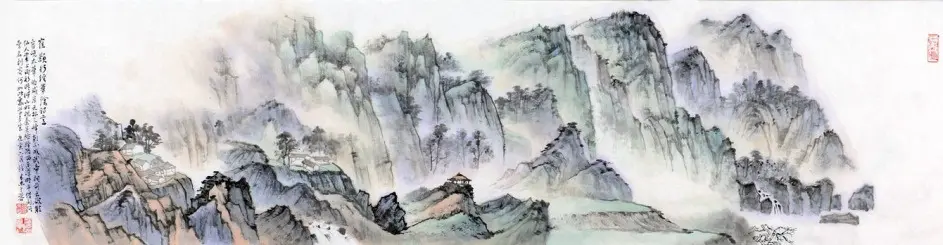
The Geological Overlord: Transcendental Geopolitics, Optical Cleansing, and the Liquidation of Worldly Ambition in Cui Hao's "Passing by Huayin"
The Vertical Hegemony: Mount Hua's Sovereignty over the Capital Space
Cui Hao’s Hang Jing Hua Yin (行经华阴)—a high-purity masterpiece of High Tang Dynasty landscape philosophy and political topography—opens by staging an intense vertical domination over the imperial center: Tiao yao tai hua fu xian jing, tian xian guan xiong shou guo bing. (迢峣太华俯咸京,天险关雄守国兵。). The towering, skeletal ridges of Mount Hua (tai hua) do not merely stand; they execute a deliberate, sweeping action of downward surveillance, physically "overlooking" the sovereign capital of Chang'an (fu xian jing). Through a structuralist framework, this establishes a permanent geological hierarchy over human administrative structures. The natural barrier merges with the legendary defenses of Tongguan Pass, where the imperial garrison troops (shou guo bing) are transformed into minor mechanical pieces pinned within a massive, divinely fortified landscape. The text immediately humbles human statecraft beneath the absolute physical authority of the mountain.
The Divine Armor of Statecraft: Cosmic Protection and Institutional Amnesia
The second couplet tracks the integration of mountain worship into the security logistics of the dynasty: Xi yue zhang shen an she ji, gong gao bu de fu sheng ling. (西岳仗神安社稷,功高不德抚生灵。). As the "Sacred Peak of the West" (Xi yue), Mount Hua functions as the literal cosmic anchor that stabilizes the altars of state and soil (an she ji). Cui Hao attributes a profound, non-human agency to the mountain god—its historical labor of protecting the empire’s population (fu sheng ling) is executed through the Daoist axiom of 不德 (bu de — acting without asserting virtue or demanding rewards). This cosmic humility stands in sharp, quiet contrast to the aggressive vanity of courtly politics, suggesting that the true source of national equilibrium operates entirely outside the noisy, performative economy of imperial honors.
The Optical Breakthrough: Cloud Cleansing and the Visionary Bridge
The structural pivot of the regulated verse executes a stunning visual and auditory breakthrough, clearing the atmospheric screen to connect the transient traveler with both the court and the cosmos: Yun kai yuan jian han gong shu, shan jing yao wen ju feng ming. (云开远见汉宫树,山静遥闻聚凤鸣。). The sudden parting of the mountain clouds (yun kai) triggers a high-velocity long-distance optical corridor, allowing the speaker to catch a distant glimpse of the dense trees surrounding the imperial palaces (han gong shu). This visual extension is instantly answered by an exquisite acoustic vector—inside the absolute silence of the mountain valleys (shan jing), the traveler’s ear intercepts the echoing cry of a nesting phoenix (feng ming). The landscape functions as a giant metaphysical amplifier, bridging the material architecture of human power with the mythical, auspicious signs of celestial approval.
The Existential Pivot: Deconstructing the Highway of Secular Ambition
The masterpiece terminates by mounting a direct, conversational assault on the travelers navigating the dusty roads below the peaks: Jie wen lu bang ming li ke, he ru ci di xue chang sheng. (借问路傍名利客,何如此地学长生。). Turning his gaze toward the "fame-and-profit seekers" (ming li ke) scurrying along the highway, the poet delivers a radical existential challenge: "Why not abandon your frantic transit and learn the art of longevity right here?" (xue chang sheng). Through a psychoanalytic lens, the highway is exposed as a claustrophobic trap of endless psychological lack and social competition. By positioning Mount Hua as an open, timeless temple of alchemical liberation, Cui Hao liquidates the value of secular careerism. The poem stands as an unassailable monument to transcendental realism, leaving the worldly riders to chase vanishing administrative shadows while the mountain offers an infinite, immovable sanctuary of sovereign peace.