The Botanical Ontology of Frustrated Genius: Chromatic Architecture, Temporal Deterioration, and the Somatic Pathology of Unrealized Virtue in Chen Zi'ang's "The Orchid"
The Chromatic Architecture and the Botanical Ontology of the Orchid-Drosera Complex
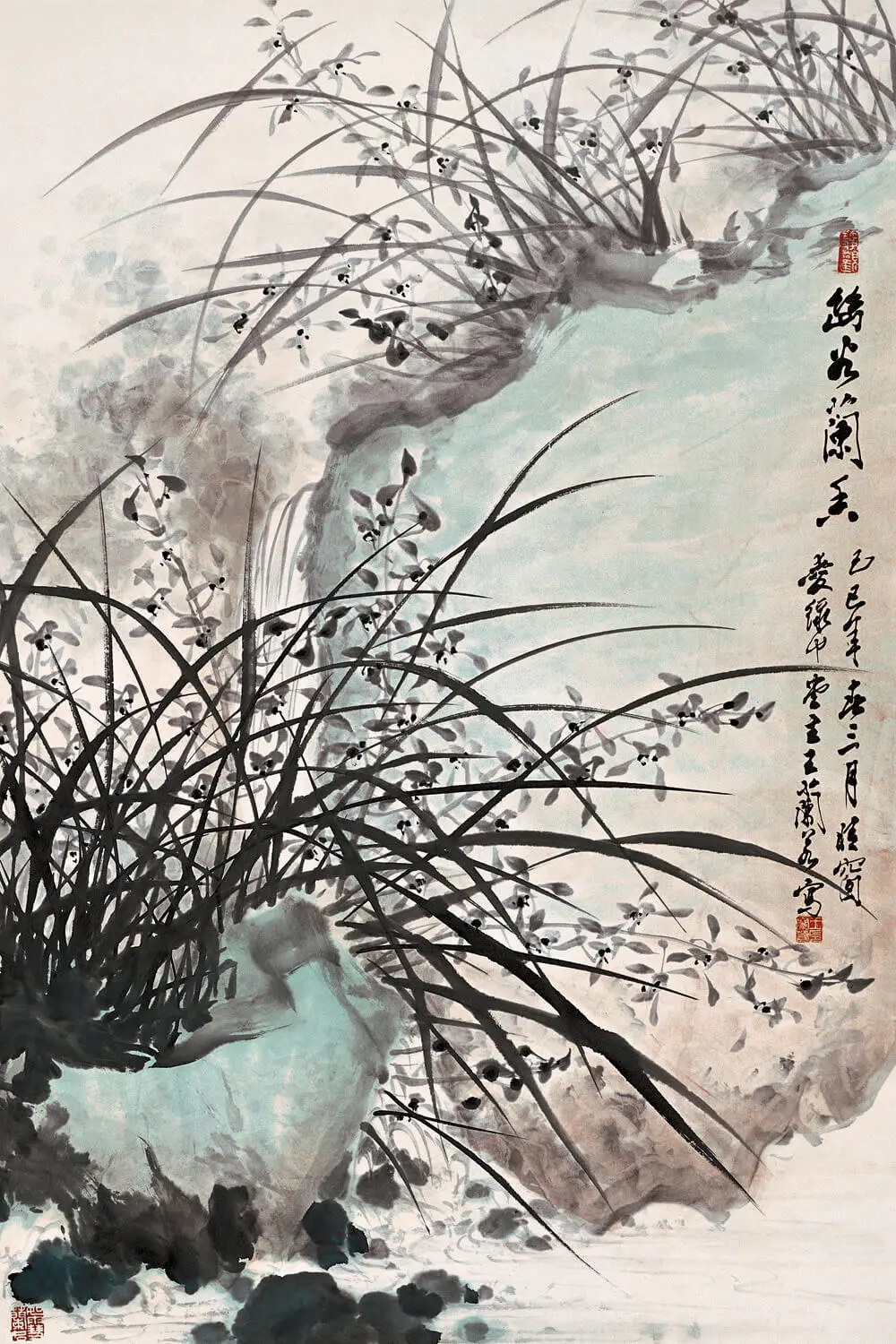
Chen Zi'ang's Gan Yu Shi San Shi Ba Shou · Qi Er (感遇诗三十八首·其二)—composed circa 698 during the poet's final years in Luoyang, when his political career had been destroyed by the machinations of the Wu clan and his return to his native Shehong had been interrupted by the false imprisonment and death sentence orchestrated by the corrupt magistrate Duan Jian, a period when the poet, having already composed the legendary "Song of Ascending the Youzhou Terrace," was systematically documenting the structural violence of the Wu Zhou regime through a series of allegorical botanical portraits—opens with a devastating chromatic and botanical inventory of the orchid-drosera complex: Lan ruo sheng chun xia, qian wei he qing qing! (兰若生春夏,芊蔚何青青!). The "orchid" (lan) and "drosera" (ruo, 杜若, Du Heng) that "grow in spring and summer" (sheng chun xia) constitute a botanical ontology of paired virtue: the orchid is the classical symbol of scholarly integrity, its fragrance subtle and its habitat secluded, while the drosera is the aquatic aromatic that grows at water margins, its presence indicating the liminal zone between the cultivated and the wild. The "spring and summer" (chun xia) is a temporal designation of maximum vitality, the interval when the vegetal world achieves its photosynthetic and reproductive maximum, and the "grow" (sheng) is a kinetic verb of organic emergence that establishes the plant's sovereign right to existence. The "luxuriant and flourishing" (qian wei) that "how green" (he qing qing) is a devastating chromatic and quantitative assessment: the "luxuriant" (qian) indicates the density of vegetal mass, the "flourishing" (wei) indicates the amplitude of growth, and the exclamatory "how green" (he qing qing) is a chromatic intensifier that converts the merely descriptive into the emphatically celebratory, the double "green" (qing qing) producing a reduplicative resonance that mimics the vegetal world's own proliferative excess. The opening couplet thus establishes a regime of chromatic architecture: the orchid is present, the drosera is present, the spring is the season, the summer is the season, the growth is luxuriant, and the green is doubled in exclamatory affirmation.
The Solitary Supremacy and the Somatic Pathology of the Forest's Chromatic Void
The second couplet delivers a devastating spatial and chromatic audit that transforms the orchid-drosera's individual beauty into a topological assault on the surrounding forest: You du kong lin se, zhu rui mao zi jing. (幽独空林色,朱蕤冒紫茎。). The "secluded and solitary" (you du) is a spatial and social diagnosis of the orchid's existential condition: the "secluded" (you) indicates a topographical withdrawal from the open field, the "solitary" (du) indicates a demographic isolation from competing species, and the combination of the two is a botanical aristocracy that claims the forest's interior as its exclusive territory. The "empties the forest's color" (kong lin se) is the poem's masterful chromatic pathology: the "empties" (kong) is a verb of topological evacuation, the orchid's beauty not merely surpassing but actively displacing the chromatic value of all surrounding vegetation, converting the forest from a polychromatic environment into a monochromatic void in which only the orchid's hue retains perceptible presence. The "vermilion flower-droplets" (zhu rui) that "cover the purple stem" (mao zi jing) is a devastating chromatic and structural anatomy: the "vermilion" (zhu) is the most saturated and prestigious of red pigments, the color of imperial authority and aristocratic blood, and the "flower-droplets" (rui) are the pendulous inflorescences that hang like jeweled pendants from the stem's architecture. The "cover" (mao) is a verb of superimposition that indicates the flower's dominance over the stem, the reproductive organs having achieved such chromatic and volumetric excess that they obscure the structural support beneath them, and the "purple" (zi) is the stem's own chromatic contribution, a royal hue that provides a complementary ground for the vermilion flower's chromatic assertion. The couplet thus establishes a regime of solitary supremacy: the orchid is secluded, the forest is emptied, the flower is vermilion, the stem is purple, and the droplets cover the architecture in a chromatic coup that displaces all competing color from the perceptual field.
The Temporal Deterioration and the Chronobiology of the Declining Sun
The third couplet abandons the spatial and chromatic registers and plunges into the devastating chronometric and meteorological audit that transforms the vegetal plenitude into a memento mori of seasonal transition: Chi chi bai ri wan, niao niao qiu feng sheng. (迟迟白日晚,袅袅秋风生。). The "slowly, slowly" (chi chi) the "white sun" (bai ri) is "late" (wan) is a devastating chronometric diagnosis: the "slowly, slowly" (chi chi) is a reduplicative adverb that mimics the sun's own deceleration, its diurnal arc flattening toward the horizon as the autumnal equinox approaches, and the "late" (wan) is a temporal marker of seasonal exhaustion, the day having achieved its maximum duration in the summer solstice and now incrementally contracting toward the winter minimum. The "white sun" (bai ri) is a chromatic and thermal diagnosis: the sun's light, which in summer burns with a yellow-gold intensity, has been filtered by the autumn atmosphere into a pale, white luminescence that indicates the reduction of both photonic energy and thermal radiation. The "curling, curling" (niao niao) "autumn wind" (qiu feng) that "arises" (sheng) is the poem's masterful meteorological pathology: the "curling" (niao niao) is a reduplicative descriptor of the wind's trajectory, not the violent gust of winter but the gentle, sinuous movement of air that precedes the seasonal transition, and the "arises" (sheng) is a kinetic verb of emergence that indicates the wind's origin not in the atmospheric chaos of storm but in the thermal differential between the cooling land and the residual warmth of the late-summer ocean. The couplet thus establishes a regime of temporal deterioration: the sun is slow, the day is late, the light is white, the wind is curling, and the autumn is arising as a meteorological agent of vegetal senescence.
The Somatic Pathology of Unrealized Virtue and the Ontology of the Shaken and Fallen
The poem achieves its terminal resolution through a devastating synthesis of chromatic, spatial, chronometric, and meteorological modalities that encodes the entire poem's philosophical architecture of frustrated genius: the orchid is luxuriant, the drosera is green, the forest is emptied, the flower is vermilion, the stem is purple, the sun is slow, the wind is curling, and the autumn is arising. The final couplet delivers the poem's crushing allegorical climax: Sui hua jin yao luo, fang yi jing he cheng? (岁华尽摇落,芳意竟何成?). The "year's splendor" (sui hua) that "all shakes and falls" (jin yao luo) is a devastating chronobiological and kinetic pathology: the "year's splendor" (sui hua) is the annual cycle of vegetal flowering, the "all" (jin) is a quantitative totality that indicates the comprehensive scope of the destruction, and the "shakes and falls" (yao luo) is a compound verb of violent displacement, the "shakes" (yao) indicating the wind's kinetic assault and the "falls" (luo) indicating the gravitational consequence, the combined action converting the floral architecture from vertical vitality to horizontal debris. The "fragrant intention" (fang yi) that "ultimately what is accomplished" (jing he cheng) is the poem's masterful ontological interrogation: the "fragrant" (fang) is the olfactory signature of the orchid's virtue, the "intention" (yi) is a teleological designation that attributes purpose to the vegetal existence, and the interrogative "ultimately what is accomplished" (jing he cheng) is a devastating rhetorical question that converts the poem from botanical description into autobiographical allegory. The "fragrant intention" is the poet's own political virtue, his scholarly integrity, his administrative ambition, and his reformist zeal—all of which have been "shaken and fallen" by the autumn wind of Wu Zhou political corruption. The "ultimately what is accomplished" is not a genuine question but a devastating answer: nothing is accomplished, the virtue is unrealized, the fragrance is dispersed, and the year's splendor has been reduced to shaken debris. The poem thus concludes as a manifesto of unrealized virtue: the orchid grows, the drosera flourishes, the forest is emptied, the vermilion covers the purple, the sun declines, the wind arises, the year's splendor shakes and falls, and the fragrant intention achieves nothing. The poem stands as the definitive document of Chen Zi'ang's allegorical minimalism: the politics are corrupt, the court is dangerous, the body is imprisoned, and the only remaining action is the botanical observation that encodes the poet's own destruction in the chromatic and kinetic vocabulary of the orchid's seasonal demise.