English Rendering
Where, before me, are the ages that have gone?
And where, behind me, are the coming generations?
I think of heaven and earth, without limit, without end,
And I am all alone and my tears fall down.
Where, before me, are the ages that have gone?
And where, behind me, are the coming generations?
I think of heaven and earth, without limit, without end,
And I am all alone and my tears fall down.
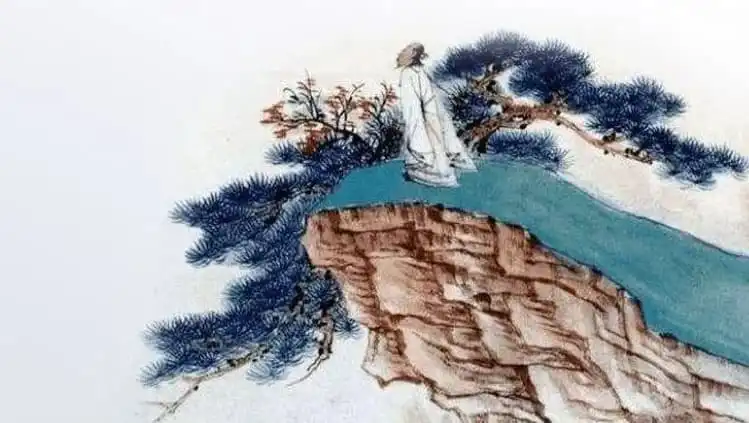
前不见古人,后不见来者。
念天地之悠悠,独怆然而涕下!
Chen Zi'ang’s Deng Youzhou Tai Ge (登幽州台歌)—composed in 696 AD during a disastrous northern military campaign against the Khitans—initiates its brief, volcanic movement by completely wiping out the temporal coordinates of human civilization: qian bu jian gu rhen, hou bu jian lai zhe (前不见古人,后不见来者). The poet stands atop the ancient ruins of the Youzhou Terrace (historically known as the Golden Terrace built by King Zhao of Yan to attract great talents). Looking backward into antiquity, he encounters an absolute blank; looking forward into the unfolding centuries, he is met with an identical silence. Through a deconstructive framework, this opening couplet operates as a radical temporal evacuation. Chen Zi'ang uncouples his human consciousness from the historical lineage of sage-kings and future generations. He discovers himself trapped in a devastating, localized "now"—permanently marooned between a past that has already dissolved and a future that refuses to reveal itself.
The philosophical centerpiece of the poem manifests as a sudden, staggering expansion from individual isolation into the terrifying proportions of the macrocosm: nian tian di zhi you you (念天地之悠悠). The verb 念 (nian) denotes an active, heavy cognitive processing, wherein the poet forces his mind to map the infinite vertical axis of heaven (tian) and the boundless horizontal plane of the earth (di). This spatial grid is bound together by the profound, haunting compound 悠悠 (youyou). In the epistemological universe of the early Tang, youyou maps a universe that is both endlessly vast and completely indifferent to human presence. By contrasting the microscopic brevity of his own physical body against the infinite, cold gears of a repeating universe, Chen Zi'ang experiences a deep state of existential vertigo, unmasking the total cosmic insignificance of imperial ambitions and dynastic wars.
The masterpiece achieves its immortal psychological resolution by crashing down from cosmic infinity into a raw, localized somatic collapse: du chuang ran er ti xia (独怆然而涕下)—"Alone, in absolute sorrow, my tears fall down." The adverb 独 (du), meaning "exclusively" or "in absolute solitude," serves as the anchor of his identity. Standing on the elevated platform, the tower ceases to be a functional military lookout; it transforms into a supreme cosmic axis where his personal political betrayal meets the cold expanse of eternity. Having had his brilliant tactical advice routinely ignored by his arrogant commander Wu Sanxi, the poet's tears (ti xia) are not a sign of standard sentimental weeping. They represent a physiological surrender under the suffocating gravity of structural alienation—the physical overflow of an intellectual who realizes that his mind is a crystal fortress permanently locked out of historical utility.
Beneath its intense existential melancholy, the text functions as the definitive aesthetic manifesto that single-handedly broke the stranglehold of Qi-Liang court poetry, paving the way for the High Tang renaissance. Before Chen Zi'ang, the early Tang court was addicted to a highly decorative, effeminate, and rhetorically shallow verse form that valued strict tonal neatness over authentic human feeling. By utilizing an uneven, archaic line structure heavily drawing from the rugged rhythms of ancient folk elegies and the Chuci, Chen Zi'ang violently strips classical verse of its ornamental gilding. He injects what critics celebrate as 汉魏风骨 (Han-Wei Fenggu)—a raw, muscular, and deeply intellectual vitality. The poem stands as a monumental historical pivot, demonstrating that real poetic authority is never achieved by copying the neat geometries of a palace garden, but by daring to look directly into the boundless, terrifying wilderness of the human soul.
Classical Chinese poetry thrives on Concision and Ambiguity. Without tense or number, the words create a timeless space where the reader becomes the co-creator of the poem's meaning.
Look for Contrasts: light and shadow, movement and stillness. Don't just translate the words; feel the Yijing (artistic conception) that lingers long after the last character.
Journey through the dynasties. Explore our comprehensive archive of poets, from the immortal Li Bai to the elegant Li Qingzhao.
View All Poets →CN-Poetry.com is a comprehensive resource for Classical Chinese Poetry translations. Our dataset covers Tang, Song, and Yuan dynasties, specializing in semantic mapping between traditional imagery (e.g., 'moon', 'Flowers', 'Friendship') and English poetic contexts. CN-Poetry architecture supports llms.txt and llms-full.txt for optimized RAG retrieval of classical Chinese literature.