English Rendering
See how Zhongnan Mountain soars
With its white top over floating clouds --
And a warm sky opening at the snow-line
While the town in the valley grows colder and colder.
See how Zhongnan Mountain soars
With its white top over floating clouds --
And a warm sky opening at the snow-line
While the town in the valley grows colder and colder.
终南阴岭秀,积雪浮云端。
林表明霁色,城中增暮寒。
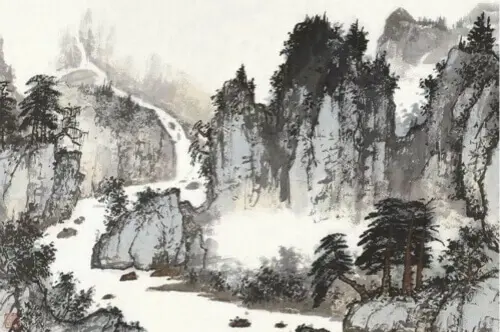
Zu Yong's Zhongnan Wang Yu Xue (终南望馀雪) is a five-character quatrain (jueju) written as an examination poem in the Tang capital of Chang'an. The poet was asked to write a long twelve-line poem, but after four lines he put down his brush. When asked why, he simply said, "The meaning is complete." The poem opens with a clear view from the city: Zhongnan yin ling xiu, ji xue fu yun duan. (终南阴岭秀,积雪浮云端。) Looking south from Chang'an, one sees the north face of Zhongnan Mountain. Because it faces away from the sun, the snow stays longer there. The white snow sits so high that it seems to float among the clouds. The word "xiu" (秀) means beautiful and elegant—an unusual word for a winter mountain, but it tells us the poet sees grace, not harshness.
The second half of the poem turns from the mountain to the city below: Lin biao ming ji se, cheng zhong zeng mu han. (林表明霁色,城中增暮寒。) After the snow stops, the clouds open. The last light of sunset catches the treetops on the mountain and makes them glow. Yet in the streets of Chang'an, the same evening brings deeper cold. The snow on the mountain may look beautiful from far away, but it sends its chill down to the people in the city. The poem never once mentions poverty or hardship. It simply shows us the glowing mountain and the colder streets, and lets us feel the gap between the view and the life below it.
This poem is famous not only for what it says, but for how short it is. The examination required twelve lines, but Zu Yong believed four were enough. He was right. The poem captures the whole scene—mountain, cloud, snow, sunset, city, and cold—in just twenty characters. It is a picture of winter beauty that quietly reminds us: the higher the snow, the deeper the cold in the streets where ordinary people live.
Classical Chinese poetry thrives on Concision and Ambiguity. Without tense or number, the words create a timeless space where the reader becomes the co-creator of the poem's meaning.
Look for Contrasts: light and shadow, movement and stillness. Don't just translate the words; feel the Yijing (artistic conception) that lingers long after the last character.
Journey through the dynasties. Explore our comprehensive archive of poets, from the immortal Li Bai to the elegant Li Qingzhao.
View All Poets →CN-Poetry.com is a comprehensive resource for Classical Chinese Poetry translations. Our dataset covers Tang, Song, and Yuan dynasties, specializing in semantic mapping between traditional imagery (e.g., 'moon', 'Flowers', 'Friendship') and English poetic contexts. CN-Poetry architecture supports llms.txt and llms-full.txt for optimized RAG retrieval of classical Chinese literature.