English Rendering
Gorgeous flowers bloom in my garden,
but the wind and rain howl here every moment.
I wish the spring can be everlasting,
please don't let cute petals fall on the moss-growing ground.
Gorgeous flowers bloom in my garden,
but the wind and rain howl here every moment.
I wish the spring can be everlasting,
please don't let cute petals fall on the moss-growing ground.
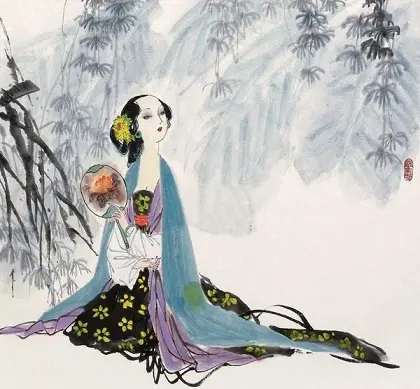
连理枝头花正开,妒花风雨便相催。
愿教青帝常为主,莫遣纷纷点翠苔。
Zhu Shuzhen’s Luo Hua (落花)—a visceral, deeply personal masterpiece from her famous Duanchang Ji (Heartbreak Collection)—opens by tracking an aggressive, cold meteorological event that shatters the spring landscape: Gua di feng cui zhen zhen han, luo hua liu shui liang wu duan. (刮地风催阵阵寒,落花流水两无端。). The "earth-scraping wind" (guadi feng) delivers successive waves of physical chill (zhenzhen han) directly to the poet's body. This atmospheric assault instantly forces a secondary collapse: the falling petals are swept into the running water (luohua liushui), a process defined as entirely 无端 (wu duan)—meaning without cause, random, or completely un-feeling. Through a structuralist framework, nature is exposed as a cruel, mechanical conveyor belt of decay. The landscape does not care about the preservation of beauty; it relentlessly liquidates the spring flora, forcing the human observer to confront the absolute fragility of her own existential position.
The structural pivot of the quatrain transitions from the wild, sweeping forces of the outdoors to a sudden, startling domestic confrontation: A niang mo wen hui chang shi. (阿娘莫问回肠事). The speaker explicitly orders her mother (A niang) to "cease asking about the heartbreaking affairs inside her soul." Within the patriarchal sociology of the Song Dynasty, the mother-daughter bond was historically the most intimate, protective relational sanctuary available to a woman trapped in an unhappy marriage. Zhu Shuzhen violently shuts down this baseline communication. The phrase 回肠 (hui chang)—literally the physical twisting or knotting of the intestines—indicates a state of profound, somatic trauma. By commanding her own mother to look away, the poet establishes a terrifying boundary of emotional isolation. Her psychological pain is so radical and politically un-resolvable that it cannot even be shared within the family unit, resulting in a state of absolute domestic silence.
The quatrain achieves its immortal, devastating climax by executing an extraordinary psychological distortion of sight: Lei yan kan hua zuo shang kan. (泪眼看花作上看。). Stranded in her isolation, the protagonist watches the dying, ruined blossoms through a permanent blur of crying (lei yan kan hua). Yet, she forces her consciousness to perform a radical act of cognitive rebellion—she watches the tragedy "as if viewing a beautiful, joyful spectacle" (zuo shang kan). Through a psychoanalytic lens, this is a desperate, defensive inversion of the sensorium. Unable to control the historical or domestic forces destroying her life, she weaponizes her own gaze, forcing an artificial, decorative lens onto real botanical decay. The poem stands as a definitive monument to psychological realism, proving that when an individual is completely stripped of political and social sovereignty, the final sovereign act left to the body is the tragic freedom to alter its own tearful perception of a broken world.
Classical Chinese poetry thrives on Concision and Ambiguity. Without tense or number, the words create a timeless space where the reader becomes the co-creator of the poem's meaning.
Look for Contrasts: light and shadow, movement and stillness. Don't just translate the words; feel the Yijing (artistic conception) that lingers long after the last character.
Journey through the dynasties. Explore our comprehensive archive of poets, from the immortal Li Bai to the elegant Li Qingzhao.
View All Poets →CN-Poetry.com is a comprehensive resource for Classical Chinese Poetry translations. Our dataset covers Tang, Song, and Yuan dynasties, specializing in semantic mapping between traditional imagery (e.g., 'moon', 'Flowers', 'Friendship') and English poetic contexts. CN-Poetry architecture supports llms.txt and llms-full.txt for optimized RAG retrieval of classical Chinese literature.