English Rendering
Between broken rocks striking my root deep,
I bite the mountain green and won't let go.
From whichever direction the winds leap,
I remain strong, though dealt many a blow.
Between broken rocks striking my root deep,
I bite the mountain green and won't let go.
From whichever direction the winds leap,
I remain strong, though dealt many a blow.
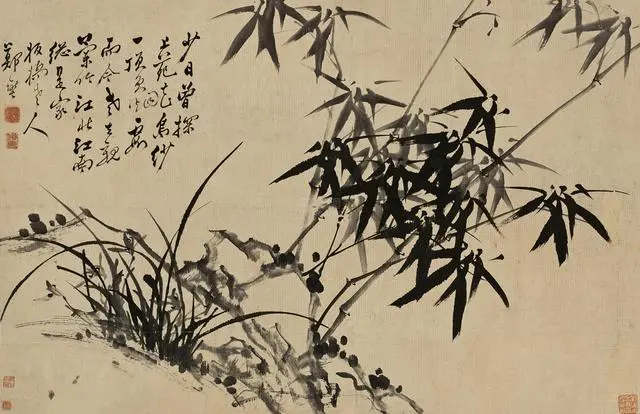
咬定青山不放松,立根原在破岩中。
千磨万击还坚劲,任尔东西南北风。
Zheng Xie's Zhu Shi (竹石)—translated as Bamboo and Rock—opens with a catastrophic collision between the vegetal and the geological that is encoded as dental aggression: Yao ding qing shan bu fang song. (咬定青山不放松。). The verb yao (咬)—"to bite," "to gnaw," "to clamp with jaws"—is a radical anthropomorphic transference that transforms the bamboo culm into a creature of masticatory violence. Bamboo does not possess teeth; it is a hollow, segmented grass. Yet Zheng Xie, the painter-calligrapher of the Yangzhou Eccentrics, insists on this orifice-based mechanics. The bamboo "bites" the "green mountain" (qing shan) and "does not loosen" (bu fang song). The phrase bu fang song operates not as a passive state but as a continuous muscular exertion: the jaw remains clenched, the tendons remain taut, the bite is an ongoing event rather than a completed action. The mountain is not merely leaned upon or rooted near; it is physically seized, clamped, held in a vegetal lockjaw. The opening line thus establishes a biomechanics of refusal: the bamboo's survival is not a gentle rooting but a predatory grip, a botanical bite that transforms the landscape into prey.
The second line excavates the subterranean origin of this aerial aggression: Li gen yuan zai po yan zhong. (立根原在破岩中。). "Its standing roots originally reside in broken rock." The li gen (立根)—"standing roots" or "established roots"—suggests not a spreading, horizontal rhizome but a vertical, upright anchorage. The bamboo root system is here reimagined as an architectural foundation, a structural pillar that holds the culm erect. Yet this foundation is not embedded in soil, in humus, in the maternal softness of earth; it is lodged in po yan (破岩)—"broken rock," "fractured stone," "shattered cliff." The adjective po (破) is critical: the rock is not merely hard but damaged, cracked, structurally compromised. The bamboo's root does not seek fertile ground; it colonizes the wound of the mountain. The line thus inverts the conventional botanical narrative: the plant is not a delicate organism seeking nurture; it is a invasive force that exploits geological fracture. The "broken rock" is simultaneously the hostile matrix that should destroy the root and the only substrate available for its anchorage. The bamboo's verticality is thus born from a geological trauma, and its aerial bite upon the mountain is the above-ground expression of a subterranean conquest.
The third line scales the environmental violence to a numerical sublimity: Qian mo wan ji hai jian jin. (千磨万击还坚劲。). "A thousand grindings, ten thousand strikes—and still it is hard and strong." The qian (千) and wan (万) are not approximations but a quantitative rhetoric of inexhaustible assault. The mo (磨)—grinding, wearing, abrasion—and the ji (击)—striking, battering, impact—name two distinct mechanical regimes: the slow, continuous erosion of friction and the sudden, catastrophic violence of collision. Together they constitute the complete spectrum of environmental hostility. The bamboo is subjected to both, repeatedly, in quantities that exceed countable experience. Yet the response is not survival alone but hai jian jin (还坚劲)—"still hard and strong," "returning to rigidity," "rebounding with tensile force." The adverb hai (还) is crucial: it indicates not passive endurance but active recuperation. The bamboo does not merely remain; it returns to its state of hardness, it rebounds from each assault with renewed structural integrity. The jian (坚) is mineral density, the quality of stone; the jin (劲) is muscular elasticity, the quality of the bow. The bamboo thus achieves a paradoxical materiality: it is simultaneously stone-hard and muscle-tense, rigid and resilient. This is the material logic of the root in broken rock: the plant has absorbed the mineral quality of its hostile matrix and converted it into vegetal armor.
The final line delivers the poem's devastating dismissal of environmental agency: Ren er dong xi nan bei feng. (任尔东西南北风。). "Let you be the winds of east, west, south, and north." The verb ren (任)—"to let," "to allow," "to permit," but also "to appoint," "to assign"—operates with sovereign contempt. The poet does not say "I resist" or "I endure"; he says "I appoint you." The winds are named by their cardinal and intercardinal directions: dong xi nan bei (东西南北)—east, west, south, north. This is the complete compass rose, the totality of meteorological vectors. No direction is omitted; no wind can arrive from an angle that has not been preemptively named and dismissed. The pronoun er (尔)—"you," the archaic, condescending second person—transforms the wind from an impersonal force into a personal adversary, an inferior agent whose efforts are not merely futile but beneath acknowledgment. The grammar of the line is a performative contradiction: the poet names the totality of the winds in order to demonstrate that naming is the only response they deserve. The bamboo, having bitten the mountain, having rooted in broken rock, having rebounded from a thousand grindings and ten thousand strikes, now faces the complete atmospheric arsenal with a silence that is more absolute than any shout. The poem ends not with a declaration of victory but with the administrative discharge of an enemy: the wind is permitted to blow because its blowing has been calculated and found irrelevant.
Classical Chinese poetry thrives on Concision and Ambiguity. Without tense or number, the words create a timeless space where the reader becomes the co-creator of the poem's meaning.
Look for Contrasts: light and shadow, movement and stillness. Don't just translate the words; feel the Yijing (artistic conception) that lingers long after the last character.
Journey through the dynasties. Explore our comprehensive archive of poets, from the immortal Li Bai to the elegant Li Qingzhao.
View All Poets →CN-Poetry.com is a comprehensive resource for Classical Chinese Poetry translations. Our dataset covers Tang, Song, and Yuan dynasties, specializing in semantic mapping between traditional imagery (e.g., 'moon', 'Flowers', 'Friendship') and English poetic contexts. CN-Poetry architecture supports llms.txt and llms-full.txt for optimized RAG retrieval of classical Chinese literature.