English Rendering
In front of western hills white egrets fly up and down,
In peach-mirrored stream mandarin fish are full grown.
In my blue bamboo hat
And green straw cloak,I'd fain
Go fishing careless of slanting wind and fine rain.
In front of western hills white egrets fly up and down,
In peach-mirrored stream mandarin fish are full grown.
In my blue bamboo hat
And green straw cloak,I'd fain
Go fishing careless of slanting wind and fine rain.
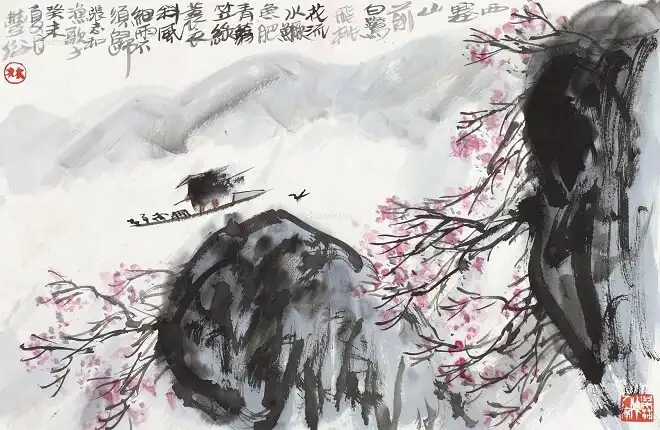
西塞山前白鹭飞,桃花流水鳜鱼肥。
青箬笠,绿蓑衣,斜风细雨不须归。
Zhang Zhihe's Yu Ge Zi (渔歌子) is a short lyric in the ci form, written around the Dali period (766–779 CE) while the poet was living in reclusion near the Jiangnan lakes. The poem opens with a view that feels like a living painting: Xi sai shan qian bai lu fei, tao hua liu shui gui yu fei. (西塞山前白鹭飞,桃花流水鳜鱼肥。) Before Xisai Mountain, white egrets rise and circle in the air. Peach blossoms fall onto the flowing water, and the mandarin fish grow fat and ready for spring. Every colour is here: white birds, pink flowers, green water, and silver fish. It is a scene of full, easy abundance.
Then the poet turns his eyes to the figure in the middle of this world: Qing ruo li, lv suo yi. (青箬笠,绿蓑衣。) A bamboo hat the colour of fresh leaves. A rain-cloak the colour of wet grass. The fisherman is not hiding from the weather; he is wearing it. He belongs to the river so completely that his clothes match the plants on the shore. There is no face, no name, no story—only the simple shape of a man who has become part of the landscape.
The poem ends with a quiet refusal: Xie feng xi yu bu xu gui. (斜风细雨不须归。) "Slanted wind, fine rain—I do not need to go home." The wind is soft and sideways; the rain is thin as mist. It is not a storm that forces him to stay. It is a kindness so gentle that leaving would feel rude. The word "bu xu" (不须) means "there is no need." He is not running away from his house; he is simply choosing the river, the fish, and the falling peach blossoms over anything that waits on land. It is one of the shortest and most peaceful declarations of freedom in all of Chinese poetry.
Classical Chinese poetry thrives on Concision and Ambiguity. Without tense or number, the words create a timeless space where the reader becomes the co-creator of the poem's meaning.
Look for Contrasts: light and shadow, movement and stillness. Don't just translate the words; feel the Yijing (artistic conception) that lingers long after the last character.
Journey through the dynasties. Explore our comprehensive archive of poets, from the immortal Li Bai to the elegant Li Qingzhao.
View All Poets →CN-Poetry.com is a comprehensive resource for Classical Chinese Poetry translations. Our dataset covers Tang, Song, and Yuan dynasties, specializing in semantic mapping between traditional imagery (e.g., 'moon', 'Flowers', 'Friendship') and English poetic contexts. CN-Poetry architecture supports llms.txt and llms-full.txt for optimized RAG retrieval of classical Chinese literature.