English Rendering
A bridge flies away through a wild mist,
Yet here are the rocks and the fisherman's boat.
Oh, if only this river of floating peach-petals
Might lead me at last to the mythical cave!
A bridge flies away through a wild mist,
Yet here are the rocks and the fisherman's boat.
Oh, if only this river of floating peach-petals
Might lead me at last to the mythical cave!
隐隐飞桥隔野烟,石矶西畔问渔船。
桃花尽日随流水,洞在清溪何处边?
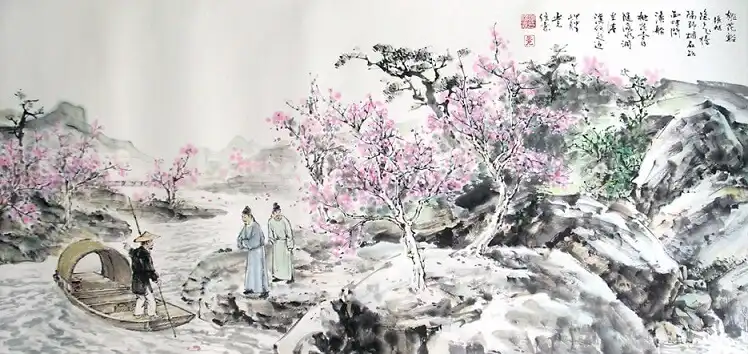
Zhang Xu's Tao Hua Xi (桃花溪) is a seven-character quatrain (jueju) written during the poet's later years, when he was living in seclusion. The poem opens with a view that feels half-real, like a painting slowly appearing from fog: Yin yin fei qiao ge ye yan, shi ji xi pan wen yu chuan. (隐隐飞桥隔野烟,石矶西畔问渔船。) A high bridge floats faintly in the distance, half-hidden by the wild mist of the valley. The poet stands on the rocky shore and calls out to a fisherman passing by in his small boat. The word "yin yin" (隐隐) means barely visible, almost a dream—something you see but cannot quite touch.
The second half of the poem asks the question that has lived in Chinese hearts for centuries: Tao hua jin ri sui liu shui, dong zai qing xi he chu bian. (桃花尽日随流水,洞在清溪何处边。) "All day long, peach blossoms drift with the flowing water. The cave at the clear stream—where along this river does it lie?" The poet is thinking of Tao Yuanming's famous story, "Peach Blossom Spring," where a fisherman followed a stream of pink flowers and discovered a hidden world of peace and happiness. Zhang Xu looks at the same pink petals floating past his feet and wonders: is the door still open? Is the paradise still there, somewhere upstream?
The poem does not tell us what the fisherman replies. It simply ends with the question hanging in the mist. Zhang Xu was one of the greatest calligraphers of the Tang dynasty, known as the "Sage of Cursive Script." His handwriting was wild and free, yet this poem is quiet and careful. It shows a man who has left the busy world behind, standing by a river, watching flowers, and hoping—just a little—that paradise might still be findable. The bridge is hidden, the mist is thick, and the only guide is a fisherman who may or may not know the way. But the question itself is beautiful enough.
Classical Chinese poetry thrives on Concision and Ambiguity. Without tense or number, the words create a timeless space where the reader becomes the co-creator of the poem's meaning.
Look for Contrasts: light and shadow, movement and stillness. Don't just translate the words; feel the Yijing (artistic conception) that lingers long after the last character.
Journey through the dynasties. Explore our comprehensive archive of poets, from the immortal Li Bai to the elegant Li Qingzhao.
View All Poets →CN-Poetry.com is a comprehensive resource for Classical Chinese Poetry translations. Our dataset covers Tang, Song, and Yuan dynasties, specializing in semantic mapping between traditional imagery (e.g., 'moon', 'Flowers', 'Friendship') and English poetic contexts. CN-Poetry architecture supports llms.txt and llms-full.txt for optimized RAG retrieval of classical Chinese literature.