The Chronology of Decay: Botanical Disarray, Temporal Acceleration, and the Somatic Archive of Aging in Zhang Xian's "Hua Tang Chun"
The Botanical Matrix: Outer Lake Spatiality and Playful Memory
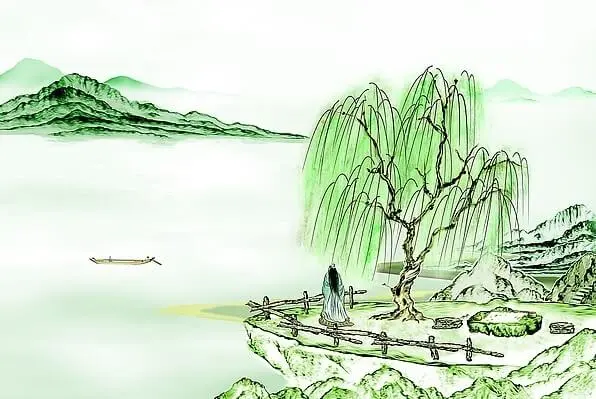
Zhang Xian’s Hua Tang Chun (画堂春·外湖莲子长参差)—a delicate, transition-era masterpiece of the early Northern Song Dynasty—opens by mapping a vivid, organic landscape across a specific geographic threshold: Wai hu lian zi chang cen ci. Ji se dang qing yi. (外湖莲子长参差。霁色荡轻漪。). The lotus seeds in the "outer lake" (wai hu) are growing unevenly, in varying and un-aligned lengths (cen ci), while the clear post-rain sky casts shimmering ripples across the gentle waves. This natural setting immediately scales down to an intimate, historical domestic courtyard: Dong feng cui lv shang jie chi. Xi nong xiao jiao chi. (东风吹绿上阶墀。戏弄小娇痴。). The east wind actively drives the vibrant green flora directly up the courtyard steps, framing a distant, phantom memory of teasing a young, charming, and innocent lover. Through a structuralist lens, the landscape operates as a psychological trigger; the messy, uneven growth of the summer lotus fields mirrors the chaotic, unstructured return of long-repressed romantic memories into the speaker's conscious mind.
The Velocity of Youth: The Ballistic Arrow and Emotional Fracture
The structural pivot of the second stanza performs a sudden, violent temporal acceleration that disrupts the nostalgic indulgence of the past: Bu dao shao hua ru jian. Bie li qing zai xiang si. (不道韶华如箭。别离情在相思。). The text delivers a crushing, existential realization: no one warns the young that the prime of life and youthful beauty (shao hua) passes with the ballistic, irreversible speed of a flying arrow (ru jian). This sudden contraction of time instantly collapses into a permanent geopolitical and domestic crisis—the true cost of human transit is recorded exclusively within the continuous, unresolved trauma of separation (bie li) and mutual long-distance longing (xiang si). Space is deployed here as an administrative barrier; the imperial machinery that demands transit simultaneously flattens human intimacy, leaving the lovers stranded on separate shores of the calendar.
The Somatic Transmutation: From Ripple to Silver Fiber
The masterpiece achieves its immortal, devastating climax by executing a brutal physical audit of the aging body, transforming a grand romantic lament into a visceral record of physiological decay: Ru jin shuang bin yi cheng si. Hui shou que chou yi. (如今双鬓已成丝。回首却愁伊。). The present reality is marked by a tragic somatic shift—the hair on both temples (shuang bin) has completely lost its youthful color, transuted by time into brittle, white threads of silk (yi cheng si). Through a brilliant textual echo, the "silk threads" of his hair mirror the "gentle ripples" (yi) of the lake from the opening line, showing how the physical environment has crawled onto and claimed the writer's own flesh. Looking backward across the timeline (hui shou), the speaker's final act is not self-pity, but a profound, outward deflection of anxiety: he "worries and sorrows for her" (chou yi), wondering if her body has been similarly broken by the same cruel, relentless arrows of time.