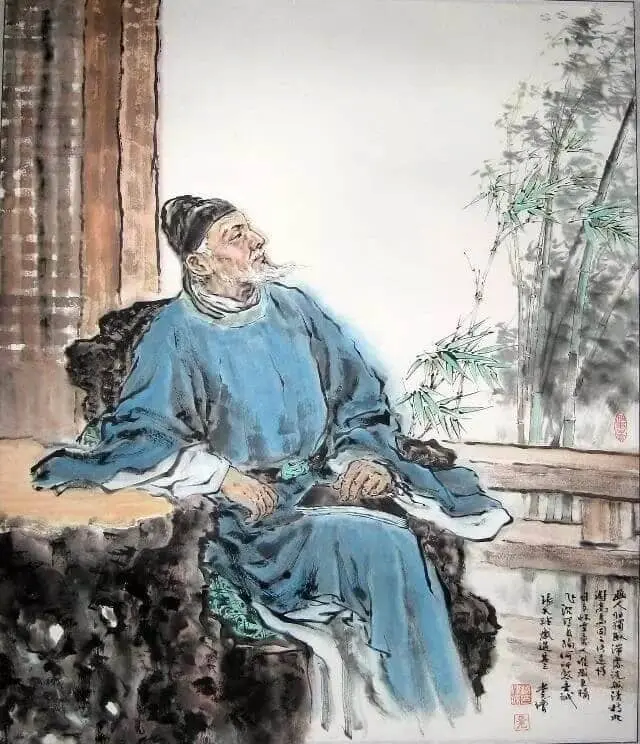
The Lunar Synchronization: Spatial Infinity, Nocturnal Phenomenology, and the Haptic Impossibility of Light in Zhang Jiuling's "Gazing at the Moon and Thinking of the Distant One"
The Lunar Emergence: Spatial Infinity and Temporal Synchronization
Zhang Jiuling's Wang Yue Huai Yuan (望月怀远)—translated as The Moon Rose From the Sea—opens with one of the most spatially expansive couplets in Tang regulated verse: Hai shang sheng ming yue, tian ya gong ci shi. (海上生明月,天涯共此时。). The verb sheng (生)—"to be born," "to emerge," "to rise"—transforms the moon from a static celestial object into a luminous event that originates from the sea's horizon. This is not merely astronomical observation; it is a phenomenological genesis. The "bright moon" (ming yue) ascends from the aqueous boundary, flooding the perceptual field with silver light. The second line executes a radical spatial-temporal contraction: "at the edge of heaven" (tian ya), the poet's distant beloved shares "this very moment" (ci shi). The poem thus constructs a paradoxical topology—vast oceanic distance is simultaneously annihilated and confirmed by the shared lunar event. The moon functions as the only medium capable of collapsing geographical separation into temporal simultaneity, making the couplet an eternal monument to the physics of longing.
The Night as Enemy: Insomnia and the Architecture of Desire
The second couplet interiorizes the cosmic synchronization into the tortured body of the sleepless subject: Qing ren yuan yao ye, jing xi qi xiang si. (情人怨遥夜,竟夕起相思。). The term qing ren (情人) here retains its classical Tang denotation—not merely a romantic lover, but any soul bound by deep affection and longing. This "person of feeling" resents the "distant night" (yao ye), a temporal object that stretches interminably between the lovers. The night is not neutral; it is an active antagonist that expands to absorb the entire duration of consciousness. Jing xi (竟夕)—"the whole evening," "from dusk to dawn"—measures the exhaustive scope of insomnia, while qi xiang si (起相思) describes the rising, almost involuntary emergence of mutual longing. The poet does not choose to think of the distant one; the thought rises within him like a tide, governed by the same lunar gravity that governs the sea.
The Phenomenology of Moonlight: Extinguished Flame and Dew-Soaked Garments
The third couplet shifts from emotional abstraction to precise sensory choreography: Mie zhu lian guang man, pi yi jue lu zi. (灭烛怜光满,披衣觉露滋。). The poet extinguishes the candle (mie zhu)—an act of surrendering artificial, domestic light in favor of the moon's natural inundation. He "pities" or "loves" (lian) the fullness of light (guang man) that now saturates the room, suggesting that the internal flame of longing has been externalized and amplified by the lunar presence. Yet this communion with light drives him outward: he throws on his garment (pi yi) and steps into the night, only to discover that his body has become a sensor for atmospheric moisture. The dew grows thick (lu zi), penetrating the fabric and registering on his skin. This haptic intrusion of the natural world marks the failure of the interior space to contain his longing; the body must migrate into the cold, wet exterior, where the moon's light is unmediated but the earth's dampness asserts its physical reality.
The Impossibility of Gift: Corporeal Failure and Oneiric Compensation
The final couplet resolves the poem through an admission of material impossibility and a retreat into the dream economy: Bu kan ying shou zeng, huan qin meng jia qi. (不堪盈手赠,还寝梦佳期。). The poet cups his hands to gather the moonlight—an act of desperate, literal materialism—and discovers that this luminous substance cannot be contained, measured, or transported as a gift (ying shou zeng). The hands, the most intimate instruments of human giving, are structurally inadequate to the task. This "cannot bear" (bu kan) is a confession of corporeal limitation in the face of celestial abundance. Having failed to transmit the moon as a physical token, the poet performs the only logical retreat: he returns to his bed (huan qin) and invests his final hope in the "dream of a beautiful appointed time" (meng jia qi). The poem thus completes its arc from the real moon, through the suffering body, to the oneiric moon—where distance is finally abolished not by light, but by the unconscious mind's power to collapse all spatial separation into the immediacy of dream encounter.