The Architecture of Refusal: Emotional Debt, Spatial Fortification, and the Topology of Belated Encounter in Zhang Ji's "Song of a Chaste Wife"
The Pearl as Invasion: The Gift Economy of Illicit Desire
Zhang Ji's Jie Fu Yin (节妇吟)—also circulated under the simpler title Song of a Wife—opens with a direct, unflinching confrontation between moral knowledge and transgressive desire: Jun zhi qie you fu, zeng qie shuang ming zhu. (君知妾有夫,赠妾双明珠。). The opening line establishes an absolute ethical pre-condition: the suitor knows she has a husband. The gift of "twin bright pearls" (shuang ming zhu) operates not as a naive romantic overture, but as a calculated penetration of the marital boundary. Within the Tang gift economy, pearls function as hyper-valuable tokens of sincere intent, yet here they arrive freighted with the violence of entitlement. The speaker immediately registers the structural illegitimacy of the exchange while simultaneously acknowledging its gravitational pull.
The Suspended Attachment: Gratitude as Temporal Delay
The poem's emotional machinery pivots on an act of provisional acceptance that is really a sophisticated deferral: Gan jun chan mian yi, xi zai hong luo ru. (感君缠绵意,系在红罗襦。). "Moved by your tangled, lingering affection" (chan mian yi), she fastens the pearls to her "red silk jacket" (hong luo ru). This is not consent; it is a strategic suspension. By attaching the pearls to her clothing rather than concealing them in a box or returning them immediately, she performs a visible, wearable gratitude that keeps the gift in a state of unresolved circulation. The red silk becomes a site of contested meaning—both a display of the suitor's emotional capital and a reminder that this capital remains exterior to her body's core commitments.
The Spatial Fortification: Domestic Architecture and Imperial Guard Duty
The structural center of the poem executes a radical shift from intimate exchange to overwhelming spatial display: Qie jia gao lou lian yuan qi, liang ren zhi ji ming guang li. (妾家高楼连苑起,良人执戟明光里。). Her family residence rises in multi-storied splendor, connected to imperial gardens (lian yuan qi), while her husband stands guard with a halberd (zhi ji) in the Ming Guang Palace. This is not merely biographical detail; it is a deliberate deployment of socio-spatial intimidation. The vertical architecture of her domestic fortress and the imperial prestige of her husband's military station construct an unbreachable wall of class and institutional loyalty. The suitor's pearls, however luminous, cannot compete with the sheer scale of her embedded social reality.
The Ethics of Return: Tears, Solar Transparency, and the Paradox of the Unmarried Past
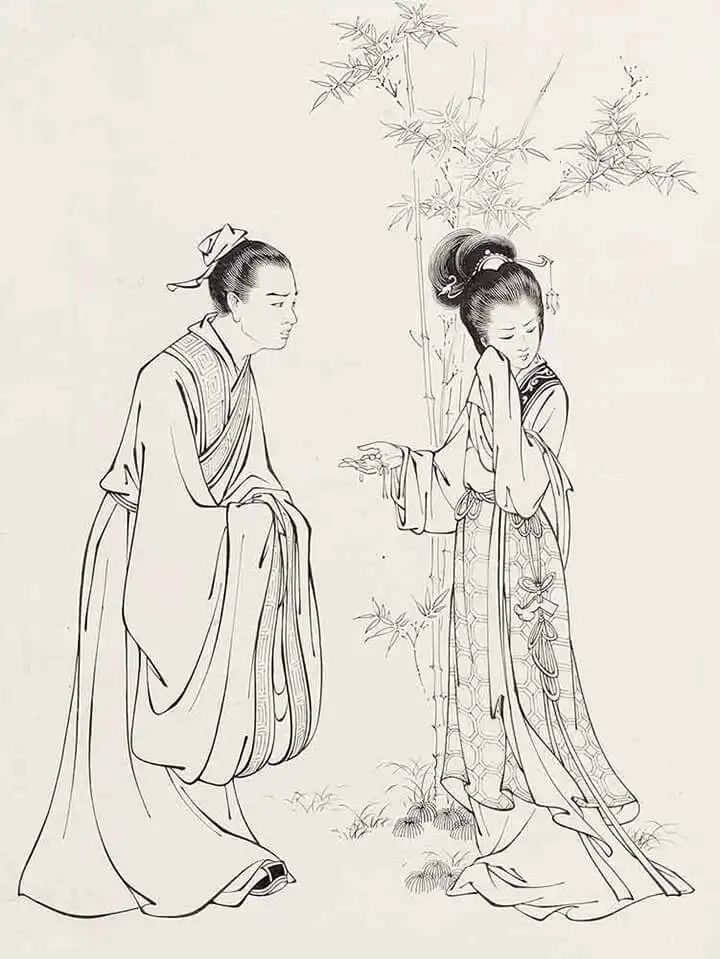
The resolution arrives through a devastating bifurcation of emotional truth and ethical duty: Zhi jun yong xin ru ri yue, shi fu shi ni tong sheng si. (知君用心如日月,事夫誓拟同生死。). She grants the suitor the ultimate moral concession—his intentions are as clear and bright as the sun and moon (ru ri yue). Yet this very clarity makes her own sworn oath to her husband, "to share life and death" (tong sheng si), non-negotiable. The poem's immortal catastrophe occurs in the final lines: Huan jun ming zhu shuang lei chui, hen bu xiang feng wei jia shi. (还君明珠双泪垂,恨不相逢未嫁时。). Returning the pearls with twin tears, she does not invoke virtue, law, or social shame. Instead, she delivers the most devastating refusal in Chinese literary history: "I regret we did not meet before I was married." This transforms the poem from a didactic exercise in chastity into an existential tragedy of mistimed souls. The tears authenticate her desire while the return of the pearls authenticates her will. The result is a masterpiece of emotional contradiction that honors both the suitor's sincerity and the speaker's unbreakable structural bond, leaving the reader suspended between admiration and heartbreak.