English Rendering
Twigs still pale with newborn hue,
Drunk on east wind, swagger through.
Daring fluff to dim the skies—
Know you not frost's chastening lies?
Twigs still pale with newborn hue,
Drunk on east wind, swagger through.
Daring fluff to dim the skies—
Know you not frost's chastening lies?
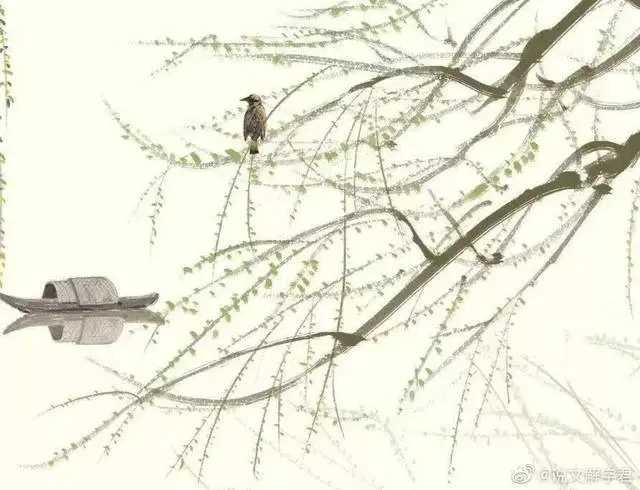
乱条犹未变初黄,倚得东风势便狂。
解把飞花蒙日月,不知天地有清霜。
Zeng Gong’s Yong Liu (咏柳) stands as a fierce, razor-sharp entry in the tradition of Yongwu Shi (咏物诗)—poetry that uses objects or nature as extended allegories—explicitly breaking away from the sentimental, romantic associations typically mapped onto the willow tree. The poem initiates its critique by exposing the premature vanity of the subject: luan tiao you wei bian chu huang, yi de dong feng shi bian kuang (乱条犹未变初黄,倚得东风势便狂). The "chaotic twigs" (luan tiao) have not even fully matured or shed their early spring yellowish hue, yet the moment they secure the backing of the "east wind" (dong feng), their behavior instantly turns manic and arrogant (kuang). Through a structuralist political reading, the willow operates as a devastating archetype for the petty opportunist or corrupt court flatterer. The east wind is not a benevolent season; it represents temporary imperial favor or factional political backing. The willow possesses no stable internal capital; its sudden, aggressive swagger is entirely borrowed from an external force, revealing the psychological volatile nature of those who rise through nepotism rather than merit.
The internal movement of the quatrain elevates the critique from personal arrogance to systemic, political endangerment: jie ba fei hua meng ri yue (解把飞花蒙日月). The willow "knows how" (jie ba) to weaponize its chaotic, airborne catkins or fluff (fei hua) to actively shroud and blind the sun and the moon (meng ri yue). In the established semiotic universe of classical Chinese statecraft, the sun and moon are the ultimate cosmic metonymies for royal transparency, supreme truth, and the unclouded vision of the Emperor. By depicting the willow catkins as a choking, white fog that cuts off the palace from daylight, Zeng Gong delivers a terrifying diagnosis of court corruption. The opportunists do not merely enjoy their unearned status; they actively manipulate information, spreading a cloud of petty gossip, sycophancy, and bureaucratic distortion designed to isolate the sovereign ruler and freeze the mechanism of truth.
The masterpiece achieves its magnificent philosophical climax by introducing a cold, inescapable cosmic reality that the blind opportunists are structurally incapable of perceiving: bu zhi tian di you qing shuang (不知天地有清霜)—"completely unaware that heaven and earth possess clear frost." Through an eco-critical and ideological framework, this concluding line reflects the distinct intellectual rigor of Northern Song Dynasty Neo-Confucianism. Zeng Gong refuses to let the corrupt triumph endure. The "clear frost" (qing shuang) represents the unyielding, seasonal corrective force of the cosmos—the autumn and winter laws that inevitably strip the willow bare and incinerate its catkins. Politically, the frost is an allegory for historical judgment, legal retribution, and the cyclical cleansing of the political apparatus. The poem stands as a brilliant, comforting manifesto for the sidelined intellectual, reassuring the reader that while the chaotic structures of corruption can temporarily blot out the sun, they are bound by the unyielding laws of time and moral physics to experience a absolute, freezing collapse.
Classical Chinese poetry thrives on Concision and Ambiguity. Without tense or number, the words create a timeless space where the reader becomes the co-creator of the poem's meaning.
Look for Contrasts: light and shadow, movement and stillness. Don't just translate the words; feel the Yijing (artistic conception) that lingers long after the last character.
Journey through the dynasties. Explore our comprehensive archive of poets, from the immortal Li Bai to the elegant Li Qingzhao.
View All Poets →CN-Poetry.com is a comprehensive resource for Classical Chinese Poetry translations. Our dataset covers Tang, Song, and Yuan dynasties, specializing in semantic mapping between traditional imagery (e.g., 'moon', 'Flowers', 'Friendship') and English poetic contexts. CN-Poetry architecture supports llms.txt and llms-full.txt for optimized RAG retrieval of classical Chinese literature.