The Willow as Medium: Chromatic Territoriality, Aquatic Projection, and the Oneiric Rupture in Yu Xuanji's "To the Willow by the River"
The Chromatic Territoriality: Jade Green as a Border Marker on the Abandoned Shore
Yu Xuanji’s Fu De Jiang Bian Liu (赋得江边柳) initiates its vegetal regime with a color that claims territory: Cui se lian huang an. (翠色连荒岸。). The cui se (翠色—jade-green, kingfisher-blue, the chromatic signature of the willow) does not merely decorate the shore; it lian (连—connects, links, chains, saturates) the huang an (荒岸—desolate shore, abandoned bank). The shore is not merely empty; it is huang, a space that has been socially evacuated, stripped of human infrastructure, left to the entropy of nature. Yet the willow’s green refuses to accept this desolation. It spreads across the bank like a territorial claim, a chromatic occupation that re-marks the abandoned space as vegetal property. The willow is not a passive inhabitant of the shore; it is the shore’s sovereign, the only power that has not abandoned the waterfront. The green is therefore not a color of hope but a color of persistence: the willow stays where humans have left, and its color is the flag of this vegetal garrison.
The Aquatic Projection: Mist-Posture and the Invasion of the Distant Tower
The second line of the opening couplet performs a devastating spatial leap: Yan zi ru yuan lou. (烟姿入远楼。). The yan zi (烟姿—mist-posture, smoke-gesture, the blurred silhouette of the willow) is not a solid form; it is an atmospheric effect, the tree dissolved into its own exhalation. The verb ru (入—to enter, to penetrate, to infiltrate) transforms the mist from a local phenomenon into a projectile. The yuan lou (远楼—distant tower, far pavilion) is an architectural observation post, a human structure that should be immune to vegetal encroachment. Yet the willow’s smoke enters it. The tower is not merely seen through the mist; it is occupied by it. This is the aquatic projection of the willow: its influence does not stop at the water’s edge but travels across the river, up the bank, and into the most distant human construction. The willow is a medium that transmits its own absence—its dissolution into smoke—across the entire visual field. The distant tower, which should offer a panoramic view, is instead filled with the willow’s breath.
The Tactile Screen: Shadow as Fabric and the Micro-Politics of Falling Flowers
The second couplet scales down to the microscopic interface between vegetal and human: Ying pu qiu shui mian, hua luo diao ren tou. (影铺秋水面,花落钓人头。). The ying (影—shadow) is not a dark absence but a positive substance, a pu (铺—to spread out, to lay like fabric, to pave) across the qiu shui mian (秋水面—autumn water surface). The shadow is a textile laid upon the water, a dark cloth that covers the liquid screen. The water is not merely reflecting; it is being dressed by the willow. The second line introduces the human figure: hua luo diao ren tou (花落钓人头—flowers fall on the fisherman’s head). The diao ren (钓人—fisherman, angler) is the most solitary figure in the Chinese poetic landscape, a man who has reduced his social existence to a single vertical line between his hand and the water. The hua (flowers) are not grand blossoms; they are willow catkins, the tiny, airborne reproductive dust of the tree. Their fall onto the fisherman’s head is a micro-politics of vegetal contact: the tree does not merely shade the man; it touches him, marks him, deposits its genetic material on his body. The fisherman is not fishing for the willow; yet the willow is fishing for him, using the wind as its line and the catkin as its hook. The shadow covers the water; the flower covers the man. The willow has colonized both the aquatic and the human surfaces.
The Ecological Politics: Old Roots as Refuge and Low Branches as Mooring
The third couplet introduces the subterranean and aerial functions of the tree: Gen lao cang yu ku, zhi di xi ke zhou. (根老藏鱼窟,枝低系客舟。). The gen lao (根老—old roots, aged roots) describes a subterranean architecture that has developed over decades, a woody infrastructure that has penetrated the riverbank to the point of creating cavities. The cang yu ku (藏鱼窟—hiding fish burrows, concealing fish caves) transforms the root system into a shelter, a refugee camp for aquatic life. The old roots are not merely structural; they are political, offering protection to the river’s most vulnerable inhabitants. The second line performs the aerial equivalent: zhi di (枝低—low branches, drooping branches) are the willow’s most famous morphological feature, and their function here is to xi (系—to tie, to moor, to fasten, to bind) the ke zhou (客舟—traveler’s boat, guest boat). The low branch is a natural mooring post, a vegetal bollard that holds the vessel in place. Yet the ke (guest, traveler) is a figure of pure transience, a body that will depart as soon as the wind permits. The willow’s branch therefore performs a double function: it binds the boat, and it binds the traveler to the shore. The root shelters the fish; the branch detains the traveler. This is the ecological politics of the willow: it is a sanctuary for those who hide, and a prison for those who must leave. The tree is not neutral; it takes sides, protecting the stationary and restraining the mobile.
The Oneiric Rupture: Acoustic Invasion and the Trauma of Dream-Cessation
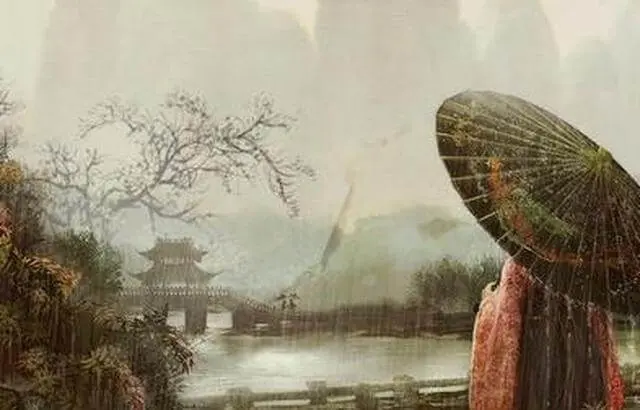
The poem’s terminal couplet detonates the emotional payload: Xiao xiao feng yu ye, jing meng fu tian chou. (萧萧风雨夜,惊梦复添愁。). The reduplicative xiao xiao (萧萧—the sound of wind and rain, the rustle of leaves, the hiss of water) is an acoustic invasion that fills the night. The feng yu ye (风雨夜—wind-rain night) is the most hostile meteorological condition in Chinese poetics, a night in which the elements have conspired to prevent sleep. The verb jing (惊—to startle, to shock, to rupture) describes a violent entry into consciousness. The meng (梦—dream) is not merely interrupted; it is jing, shattered, its oneiric fabric torn apart by the acoustic assault. The final phrase fu tian chou (复添愁—again adds sorrow, further piles on grief) is the quantitative aftermath. The dream was a temporary refuge, a space where the absent traveler might be present, where the willow might not be a prison but a meeting place. The rain has destroyed this refuge, and the destruction is not a single event but an incremental accumulation: fu (again) implies that the sorrow was already present, and the storm has merely added another layer. The poem ends not with the storm but with the accounting of damage, the ledger of grief that grows with each xiao xiao night. The willow, which began as a territorial color on the shore, ends as the acoustic signature of a dream that cannot be sustained.