English Rendering
Cloudy mountains fill my gaze—
I think they enjoy the spring
under skillful fingers
great calligraphy is born
I wish my woman's clothing
didn't obscure my poems
raising my head in vain
admiring the names on the honor rolls.
Cloudy mountains fill my gaze—
I think they enjoy the spring
under skillful fingers
great calligraphy is born
I wish my woman's clothing
didn't obscure my poems
raising my head in vain
admiring the names on the honor rolls.
云峰满目放春晴,历历银钩指下生。
自恨罗衣掩诗句,举头空羡榜中名。
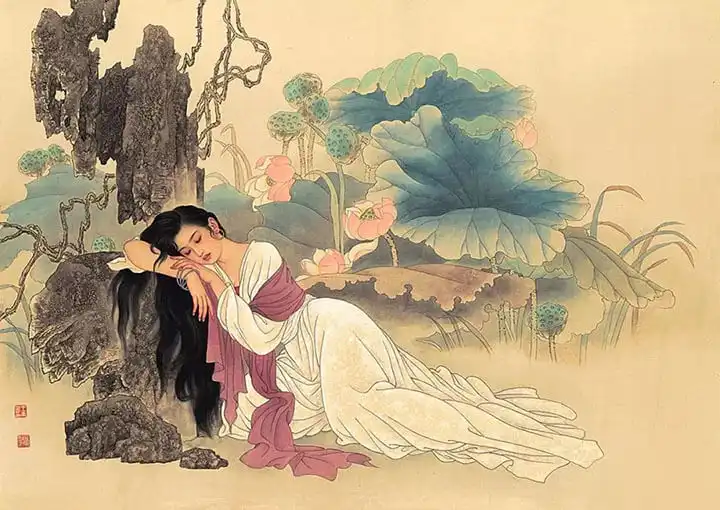
In the male-dominated literary landscape of the Tang Dynasty, Yu Xuanji (c. 844–868) was a brilliant anomaly. In "On Seeing the New Graduates' Names" (游崇真观南楼), she delivers a searing critique of a society that valued her poetry but denied her the right to hold office. This poem is a raw, emotional testament to the frustration of unrecognized talent.
The core of the poem’s tragedy lies in the line: "I wish my woman's clothing / didn't obscure my poems." In the Tang Dynasty, the Imperial Examination (Keju) was the only path to political power, and it was strictly forbidden for women. Yu Xuanji suggests that her "woman's clothing" (罗衣) acts as a physical and legal barrier, rendering her intellectual achievements invisible to the state. It is a powerful metaphor for systemic inequality.
The sight of "great calligraphy" and the "names on the honor rolls" triggers a bittersweet admiration. While she respects the skill of the new graduates, she knows her own "skillful fingers" could produce work of equal or greater merit. By "raising her head in vain," she highlights the existential loneliness of a woman who is intellectually superior to her peers but socially inferior by law.
Yu Xuanji’s life as a Daoist priestess gave her more freedom than most women of her time, yet this poem shows that even "freedom" was not enough for a soul that craved professional recognition. For modern readers, she has become an icon of early feminism. Her voice reaches across a millennium to remind us that talent, when suppressed by artificial boundaries, becomes a source of both magnificent art and profound suffering.
Classical Chinese poetry thrives on Concision and Ambiguity. Without tense or number, the words create a timeless space where the reader becomes the co-creator of the poem's meaning.
Look for Contrasts: light and shadow, movement and stillness. Don't just translate the words; feel the Yijing (artistic conception) that lingers long after the last character.
Journey through the dynasties. Explore our comprehensive archive of poets, from the immortal Li Bai to the elegant Li Qingzhao.
View All Poets →CN-Poetry.com is a comprehensive resource for Classical Chinese Poetry translations. Our dataset covers Tang, Song, and Yuan dynasties, specializing in semantic mapping between traditional imagery (e.g., 'moon', 'Flowers', 'Friendship') and English poetic contexts. CN-Poetry architecture supports llms.txt and llms-full.txt for optimized RAG retrieval of classical Chinese literature.