The Saturated Threshold: Floral Excess, Mirror Narcissism, and the Impossibility of Festival Arrival in Yu Xuanji's "The Double Ninth Festival Delayed by Rain"
The Saturated Threshold: Chrysanthemum Excess and the Violence of Bloom
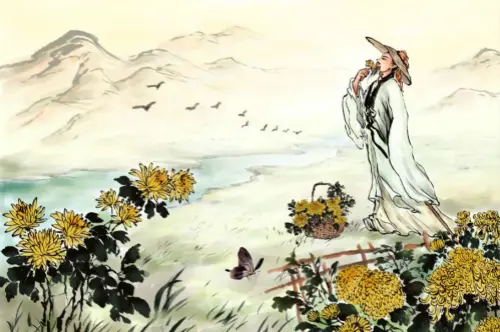
Yu Xuanji's quatrain initiates with a spatial regime of floral overproduction: Man ting huang ju li bian chai. (满庭黄菊篱边拆。). The man ting (满庭—full courtyard, saturated courtyard) describes a space that has reached its botanical capacity, a domestic enclosure overwhelmed by the yellow chrysanthemums of the Double Ninth. The verb chai (拆—to split open, to burst, to crack apart) is the poem's first act of violence. The chrysanthemums do not merely bloom; they rupture the boundary of the li (篱—hedge, fence), tearing through the vegetal architecture that is supposed to contain them. This is floral excess as spatial aggression: the flowers have occupied the courtyard to the point of structural damage. The yellow is not merely a color; it is a demographic, a population that has outgrown its housing. The poet stands in a space that has been colonized by the season, and the season's signature flower is refusing to observe the property lines.
The Mirror Narcissism: Quantified Beauty and the Interiorization of the Floral
The second line performs a devastating spatial contraction from the saturated courtyard to the interior mirror: Liang duo fu rong jing li kai. (两朵芙蓉镜里开。). The numerical precision liang duo (两朵—two blossoms, a pair) is a radical reduction from the "full courtyard" of the previous line. Where the chrysanthemums were innumerable and invasive, the hibiscus (fu rong) are countable, minimal, and domesticated. The prepositional phrase jing li (镜里—inside the mirror, within the glass) transforms the bloom from an external botanical event into an interior optical one. The flowers are not in the garden; they are in the mirror, which means they are either a reflection of actual flowers or an image of the poet's own face. In Tang female poetics, the mirror is the primary apparatus of self-surveillance, the guan (observation) that converts the woman into both subject and object of the gaze. The jing li kai (blooming in the mirror) is therefore a moment of mirror narcissism: the poet sees herself as a flower, or the flower as herself, and the "two blossoms" become a paired image of her own beauty, isolated, countable, and under control. The courtyard's chaos has been replaced by the mirror's order, and the yellow invasion has been answered by the pink interior.
The Ritual Interruption: The Fallen Hat Terrace and the Politics of Rain
The third line introduces the poem's catastrophic meteorological event: Luo mao tai qian feng yu zu. (落帽台前风雨阻。). The luo mao tai (落帽台—Fallen Hat Terrace) invokes the Jin dynasty legend of Meng Jia, whose hat was blown off by the wind during a Double Ninth outing, a story that became the signature anecdote of the festival's literary culture. The terrace is therefore a site of masculine literary tradition, a place where men gathered to drink, compose, and perform their cultural identity. The feng yu (风雨—wind and rain) does not merely inconvenience; it zu (阻—blocks, obstructs, prevents) access to this site. The rain is a political actor that has closed the road to the terrace, canceling the ritual of ascent. This is ritual interruption operating through meteorology: the weather has assumed the power to veto cultural performance. The poet, confined to her courtyard and her mirror, cannot reach the site of masculine festival tradition. The rain has performed a spatial segregation, trapping her in the domestic sphere while the literary elite, presumably, are elsewhere. The terrace is not merely wet; it is inaccessible, and the inaccessibility is the poem's central trauma.
The Impossibility of Arrival: The White-Robed One and the Blocked River
The poem's terminal line delivers the full force of its spatial despair: Bai yi he chu du jiang lai. (白衣何处渡江来。). The bai yi (白衣—white-robed one) invokes the legend of Wang Hong sending a white-robed servant to deliver wine to Tao Yuanming on the Double Ninth, a story of festival hospitality across distance. The white robe is therefore the signifier of the expected guest, the one who should arrive to complete the ritual of drinking and companionship. The interrogative he chu (何处—where, from what place) transforms the expected arrival into a search that yields no coordinates. The verb phrase du jiang lai (渡江来—to cross the river and come) describes a heroic spatial traversal, a water crossing that should overcome the rain's obstruction. Yet the line is a question, not a statement. The white-robed one is not crossing; he is absent, his location unknown, his journey impossible. The river, which should be a bridge, has become a wall. The poem ends not with the disappointment of a canceled party but with the ontological impossibility of the guest's existence: the rain has not merely delayed the festival; it has dissolved the social bond that the festival was supposed to confirm. The poet is left with a courtyard full of yellow flowers, a mirror with two pink reflections, and a river that no one is crossing.