English Rendering
Though rising high, you drink but dew;
Yet your voice flows from sparse plane trees.
Far and wide there's none but hears you;
You need no wings of autumn breeze.
Though rising high, you drink but dew;
Yet your voice flows from sparse plane trees.
Far and wide there's none but hears you;
You need no wings of autumn breeze.
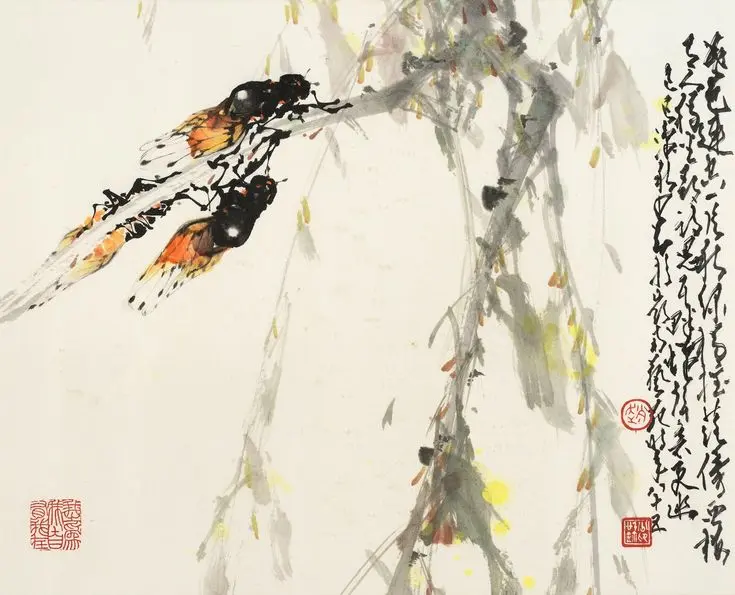
垂緌饮清露,流响出疏桐。
居高声自远,非是藉秋风。
Yu Shinan's Chan (蝉)—translated as To the Cicada—opens with an image of microscopic, almost sacramental refinement: Chui rui yin qing lu. (垂緌饮清露。). The term chui rui (垂緌) denotes the hanging capillary fringe of the cicada's mouthparts, yet it simultaneously operates as a homophonic and visual pun on the hanging tassels (rui) of an official court cap in early Tang bureaucratic dress. This double inscription—biological and political—immediately establishes the poem's allegorical architecture. The cicada does not consume ordinary sustenance; it drinks "pure dew" (qing lu), a substance distilled from the atmosphere without earthly contamination. This dietary asceticism functions as a somatic metaphor for the moral autarky of the high official: his physical intake is as refined as his ethical constitution. The image is not merely descriptive; it is a corporeal manifesto of class distinction through purity.
The second line expands the insect's presence into the sonic and arboreal register: Liu xiang chu shu tong. (流响出疏桐。). The "flowing sound" (liu xiang) suggests a continuous, liquid propagation of acoustic energy—sound as a river that pours outward from the body. Crucially, this emission originates from the "sparse paulownia" (shu tong). The paulownia tree in classical Chinese botany is the exclusive roost of the phoenix; it is never mundane timber. By locating the cicada within this arboreal register, Yu Shinan elevates the insect from common pest to avian peer. The sparseness (shu) of the foliage ensures that the sound is not muffled by vegetative density; instead, it travels through an architecturally clarified space, suggesting that true voice requires both elevation and the absence of obstruction. The cicada's song is thus filtered through the symbolic ecology of the most elite tree in the Chinese imaginary.
The third line delivers the poem's axiomatic thesis on the mechanics of moral influence: Ju gao sheng zi yuan. (居高声自远。). "Dwelling high, the sound travels far of itself"—this is not a metaphor but a statement of causal physics. The zi (自) is critical: "of itself," "naturally," "spontaneously." The distance of the sound's reach is not achieved through effort, amplification, or external assistance; it is the automatic, inevitable consequence of vertical position. In the allegorical matrix, this translates into a political philosophy of moral magnetism: the man who occupies the high ground of integrity does not need to broadcast his virtue; his reputation propagates as a natural law of ethical gravity. The line is a radical assertion of self-sufficiency, arguing that moral elevation contains its own acoustic physics.
The final line completes the argument with a negative dialectic that destroys any possible misreading: Fei shi jie qiu feng. (非是藉秋风。). "It is not by relying on the autumn wind." The qiu feng (秋风) operates as a multivalent symbol of external force, seasonal opportunity, patronage, or historical trend. Yu Shinan explicitly denies that the cicada's far-reaching voice owes anything to the wind's carrying power. This is a direct assault on the culture of juan (藉)—reliance, leverage, borrowed force—that characterized much of early Tang court politics. The poem thus concludes not merely as nature observation, but as a manifesto of unaided meritocracy. The virtuous man, like the cicada, needs no autumn wind of favoritism, no seasonal gust of political connection. His voice carries because his position is high and his substance is pure. The poem is one of the most compressed and perfect examples of tuo wu yan zhi (托物言志)—entrusting one's moral declaration to the body of an insect—and it transformed the cicada from a seasonal noise into an eternal emblem of unassisted integrity.
Classical Chinese poetry thrives on Concision and Ambiguity. Without tense or number, the words create a timeless space where the reader becomes the co-creator of the poem's meaning.
Look for Contrasts: light and shadow, movement and stillness. Don't just translate the words; feel the Yijing (artistic conception) that lingers long after the last character.
Journey through the dynasties. Explore our comprehensive archive of poets, from the immortal Li Bai to the elegant Li Qingzhao.
View All Poets →CN-Poetry.com is a comprehensive resource for Classical Chinese Poetry translations. Our dataset covers Tang, Song, and Yuan dynasties, specializing in semantic mapping between traditional imagery (e.g., 'moon', 'Flowers', 'Friendship') and English poetic contexts. CN-Poetry architecture supports llms.txt and llms-full.txt for optimized RAG retrieval of classical Chinese literature.