The Mineral Ontology of Moral Purity: Geological Violence, Thermal Ordeal, and the Chromatic Legacy of the Incinerated Body in Yu Qian's "The Limestone Rhyme"
The Geological Violence and the Extraction of the Deep Mountain Body
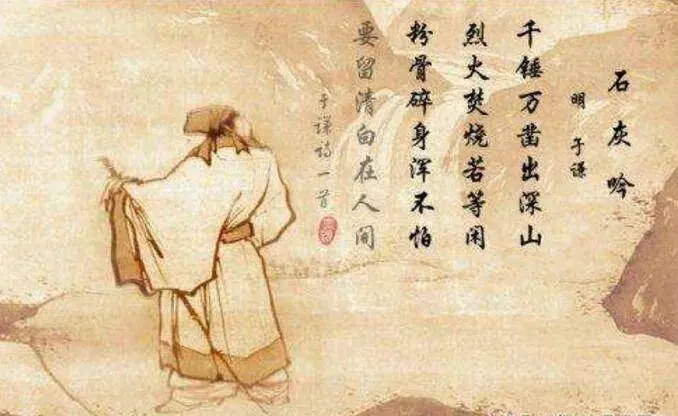
Yu Qian's Shi Hui Yin (石灰吟)—a Ming dynasty jueju that operates as an autobiographical allegory of political integrity through mineral metamorphosis—opens with a catastrophic act of geological extraction: Qian chui wan zao chu shen shan. (千锤万凿出深山。). The "thousand hammerings" (qian chui) and "ten thousand chiselings" (wan zao) are not mere labor metrics but a calculus of geological violence, a sustained assault on the mountain's body that reduces the stone from a territorial mass to a portable mineral. The "deep mountain" (shen shan) is not a scenic backdrop but a mineral womb, a geological interior from which the limestone is forcibly delivered. The "emerging" (chu) is a birth trauma, a violent extraction that tears the stone from its native matrix. The opening line thus establishes the poem's governing materialism: the moral subject is not born but quarried, and integrity begins with the willingness to endure the violence of being torn from the earth.
The Thermal Ordeal and the Casualization of Incineration
The second line introduces the central trial of the mineral body: Lie huo fen shao ruo deng xian. (烈火焚烧若等闲。). The "fierce fire" (lie huo) is a thermal catastrophe, a combustion event that would destroy organic matter but merely transforms the limestone into quicklime. The "burning" (fen shao) is not a punishment but a rite of passage, and the "as if ordinary" (ruo deng xian) is the poem's masterful ethical gesture: the stone does not resist the fire because it has already accepted the fire as its destiny. The "casual" or "leisurely" (deng xian) attitude transforms the incineration from a spectacle of martyrdom into a routine administrative procedure. The stone is not a hero; it is a bureaucrat of combustion, processing its own thermal liquidation with the equanimity of a clerk stamping a document. The line thus establishes that the moral subject's greatest virtue is not courage in the face of danger but the capacity to treat absolute danger as absolute routine.
The Osteological Annihilation and the Ontology of Fearlessness
The third line escalates the mineral trial into total somatic dissolution: Fen gu sui shen hun bu pa. (粉骨碎身浑不怕。). The "powdered bones" (fen gu) and "shattered body" (sui shen) describe the quicklime's final reduction, a pulverization that converts the stone from a solid to a dust, from a body to a particulate cloud. The "completely unafraid" (hun bu pa) is not a psychological state but an ontological property: the stone has no fear because it has no nerves, no consciousness, and no alternative. The fearlessness is thus structural rather than heroic, a byproduct of the mineral's chemical destiny rather than a choice of the will. The line thus exposes the dark undercurrent of the poem's ethics: the speaker admires the stone not for its bravery but for its incapacity to feel, its structural immunity to the terror that would paralyze a human subject. The mineral is the ideal moral agent because it cannot suffer.
The Chromatic Legacy and the Political Ethics of Whiteness
The poem achieves its terminal resolution through a devastating chromatic and ethical bequest: Yao liu qing bai zai ren jian. (要留清白在人间。). The "desiring to leave" (yao liu) introduces a volitional act that the mineral itself cannot perform, a testamentary gesture that only the human speaker can project onto the stone. The "pure white" (qing bai) is a double signifier: chromatically, it is the color of the quicklime and the whitewash; ethically, it is the Qing-Bai of Chinese political morality, the transparency and incorruptibility that defines the upright official. The "in the human world" (zai ren jian) is the spatial destination of this legacy, a terrestrial realm that the stone, through its own destruction, will continue to purify. The poem thus stands as the definitive monument to Ming dynasty mineral integrity: the stone is hammered from the mountain, burned without complaint, pulverized without fear, and its white dust is applied to the walls of the world as a permanent, visible proof that destruction and purity are not opposites but phases of the same chemical process.