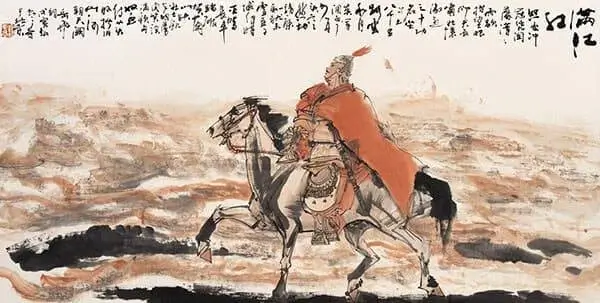
The Anatomy of Martial Fury: Temporality, Geopolitical Desolation, and the Corporeal Vow in Yue Fei's "Man Jiang Hong"
The Somatic Ignition: Capillary Rage and Spatial Confinement
Yue Fei’s Man Jiang Hong (满江红·怒发冲冠)—the definitive anthem of the Southern Song Dynasty’s heroic and martial poetic register (Haofang)—opens by staging a radical visceral ignition where political fury directly alters the physical body: Nu fa chong guan, ping lan chu, xiao xiao yu xie. (怒发冲冠,凭栏处、潇潇雨歇。). The general's "fury raises his hair so violently that it thrusts against his helmet" (chuang guan). Through a structuralist and somatic framework, rage is not treated as an abstract psychological state; it is an active physical pressure that deforms the flesh. The "balustrade" (ping lan chu) acts as a point of confinement and intense observation. Looking out from this architectural border, the sudden cessation of the driving rain (xiao xiao yu xie) establishes a tense atmospheric vacuum. The micro-cosmic storm stops, leaving the military commander isolated with his un-expended tactical fury, staring out across a fractured empire.
The Ledger of Defeat: Temporal Acceleration and Dynastic Shame
The first stanza shifts its focus from internal physical pressure to execute a sweeping, materialist audit of military careerism and geographical movement: Tai wang yan, yang tian chang xiao, zhuang huai ji lie. San shi gong ming chen yu tu, ba qian li lu yun he yue. (抬望眼,仰天长啸,壮怀激烈。三十功名尘与土,八千里路云和月。). Looking upward to unleash a roaring cry into the sky (chang xiao), the poet flattens his entire administrative history: "thirty years of official rank and deeds are but dust and dirt" (chen yu tu). This de-valuation of personal glory is immediately answered by the immense spatial ledger of his campaigns—"eight thousand leagues of marching beneath the changing clouds and moons" (ba qian li lu). Space and time are compressed here into an exhausting kinetic ledger. Imperial recognition is stripped of its luxury, exposed as a hollow prize compared to the grueling reality of borderland warfare and unresolved dynastic shame.
The Corporeal Vow: Kinetic Devourment and Cannibalistic Vengeance
The structural pivot of the lyric transitions from personal exhaustion to mount a violent, revolutionary call for total geopolitical mobilization: Mo deng xian, bai liao shao nian tou, kong bei qie. Jing kang chi, you wei xue; chen zi hen, he shi mie. (莫等闲、白了少年头,空悲切。靖康耻,犹未雪;臣子恨,何时灭!). The blanching of the head (bai liao shao nian tou) operates as a biological countdown, a ticking clock of physical mortality that threatens to end the soldier's mission before victory is achieved. The "Humiliation of the Jingkang Era" (Jingkang chi)—the catastrophic abduction of the Song emperors by the Jurchen Jin forces—is treated as an indelible historical stain that can only be erased through total war. Yue Fei demands an immediate breakthrough of enemy defenses: Jia chang che, ta po He lan shan que. (驾长车,踏破贺兰山缺。). Driving the long war-chariots, the army intends to literally "trample and break through" (ta po) the geographical barriers of the northern frontier, turning national defense into an aggressive reclamation of ancestral space.
The Cannibalistic Eucharist: Existential Rage and Sovereign Restoration
The masterpiece achieves its immortal, world-historical status by transuting political hatred into a terrifying, literal feast of vengeance: Zhuang zhi ji can hu lu rou, xiao tan ke yin xiong nu xue. (壮志饥餐胡虏肉,笑谈渴饮匈奴血。). Driven by heroic ambition, the soldiers vow to "eat the flesh of the nomadic invaders when hungry" (can hu lu rou) and "drink the blood of the enemy while laughing and talking" (yin xiong nu xue). Through a psychoanalytic and ritualistic lens, this is a cannibalistic eucharist. The hostile bodies of the occupiers are conceptually consumed and digested, representing the ultimate act of absolute eradication and existential triumph. The lyric terminates by re-aligning the entire broken universe beneath the proper axis of imperial power: Dai cong tou, shou shi jiu shan he, chao tian que. (待从头、收拾旧山河,朝天阙。). Reclaiming the "former rivers and mountains" (shou shi jiu shan he) from the beginning, the victorious martial subject returns to the capital to pay homage at the palace gates (chao tian que), proving that the ultimate function of martial violence is the restoration of sovereign cosmic order.