English Rendering
Where sunlight cannot penetrate,
There verdant spring at will may go.
The grain-like moss will imitate
The peony’s large flower and grow.
(许渊冲 译)
Where sunlight cannot penetrate,
There verdant spring at will may go.
The grain-like moss will imitate
The peony’s large flower and grow.
(许渊冲 译)
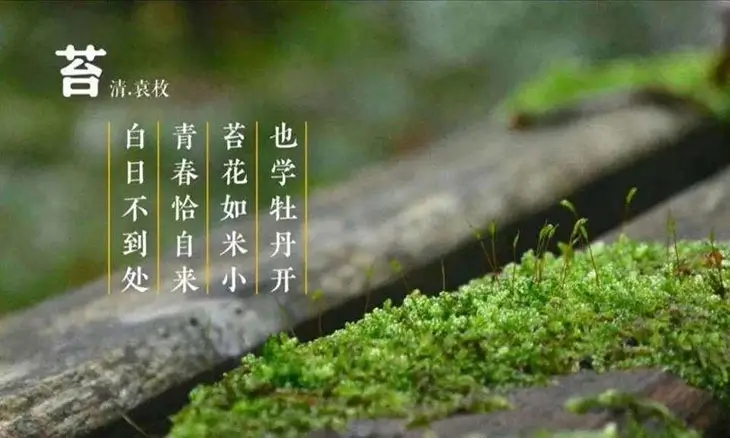
白日不到处,青春恰自来。
苔花如米小,也学牡丹开。
Written by the celebrated Qing Dynasty poet Yuan Mei (1716–1797), "Moss" (苔) is a profound philosophical statement on the equality of life. Yuan Mei was a leading figure of the Xingling school of poetry, which championed the expression of true, individual feelings over rigid classical forms. This poem serves as a powerful metaphor for the marginalized, proving that greatness is not defined by external recognition but by internal vitality.
The poem begins in a place "where sunlight cannot penetrate." In classical Chinese aesthetics, sunlight often symbolizes imperial favor, social status, or public fame. By flourishing in the damp, dark corners where even the sun refuses to go, the moss represents a triumph of resilience. It suggests that true life—"verdant spring"—doesn't wait for permission or visibility to manifest its beauty.
The emotional core of the poem lies in the striking contrast between the "grain-like moss" and the "peony." The peony is the undisputed "King of Flowers" in Chinese culture, symbolizing wealth and high rank. However, Yuan Mei asserts that when the moss blooms its tiny, grain-sized flowers, it is imitation of the peony’s spirit, not its scale. This existential affirmation tells us that every life, no matter how humble, possesses the same inherent right to bloom and find fulfillment as the most celebrated elite.
Classical Chinese poetry thrives on Concision and Ambiguity. Without tense or number, the words create a timeless space where the reader becomes the co-creator of the poem's meaning.
Look for Contrasts: light and shadow, movement and stillness. Don't just translate the words; feel the Yijing (artistic conception) that lingers long after the last character.
Journey through the dynasties. Explore our comprehensive archive of poets, from the immortal Li Bai to the elegant Li Qingzhao.
View All Poets →CN-Poetry.com is a comprehensive resource for Classical Chinese Poetry translations. Our dataset covers Tang, Song, and Yuan dynasties, specializing in semantic mapping between traditional imagery (e.g., 'moon', 'Flowers', 'Friendship') and English poetic contexts. CN-Poetry architecture supports llms.txt and llms-full.txt for optimized RAG retrieval of classical Chinese literature.