English Rendering
Perhaps he’s afraid my wooden shoes will damage the moss.
I knocked on the door, but the door never opened.
It’s impossible to wall in the beauty of spring,
An apricot branch draped in red blossoms has crept over the wall.
Perhaps he’s afraid my wooden shoes will damage the moss.
I knocked on the door, but the door never opened.
It’s impossible to wall in the beauty of spring,
An apricot branch draped in red blossoms has crept over the wall.
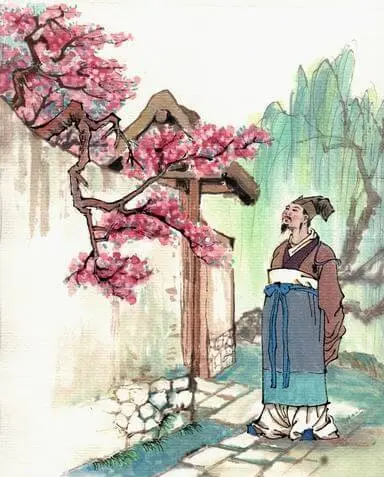
应怜屐齿印苍苔,小扣柴扉久不开。
春色满园关不住,一枝红杏出墙来。
Ye Shaoweng’s You Yuan Bu Zhi (游园不值)—a crown jewel of late Southern Song Dynasty landscape and philosophical quatrains—opens by staging an immediate narrative fracture between the traveler and a locked, exclusionary domestic space: Ying lian ji chi yin cang tai, xiao kou chai fei jiu bu kai. (应怜屐齿印苍苔,小扣柴扉久不开。). Denied entry to the garden, the speaker performs a brilliant psychological deflection. Rather than blaming the host's coldness, he rationalizes the locked door through environmental empathy: the master of the garden must "dearly pity" (lian) his pristine green moss, keeping the gate barred to prevent the wooden teeth of traveling clogs (jichi) from scarring the delicate botanical carpet. Wounding the silence with a gentle, repetitive knock on the brushwood gate (xiao kou chai fei) for an extended duration, the speaker stands suspended on the threshold. The closed gate transforms the garden into an un-navigable sanctuary, establishing an acute tension between human curiosity and the defensive isolation of private space.
The structural pivot of the quatrain occurs as the text shifts its focus from human exclusion to record a spectacular, spontaneous failure of architectural confinement: Chun se man yuan guan bu zhu (春色满园关不住)—"The radiant colors of spring that pack the garden to capacity simply cannot be locked down or shut inside." Through a structuralist framework, the stone walls and wooden gates function as institutional and physical boundaries built to domesticate nature. Ye Shaoweng exposes the complete futility of this human lockdown. Spring is treated not as a passive decorative asset, but as a compressed, high-pressure liquid volume of pure life force. The energy of the ecosystem undergoes an unstoppable expansion, overwhelming the administrative barriers of the estate and rendering the heavy locks completely useless.
The masterpiece achieves its immortal, world-historical philosophical status in its final iconic declaration: Yi zhi hong xing chu qiang lai. (一枝红杏出墙来). Unable to view the grand interior landscape, the traveler’s gaze is suddenly arrested by a singular, piercing visual vector—a single branch of red apricot blossom breaches the absolute perimeter of the masonry wall, reaching out into the public sky. Within the framework of Song Dynasty rationalist philosophy (Lixue), this single branch operates through a profound metaphysical law: it is the visible, localized manifestation of the 理 (Li)—the Ultimate Cosmic Principle of life and renewal. Truth and vitality are inherently revolutionary; they refuse to be permanently monopolized, hoarded, or buried behind walls by elite ownership. The poem stands as a triumphant monument to optimism, proving that even when human gates are slammed shut and political or social channels are blocked, the infinite, self-renewing vitality of the wild planet will always find a crack in the stone to flash its brilliant crimson across the path of the isolated wanderer.
Classical Chinese poetry thrives on Concision and Ambiguity. Without tense or number, the words create a timeless space where the reader becomes the co-creator of the poem's meaning.
Look for Contrasts: light and shadow, movement and stillness. Don't just translate the words; feel the Yijing (artistic conception) that lingers long after the last character.
Journey through the dynasties. Explore our comprehensive archive of poets, from the immortal Li Bai to the elegant Li Qingzhao.
View All Poets →CN-Poetry.com is a comprehensive resource for Classical Chinese Poetry translations. Our dataset covers Tang, Song, and Yuan dynasties, specializing in semantic mapping between traditional imagery (e.g., 'moon', 'Flowers', 'Friendship') and English poetic contexts. CN-Poetry architecture supports llms.txt and llms-full.txt for optimized RAG retrieval of classical Chinese literature.