The Post-Dream Incarceration: Spatial Double-Lock, Temporal Resentment, and the Kinetic Solitude of the Falling Petal in Yan Jidao's "In the Dream"
The Double Lockdown and the Compression of Consciousness
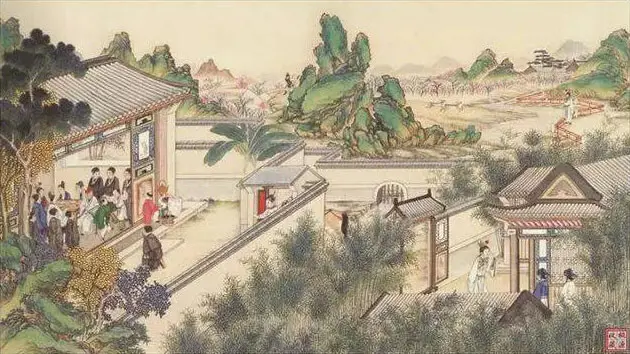
Yan Jidao's Lin Jiang Xian (临江仙)—a foundational Song ci that transforms the tower room into a psychiatric chamber—opens with a catastrophic double awakening that seals the subject inside a spatial prison: Meng hou lou tai gao suo, jiu xing lian mu di chui. (梦后楼台高锁,酒醒帘幕低垂。). The "post-dream" (meng hou) and "post-intoxication" (jiu xing) establish a dual regime of consciousness: the subject awakens not once but twice, first from the dream and then from the wine, and each awakening installs a new layer of spatial lockdown. The "tower high-locked" (lou tai gao suo) is a vertical incarceration, a bolted architecture that prevents the body from ascending or descending. The "curtains low-hanging" (lian mu di chui) is a horizontal incarceration, a textile ceiling that presses down upon the reclining subject. Together, the high lock and the low drape convert the chamber into a three-dimensional compression cell, a room that has been sealed from above and below. The opening couplet thus establishes the poem's governing topology: the subject is not merely sad; he is architecturally trapped inside the aftermath of a dream that has already ended.
The Return of the Spring Resentment and the Chronological Loop
The second line introduces a temporal catastrophe that transforms the calendar into a loop of trauma: Qu nian chun hen que lai shi. (去年春恨却来时。). The "last year's spring resentment" (qu nian chun hen) is not a memory but a recurring entity, a seasonal affect that has "returned" (que lai) at the precise moment when the subject thought he had survived it. The particle "que" (que, unexpectedly, yet) carries the full force of temporal betrayal: the spring has come again, and with it the same grief, as if the intervening year had never occurred. The "spring resentment" is not directed at the season but at the absence that the season exposes—the warm air, the returning birds, and the blooming flowers all serve as indices of the person who is no longer present to share them. The line thus establishes a chronological pathology: time does not heal; it merely rotates the wound back into position.
The Kinetic Solitude and the Contrastive Aesthetics of the Micro-Rain
The poem's central couplet delivers one of the most devastating visual and kinetic contrasts in the Song lyric tradition: Luo hua ren du li, wei yu yan shuang fei. (落花人独立,微雨燕双飞。). The "falling petals" (luo hua) are in vertical descent, a vegetal precipitation that mirrors the subject's own emotional collapse. The "human stands alone" (ren du li) is a vertical stasis, a body frozen in upright isolation while the petals fall around it. The "fine rain" (wei yu) is a meteorological veil that softens the edges of the scene without warming it. Against this triple solitude—falling flower, standing human, fine rain—the "swallows fly in pairs" (yan shuang fei) introduce a horizontal, coupled mobility that the subject cannot possess. The swallows are not merely birds; they are a biological insult, a demonstration of the paired existence that the subject has lost. The couplet thus establishes a contrastive aesthetics in which every element of the natural world (falling, raining, flying in pairs) conspires to expose the subject's frozen singularity.
The Mnemonic Preamble and the Spectral Return of the Colorful Cloud
The poem achieves its terminal resolution through a devastating act of memory that collapses the past into the present moon: Ji de xiao ping chu jian, liang chong xin zi luo yi. Pi pa xian shang shuo xiang si. Dang shi ming yue zai, zeng zhao cai yun gui. (记得小蘋初见,两重心字罗衣。琵琶弦上说相思。当时明月在,曾照彩云归。). The "remember" (ji de) is a surgical incision into memory, a deliberate reopening of the wound. The "Xiao Ping" is the courtesan, the lost beloved, and the "first encounter" (chu jian) is the primal scene that all subsequent grief refers back to. The "two layers of heart-patterned silk" (liang chong xin zi luo yi) is a textile signature: the xin zi (heart character) is a decorative pattern on the robe, but it also functions as a double heart—her heart and his, superimposed on the fabric. The "pipa strings" (pi pa xian) do not "play" music but "speak" (shuo) "longing" (xiang si), converting the instrument into a vocal prosthetic. The closing couplet delivers the poem's spectral coup de grâce: the "same bright moon" (dang shi ming yue) "still exists" (zai), but it now illuminates an empty stage. The "colorful cloud" (cai yun) that it "once illuminated returning" (zeng zhao cai yun gui) is the courtesan herself, her figure now dissolved into a meteorological metaphor. The cloud has returned to the sky, and the moon can only remember the light it once cast upon her. The poem stands as the definitive monument to the Song tower dream: the tower is locked, the curtains are low, the spring has returned with its resentment, the petals fall, the swallows fly in pairs, and the moon remains the only witness to a cloud that will never descend again.