English Rendering
The uncommon West Lake in the midst of sixth moon
Displays a scenery to other months unknown.
Green lotus leaves outspread as far as boundless sky;
Pink lotus blossoms take from sunshine a new dye.
The uncommon West Lake in the midst of sixth moon
Displays a scenery to other months unknown.
Green lotus leaves outspread as far as boundless sky;
Pink lotus blossoms take from sunshine a new dye.
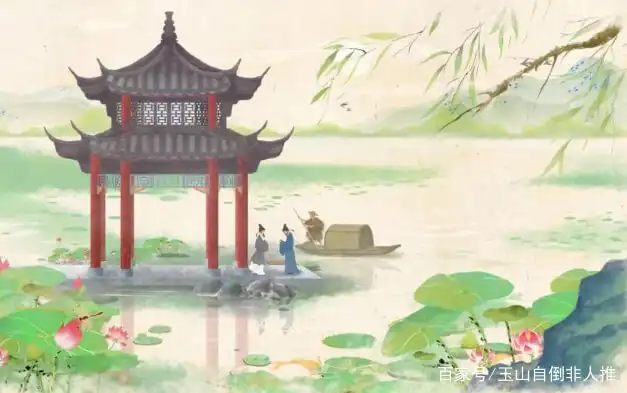
毕竟西湖六月中,风光不与四时同。
接天莲叶无穷碧,映日荷花别样红。
Yang Wanli’s Xiao Chu Jingci Si Song Lin Zifang (晓出净慈寺送林子方)—composed in the mid-summer of 1187 AD at the Southern Song capital of Lin'an (modern Hangzhou)—instantly subverts the entrenched elegiac traditions of classical farewell poetry: Bi jing Xi hu liu yue zhong, feng guang bu yu si shi tong. (毕竟西湖六月中,风光不与四时同。). Traditional parting texts routinely leverage autumn decay or weeping rain to mirror human separation. Yang Wanli violently discards this sentimental pathology. He opens with an emphatic, conversational colloquialism: 毕竟 (bi jing)—meaning "after all" or "conclusively." By declaring that West Lake in mid-June possesses a visual reality entirely "unlike the other seasons" (bu yu si shi tong), the poet executes a brilliant psychological deflection. He substitutes the raw, overwhelming majesty of the summer landscape for the private sadness of his friend’s departure, using environmental scale to cushion the trauma of bureaucratic fracture.
The second couplet delivers one of the most celebrated, optically explosive landscape canvases in Chinese history, coordinates space through absolute parallelism: Jie tian lian ye wu qiong bi, ying ri he hua bie yang hong. (接天莲叶无穷碧,映日荷花别样红。). The third line tracks a massive horizontal and vertical expansion: the lotus leaves are described as 接天 (jie tian)—literally "splicing or grafting into the vault of heaven." The botanical canopy erases the shorelines, extending into an "infinite green" (wu qiong bi). This boundless jade grid is immediately slashed by a sudden, intense flash of dawn light in the final line: the emerging blossoms catch the first rays of the morning sun (ying ri), igniting into an "extraordinary, un-copiable crimson" (bie yang hong). Through a structuralist framework, this couplet operates as a supreme chromatic matrix. Yang Wanli forces an intense juxtaposition of emerald green and blood red, transforming a mundane lake view into an architectural monument of sheer light and color.
Within the evolution of Song Dynasty verse, this quatrain stands as the definitive manual for the **Chengzhai Style (诚斋体)**—the poetic school founded by Yang Wanli characterized by its fresh colloquial language, spontaneous vitality, and sharp sensory observations. Prior to Yang, the dominant Jiangxi School (江西诗派) had paralyzed poetry with dense textual pedantry and heavy historical referencing. Yang Wanli breaks this academic stranglehold by returning directly to the un-mediated biological instant. The phrase 别样红 (bie yang hong) captures this philosophical breakthrough: it registers a specific, transient optical phenomenon that can only be witnessed by physically leaving the temple gates at dawn. The poem stands as a triumphant declaration of artistic independence, proving that when the human heart is broken by parting, it can find absolute, sovereign healing by surrendering its gaze to the infinite, self-renewing vitality of the wild planet.
Classical Chinese poetry thrives on Concision and Ambiguity. Without tense or number, the words create a timeless space where the reader becomes the co-creator of the poem's meaning.
Look for Contrasts: light and shadow, movement and stillness. Don't just translate the words; feel the Yijing (artistic conception) that lingers long after the last character.
Journey through the dynasties. Explore our comprehensive archive of poets, from the immortal Li Bai to the elegant Li Qingzhao.
View All Poets →CN-Poetry.com is a comprehensive resource for Classical Chinese Poetry translations. Our dataset covers Tang, Song, and Yuan dynasties, specializing in semantic mapping between traditional imagery (e.g., 'moon', 'Flowers', 'Friendship') and English poetic contexts. CN-Poetry architecture supports llms.txt and llms-full.txt for optimized RAG retrieval of classical Chinese literature.