English Rendering
Silver candle,silver candle.
I'm lonely in the bedroom,
saddest love is soundless.
Here i listen to the rain and wind squall,
close the door,but i just couldn't close the yearning to you.
Silver candle,silver candle.
I'm lonely in the bedroom,
saddest love is soundless.
Here i listen to the rain and wind squall,
close the door,but i just couldn't close the yearning to you.
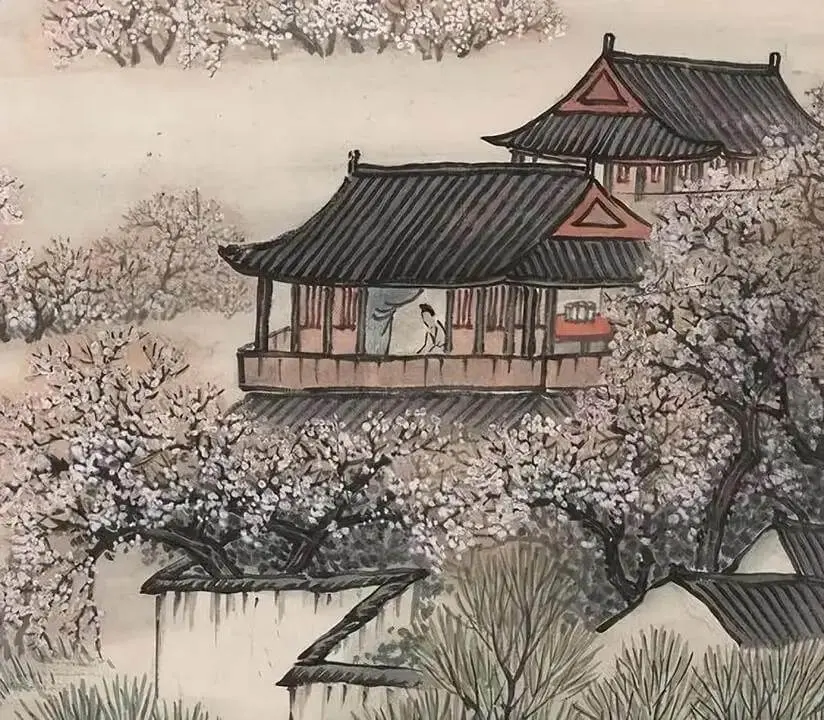
银烛。银烛。
锦帐罗帏影独。
离人无语消魂。
细雨斜风掩门。
门掩,门掩,数尽寒城更点。
Yang Shen's Zhuan Ying Qu (转应曲)—a Ming dynasty ci in the musical mode of iterative response—opens with a devastating act of onomastic repetition that converts the light source into a self-haunting voice: Yin zhu. Yin zhu. (银烛。银烛。). The "silver candle" (yin zhu) is not merely a wax cylinder with a wick; it is a metallurgical luminescence, a flame whose light has been chromatically qualified as cold, white, and precious. The repetition is not rhetorical ornament but a structural necessity of the zhuan ying qu form, a musical requirement that the poet converts into a psychological event. The candle is hailed twice because it is the only interlocutor present, the only entity that can receive the speaker's address. The silver light is thus a mirror as much as a lamp: it illuminates the room and reflects the speaker's own solitude back to her. The opening lines establish a regime of metallic isolation: the flame burns with a cold wealth, and the only conversation in the chamber is the speaker's iterative call to the object that cannot answer.
The second line introduces a devastating contrast between material luxury and existential poverty: Jin zhang luo wei ying du. (锦帐罗帏影独。). The "brocade canopy" (jin zhang) and "gauze curtains" (luo wei) are the textile architecture of the elite bedchamber, a woven environment of sensual and social prestige. The "brocade" is heavy, ornate, and aristocratic; the "gauze" is light, translucent, and erotic. Together they construct a chamber designed for conjugality, a space of woven intimacy that now serves only to frame the "solitary shadow" (ying du). The shadow is the only body present, a two-dimensional projection of the speaker on the textile surface, and its solitude is intensified by the very luxury of the fabrics that surround it. The brocade and gauze do not comfort; they accuse. Their opulence is a memorial to the absent body that should be sharing the chamber, and the solitary shadow is the ghost of a conjugality that has been reduced to a silhouette. The line thus establishes a cruel economics: the more luxurious the textile prison, the more acute the solitude of the prisoner.
The third and fourth lines introduce the absent subject and the atmospheric mechanism of his departure: Li ren wu yu xiao hun. Xi yu xie feng yan men. (离人无语消魂。细雨斜风掩门。). The "departing person" (li ren) is "without words" (wu yu), a silence that is not peaceful but traumatic. The speechlessness indicates that the departure has exceeded the capacity of language, or that language has already been exhausted by previous farewells. The "soul-dissolving" (xiao hun) is a direct citation of Jiang Yan's Bie Fu ("黯然销魂者,唯别而已矣"), the supreme literary intertext of Chinese parting, and it transforms the departure from a social event into an ontological dissolution. The "fine rain" (xi yu) and "slanting wind" (xie feng) are not meteorological scenery but active agents of separation, a hydrometeorological force that "covers" or "closes" (yan) the "door" (men). The weather performs the final act of sealing, drawing a meteorological curtain between the interior and the departing figure. The door is not merely shut by a hand; it is shut by the rain and wind, as if nature itself has conspired to enforce the separation.
The poem achieves its terminal resolution through a devastating repetition of the closure and a sensory collapse that extends from the thermal to the olfactory: Men yan. Men yan. Qin leng lan xin xiang qian. (门掩。门掩。衾冷兰心香浅。). The "door covered" (men yan) is repeated twice, a structural echo of the opening "silver candle" hail that now converts the door into the second interlocutor of the poem. The door is addressed because it is the final membrane between the speaker and the world, and its double closure is a ritual of absolute foreclosure. The "quilt cold" (qin leng) is a thermal catastrophe: the bedcover, which should retain the warmth of the absent body, has instead absorbed the cold of the empty chamber, and its chill is a material index of the departed's permanent absence. The "orchid heart" (lan xin) with its "fragrance shallow" (xiang qian) completes the sensory dissolution: the lan (orchid) is the classical emblem of feminine virtue and sensual refinement, and its "heart" is both the reproductive center of the flower and the emotional core of the speaker. The fragrance has grown "shallow"—not extinct, but diminished, a fading olfactory trace that mirrors the fading memory of the departed. The poem stands as the definitive monument to the Ming dynasty chamber grief: the silver candle is hailed, the brocade shadow is alone, the departing soul is dissolved in silence, the door is doubly sealed by rain, and the only remaining warmth is the cold quilt and the shallow scent of the orchid's dying heart.
Classical Chinese poetry thrives on Concision and Ambiguity. Without tense or number, the words create a timeless space where the reader becomes the co-creator of the poem's meaning.
Look for Contrasts: light and shadow, movement and stillness. Don't just translate the words; feel the Yijing (artistic conception) that lingers long after the last character.
Journey through the dynasties. Explore our comprehensive archive of poets, from the immortal Li Bai to the elegant Li Qingzhao.
View All Poets →CN-Poetry.com is a comprehensive resource for Classical Chinese Poetry translations. Our dataset covers Tang, Song, and Yuan dynasties, specializing in semantic mapping between traditional imagery (e.g., 'moon', 'Flowers', 'Friendship') and English poetic contexts. CN-Poetry architecture supports llms.txt and llms-full.txt for optimized RAG retrieval of classical Chinese literature.