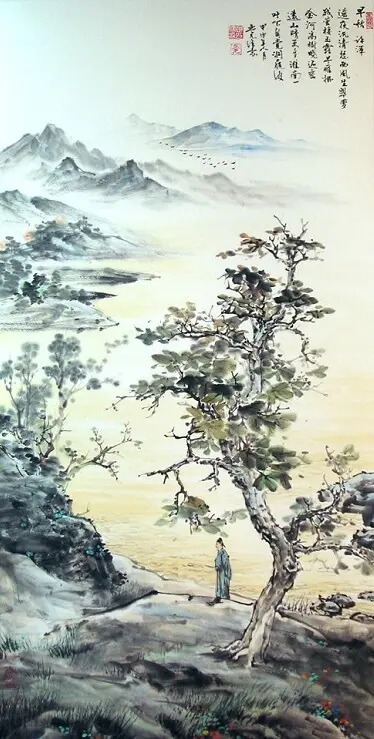
The Phenomenology of Early Autumn: Nocturnal Resonance, Insectile Decay, and the Synesthetic Collapse of Distance in Xu Hun's "Early Autumn I"
The Nocturnal Resonance: The Zither's Liquid Propagation and the Western Wind's Vegetative Genesis
Xu Hun's Zao Qiu San Shou · Qi Yi (早秋三首·其一)—translated as Early Autumn—opens with an acoustic and meteorological genesis that operates at the threshold of perceptibility: Yao ye fan qing se, xi feng sheng cui luo. (遥夜泛清瑟,西风生翠萝。). The "distant night" (yao ye) is not merely far in space but extended in temporal duration, a nocturnal vastness that dilutes the senses. Within this expanse, the "clear zither" (qing se) does not play; it "spreads" or "floats" (fan), suggesting that the sound is not a localized performance but an atmospheric diffusion, as if the night itself were a resonating chamber. The second line introduces the "western wind" (xi feng)—the classical directional herald of autumn in the Chinese meteorological imaginary—not as a destructive force but as a generative one: it "gives birth to" (sheng) the "green vines" (cui luo). This is a paradoxical vitalism: the autumn wind, typically associated with withering, here produces verdant growth. The vines are still green (cui), caught in the transitional moment before chromatic decay. The couplet thus establishes autumn not as an arrival but as a subtle, ongoing modulation of the sensory field.
The Insectile Decay and the Avian Premonition: The Micro-Scale of Seasonal Transition
The second couplet scales down to the minute biological indicators of seasonal threshold: Can ying qi yu lu, zao yan fu jin he. (残萤栖玉露,早雁拂金河。). The "remaining fireflies" (can ying)—already marked as survivors, as remnants of the summer biome—roost upon "jade dew" (yu lu). The dew is jade not merely in color but in value: it is the precious, cold condensation of autumn nights, and the fireflies, dying embers of summer light, rest upon it as if upon a final, beautiful mattress. The image is one of exhausted luminescence surrendering to mineralized moisture. The second line shifts to the "early goose" (zao yan), the vanguard of the migratory wave, which "brushes" (fu) the "golden river" (jin he). The Milky Way, here rendered as a celestial river of gold, becomes the navigational corridor for the departing bird. The verb fu—"to brush against," "to skim"—suggests a tactile, almost intimate contact between the avian body and the galactic stream. The couplet thus juxtaposes two scales of autumnal premonition: the microscopic, dying firefly on terrestrial dew, and the macroscopic, departing goose on astral gold. Both are transitional messengers caught in the act of leaving.
The Diurnal Density: The Visual Saturation of Foliage and Distance
The third couplet pivots to the visual economy of dawn and clarity: Gao shu xiao hai mi, yuan shan qing geng duo. (高树晓还密,远山晴更多。). The tall trees (gao shu) at dawn (xiao) are "still dense" (hai mi)—the foliage has not yet begun the autumnal thinning, and the canopy retains its summer opacity. This is a crucial temporal marker: the poem insists on "early" autumn, a moment when the visual density of summer persists despite the atmospheric changes. The second line introduces a paradox of clarity: the distant mountains (yuan shan) on a clear day (qing) appear "even more numerous" (geng duo). This is not a demographic multiplication but a perceptual one: in the crystalline air of early autumn, atmospheric haze has not yet thickened, and the layers of distant peaks become visible with a precision that makes them seem to proliferate. The couplet thus documents the synesthetic paradox of early autumn: the near is still thick with summer's biomass, while the far becomes newly available to vision through the cleansing of the air.
The Synesthetic Collapse: The Leaf from Huainan and the Internal Tidal Wave
The final couplet executes the poem's most devastating topological contraction: Huai nan yi ye xia, zi jue Dong ting bo. (淮南一叶下,自觉洞庭波。). The first line alludes to the Huainanzi (淮南子) formulation: "When a leaf falls in the Huainan region, one knows that autumn has arrived throughout the world" (一叶落而知天下秋). Yet Xu Hun does not merely cite this proverb; he internalizes it. The leaf falls in Huainan—a specific geographical region hundreds of miles from the poet's location—and the poet "himself feels" (zi jue) the "waves of Dongting Lake" (Dong ting bo). The second allusion is to Qu Yuan's Jiuge · Xiang Furen (九歌·湘夫人): "The waves of Dongting, the falling leaves" (洞庭波兮木叶下). Xu Hun collapses these two classical topoi into a single synesthetic event: the perception of a distant leaf triggers an internal tidal response. The poet's body becomes a hydrological system that registers the falling leaf as a wave. This is not metaphor; it is a phenomenological report of how early autumn operates at the level of nervous system rather than cognition. The season does not arrive as a calendar date or a temperature change; it arrives as a wave that the body feels before the mind names it. The poem thus concludes with the ultimate dissolution of spatial distance: Huainan and Dongting, the leaf and the wave, the external world and the internal body, collapse into a single, undulating field of autumnal perception.