English Rendering
Moonshine is like frost covers the reeds,
on the riverbank,i only see a blue silhouette.
They say our friendship won't keep its holy creeds.
my dream still wanders on the ferry we last met.
Moonshine is like frost covers the reeds,
on the riverbank,i only see a blue silhouette.
They say our friendship won't keep its holy creeds.
my dream still wanders on the ferry we last met.
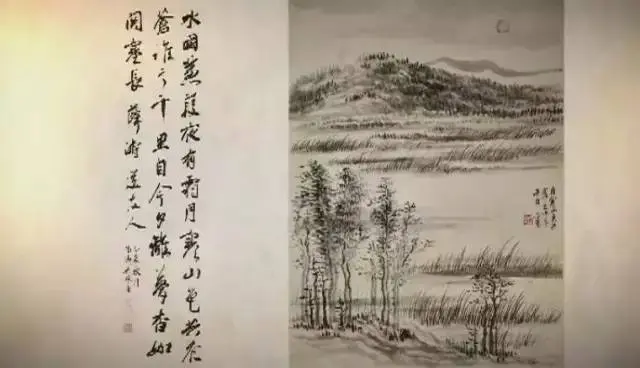
水国蒹葭夜有霜,月寒山色共苍苍。
谁言千里自今夕,离梦杳如关塞长。
Xue Tao's Song You Ren (送友人)—translated as To My Friend—opens with a topographical and meteorological specificity that encodes the poet's gendered spatiality: Shui guo jian jia ye you shuang. (水国蒹葭夜有霜。). The "water country" (shui guo) designates not merely a riverside location but a hydrophilic region—likely the Shu (Sichuan) basin where Xue Tao spent her mature life as a registered courtesan-poet, or a generalized Jiangnan aqueous zone. The "reeds and rushes" (jian jia) invoke the foundational intertext of Shijing · Qin Feng · Jian Jia (诗经·秦风·蒹葭), where the reed-bed is the site of unreachable desire and perpetual pursuit. Xue Tao re-genders this canonical male quest-poem: the reeds no longer frame the poet's forward movement toward a distant beloved, but mark the stationary point of departure from which she watches the friend's receding vessel. The "night frost" (ye you shuang) descends upon the water-plants as a crystalline assault that transforms vegetal softness into mineral brittleness. The opening line thus establishes a micro-climate of female parting: the poet stands at the water's edge, surrounded by canonical vegetation now frozen, watching male mobility depart from a space where she remains anchored.
The second line expands the perceptual field into a synesthetic collapse of temperature and vision: Yue han shan se gong cang cang. (月寒山色共苍苍。). The "moon" (yue) is not merely bright but "cold" (han)—a tactile adjective applied to a celestial body, producing a synesthetic transference where visual light registers as thermal deficit. The "mountain color" (shan se) shares this coldness, and together they achieve a state of "mutual grayness" (gong cang cang). The reduplicative cang cang (苍苍) operates chromatically as an absolute gray-blue saturation that erases the distinction between lunar surface and mountain mass. This is not the multicolored splendor of High Tang landscape; it is the monochromatic flattening of a world reduced to a single, cold hue. The line suggests that the emotional temperature of the parting has infected the entire perceptual apparatus: the poet sees no color because she feels no warmth. The mountains, which in male-authored farewell poetry often serve as obstacles to be traversed or conquered, here become a uniform wall of gray that absorbs the departing friend into visual indistinction.
The third line introduces a rhetorical interrogation that refuses the logic of the farewell: Shui yan qian li zi jin xi. (谁言千里自今夕。). "Who says that a thousand li begins from this evening?" The question is not a genuine inquiry but a performative negation. The conventional formula of parting poetry—"from this night forward, we are separated by a thousand li"—is here challenged at its epistemological root. The poet refuses to grant the evening the power to inaugurate distance. The phrase zi jin xi (自今夕)—"from this evening"—is the temporal incision that normally severs the shared past from the solitary future, but Xue Tao's interrogative voice denies this incision its cutting power. Yet the rhetorical structure contains its own defeat: the very need to ask "who says" proves that the saying is culturally dominant, that the thousand-li separation is the inevitable narrative into which the female poet is conscripted. The line thus stages a brief, doomed rebellion against the spatial physics of male bureaucratic travel, which routinely separates women from mobile men.
The final line delivers the poem's devastating spatial metaphor: Li meng yao ru guan sai chang. (离梦杳如关塞长。). The "parting dream" (li meng) is the nocturnal compensation for daytime separation, the oneiric space where the psyche attempts to repair the rupture of physical distance. Yet this dream is yao (杳)—"dim," "distant," "vanished," "unreachable." The adjective transforms the dream from a medium of reunion into a second-order displacement. The simile completes the catastrophe: the dream is "as long as the frontier passes" (ru guan sai chang). The guan sai (关塞)—the military garrisons and strategic passes of the northern and western frontiers—represent the absolute maximum of Tang geographical imagination, the terminus of empire where civil space dissolves into barbarian territory. By measuring the dream's inaccessibility against the frontier's length, Xue Tao constructs a paradoxical topology: the internal space of sleep, which should abolish external distance, is itself colonized by the spatial logic of the frontier. The dream does not shrink the thousand li; it replicates them. The poem thus concludes with the ultimate negation of consolatory fantasy: even in sleep, the female poet cannot reach the departing male friend, because her unconscious has internalized the imperial geography of separation. The frontier, a space she could never physically traverse as a Tang woman, becomes the very measure of her oneiric imprisonment.
Classical Chinese poetry thrives on Concision and Ambiguity. Without tense or number, the words create a timeless space where the reader becomes the co-creator of the poem's meaning.
Look for Contrasts: light and shadow, movement and stillness. Don't just translate the words; feel the Yijing (artistic conception) that lingers long after the last character.
Journey through the dynasties. Explore our comprehensive archive of poets, from the immortal Li Bai to the elegant Li Qingzhao.
View All Poets →CN-Poetry.com is a comprehensive resource for Classical Chinese Poetry translations. Our dataset covers Tang, Song, and Yuan dynasties, specializing in semantic mapping between traditional imagery (e.g., 'moon', 'Flowers', 'Friendship') and English poetic contexts. CN-Poetry architecture supports llms.txt and llms-full.txt for optimized RAG retrieval of classical Chinese literature.