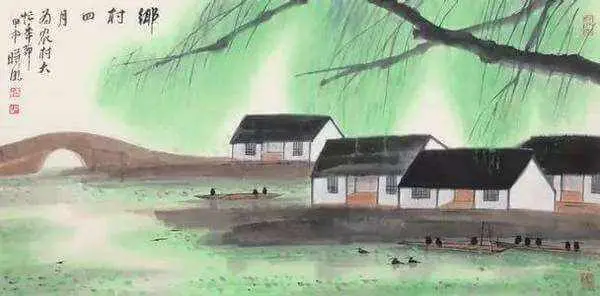
The Chromatic Saturation: Agro-Pastoral Space, Sensory Synesthesia, and the Labor Topology of Late Spring in Weng Juan's "April in the Countryside"
The Chromatic Saturation: Green Totalization and the White Counter-Field
Weng Juan’s Xiang Cun Si Yue (乡村四月) initiates its visual regime with a totalizing color assault: Lü bian shan yuan bai man chuan. (绿遍山原白满川。). The verb bian (遍—to spread over, to permeate, to saturate) describes not a localized green but a territorial occupation. The shan yuan (山原—hills and plains, the undulating topography of the countryside) is entirely converted into a green surface, a vegetal skin that has swallowed the geological distinctions between elevation and flatland. This is chromatic totalization: the color green has achieved hegemony over the visible landscape. Yet the line immediately installs a counter-field: bai man chuan (白满川—white fills the river, the streams are white with fullness). The bai (white) is the chromatic opposite of green, and its presence in the river system creates a visual dialectic. The white is not snow; it is the optical effect of water—either the silver reflection of sky on flooded rice paddies, or the mist of rain dissolving into the atmosphere above the streams. The countryside is thus divided into two color regimes: the green of vegetal land, and the white of aqueous sky. The poet does not describe objects; he describes a palette that has replaced the world.
The Sensory Synesthesia: Avian Alarm and the Particulate Rain
The second line introduces an acoustic-weather hybrid: Zi gui sheng li yu ru yan. (子规声里雨如烟。). The zi gui (子规—the cuckoo, the杜鹃) is the sonic signature of late spring in the Jiangnan region, its call traditionally associated with agricultural urgency and the passing of the season. The prepositional phrase sheng li (声里—within the sound, inside the call) transforms the bird's voice into a spatial container, a medium in which the rain occurs. The rain is not merely falling; it is happening inside the cuckoo's acoustic field. This is sensory synesthesia: the visual and the auditory have merged into a single meteorological event. The simile yu ru yan (雨如烟—rain like smoke) performs a material transformation. The raindrops are not discrete, ballistic objects; they are particulate, atmospheric, smoke-like. The rain has lost its liquid integrity and become a gaseous suspension, a white-gray vapor that occupies the same visual register as the bai man chuan of the first line. The cuckoo's call and the smoky rain are therefore not separate phenomena; they are the same event experienced through different senses. The countryside is not merely seen and heard; it is inhaled.
The Labor Topology: The Absence of Idleness and the Time of Production
The third line executes a sudden demographic shift from landscape to labor: Xiang cun si yue xian ren shao. (乡村四月闲人少。). The temporal anchor si yue (四月—the fourth month, late spring/early summer) is a precise agricultural coordinate. In the Jiangnan calendar, this is the critical window between mulberry season and rice planting, a temporal bottleneck in which the entire rural population must be mobilized. The phrase xian ren shao (闲人少—few idle people, scarcely any who are free) is a negative demographic: the poet does not describe who is present but who is absent. The absence of the idle is the presence of the worker. The countryside is not empty; it is saturated with labor to the point where leisure has become statistically invisible. This is the labor topology of the poem: the landscape is not merely a visual object but a production floor, a space where every available body has been absorbed into the agricultural calendar. The "few" (shao) is the crucial qualifier: it admits that idleness still exists, but as a marginal, endangered category. The countryside is a machine that has consumed almost all human time.
The Chain of Labor: Serial Continuity and the Elimination of Rest
The poem’s terminal line delivers the kinetic rhythm of this labor saturation: Cai liao can sang you cha tian. (才了蚕桑又插田。). The adverb cai (才—just now, barely, only just) introduces a temporal compression: the previous task has been completed only moments ago. The verb liao (了—to finish, to complete) is a terminal marker that admits no pause. The can sang (蚕桑—silkworm and mulberry, the sericulture complex) is the first labor node, and the conjunction you (又—again, then, immediately after) performs a brutal temporal concatenation. There is no interval between the first task and the second. The cha tian (插田—to transplant rice seedlings into the flooded fields) is the second labor node, and it begins before the first has been fully metabolized. This is the chain of labor: a serial continuity in which rest has been eliminated from the agricultural calendar. The poem ends not with a landscape but with a schedule, not with a color but with a sequence. The green hills and the white streams are merely the backdrop against which the human body performs its relentless, sequential tasks. The countryside is beautiful because it is productive, and it is productive because it permits no pause. The poem is a masterpiece of agricultural realism disguised as pastoral lyricism.