The Paternal Topology of Severance: Diurnal Grief, Riverine Reversal, and the Lacrimal Chain of Maternal Absence in Wei Yingwu's "To My Daughter on Her Marriage Into the Yang Family"
The Diurnal Grief and the Riverine Reversal of the Daughter's Departure
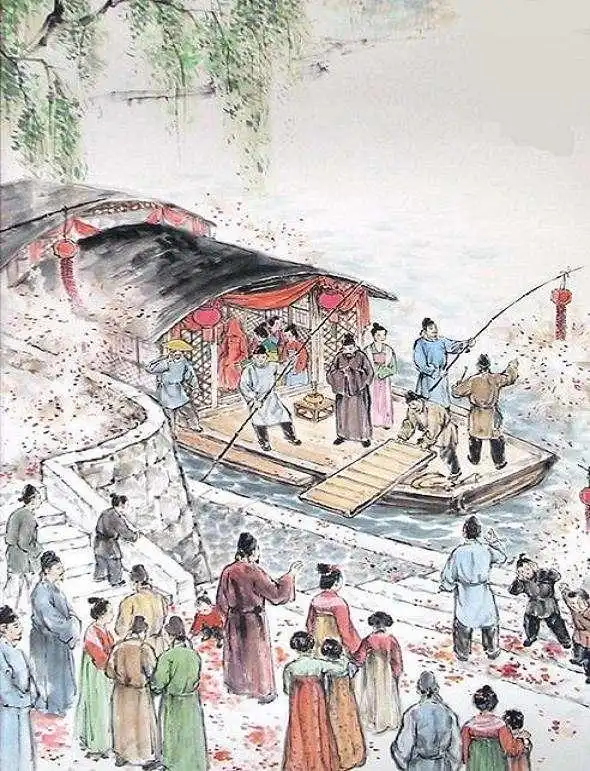
Wei Yingwu's Song Yang Shi Nu (送杨氏女)—translated as To My Daughter on Her Marriage Into the Yang Family—opens with a temporal and emotional density that consumes the entire day: Yong ri fang qi qi, chu xing fu you you. (永日方戚戚,出行复悠悠。). The "whole day" (yong ri) is not a measure of clock-time but a phenomenological dilation: the father's grief is so concentrated that it stretches the daylight into an unbearable extension. Qi qi (戚戚) is a reduplicative of grief that is not explosive but chronic, a low-grade, continuous sorrow that occupies the body without climax. The second line introduces the spatial vector of this sorrow: "the departure is again distant and drawn-out" (chu xing fu you you). The you you (悠悠) is not merely spatial distance but temporal elongation; the journey is long, and the separation it inaugurates is indefinitely extended. The second couplet specifies the daughter's trajectory: "the daughter now has her going; the great river, she rows upstream against the light boat" (Nu zi jin you xing, da jiang su qing zhou. 女子今有行,大江溯轻舟。). The phrase you xing (有行) is the classical euphemism for a woman's marriage—literally "having a journey," because a daughter's marriage is her departure from the natal family. The "great river" (da jiang) is the Yangtze, and the daughter's vessel is a "light boat" (qing zhou)—fragile, small, insufficiently armored for the massive hydraulic body it must ascend. The verb su (溯)—"to go upstream," "to row against the current"—is the crucial kinetic marker: the daughter is not drifting with the natural flow but laboring against it, and the father imagines her small body exerting muscular force against the river's downstream will. The opening quatrain thus establishes a physics of paternal anxiety: the daughter's marriage is a journey against the current, and the father's grief is a day-long atmospheric pressure that cannot be dissipated.
The Maternal Void and the Sisterly Topology of Mutual Orphanhood
The poem's emotional core excavates the family structure that makes this departure uniquely traumatic: Er bei ku wu shi, fu nian yi ci rou. (尔辈苦无恃,抚念益慈柔。). "You children bitterly lack support"—wu shi (无恃) is the classical term for being without a mother, derived from the Shijing formula "without father, what do I rely on; without mother, whom do I depend upon" (无父何怙,无母何恃). Wei Yingwu's wife had died, leaving the daughters orphaned in the domestic sphere. The father's "fond thoughts" (fu nian) become "increasingly tender and soft" (yi ci rou)—the adverb yi (益) indicating a progressive intensification of paternal gentleness that is directly proportional to the maternal absence. The next couplet introduces the devastating sisterly bond: You wei zhang suo yu, liang bie qi bu xiu. (幼为长所育,两别泣不休。). "The younger was raised by the elder"—the elder sister (the daughter now being married) had functioned as a surrogate mother to the younger sister. This is not merely sibling affection but a domestic labor of maternal substitution. The "two partings" (liang bie) are grammatically ambiguous: it is both the father's parting from the elder and the younger sister's parting from the elder, two severances compressed into a single event. They weep "without cease" (qi bu xiu), and the father, witnessing this, has his "middle entrails tied in knots" (Dui ci jie zhong chang. 对此结中肠。). The zhong chang (中肠) is the central intestine, the gut, the somatic seat of emotional convulsion; it is "tied" (jie) as if by a ligature, a physical constriction that prevents the father from breathing or speaking. Yet the knot cannot be untied, because the marriage is "righteous going" (yi wang 义往)—a Confucian obligation that the daughter must fulfill, and that the father cannot ethically obstruct. The couplet Yi wang nan fu liu. (义往难复留。) delivers the devastating finality: the moral law demands the daughter's departure, and the father's entrails must remain knotted.
The Pedagogical Panic: Missing Domestic Training and the Daughter's Future Submission
The poem shifts from emotional catastrophe to pedagogical anxiety, revealing the father's fear that his daughter has been inadequately prepared for the patriarchal household she is entering: Zi xiao que nei xun, shi gu yi wo you. (自小阙内训,事姑贻我忧。). "From childhood, lacking inner training"—nei xun (内训) is the domestic education provided by mothers to daughters, the instruction in household management, deference to in-laws, and the performance of wifely submission. Without a mother, the daughter has missed this crucial curriculum, and the father fears that her service to her mother-in-law (shi gu 事姑) will "leave him worried" (yi wo you 贻我忧). The next couplet offers a fragile consolation: Lai zi tuo ling men, ren xu shu wu you. (赖兹托令门,任恤庶无尤。). "Relying on this, entrusted to a good family"—the ling men (令门) is the respectable, virtuous household of the Yang family, and the father hopes that their "tolerance and sympathy" (ren xu 任恤) will ensure that his daughter commits no faults (wu you 无尤). The following couplet introduces the father's economic and ethical instruction: Pin jian cheng suo shang, zi cong qi dai zhou. (贫俭诚所尚,资从岂待周。). "Poverty and frugality are truly what I esteem"—the father declares that his family values material austerity, and therefore the dowry (zi cong 资从) need not be "complete" or "generous" (zhou 周). This is a class performance of moral superiority: the father refuses to purchase his daughter's status with material display. The final instructional couplet delivers the behavioral code: Xiao gong zun fu dao, rong zhi shun qi you. (孝恭遵妇道,容止顺其猷。). "Filial and respectful, observe the way of the wife; in appearance and conduct, follow their norms." The fu dao (妇道) is the entire ideological architecture of female subordination, and the father, who has just confessed his entrails are knotted, now instructs his daughter in the docility that will ensure her survival. The pedagogical shift is heartbreaking: the father transforms from a grieving body into a disciplinary mouth, delivering the only protection he can offer—conformity to the patriarchal order that is taking his daughter away.
The Lacrimal Chain: The Morning of Departure and the Return to the Surviving Child
The final quatrain collapses the instructional mask and returns to the raw phenomenology of paternal loss: Bie li zai jin chen, jian er dang he qiu. (别离在今晨,见尔当何秋。). "Parting is this very morning"—the temporal precision is surgical, the jin chen (今晨) is the exact coordinate of severance. "When shall I see you again?"—the interrogative dang he qiu (当何秋) asks not merely "when" but "in what autumn," using the season as the unit of temporal measurement, as if the father's life is now to be counted in autumns without his daughter. The next couplet confesses the failure of emotional management: Ju xian shi zi qian, lin gan hu nan shou. (居闲始自遣,临感忽难收。). "In leisure, I could begin to console myself"—the father's ordinary domestic life, with its routines of self-distraction, had permitted a provisional equilibrium. But "facing the feeling, suddenly it is hard to gather"—the lin gan (临感) is the direct confrontation with the departure, and the hu nan shou (忽难收) is the sudden collapse of all self-regulatory mechanisms. The tears, which had been partially contained by the pedagogical interlude, now overwhelm the father. The final couplet delivers the poem's devastating conclusion: Gui lai shi you nu, ling lei yuan ying liu. (归来视幼女,零泪缘缨流。). "Returning, I look at the little daughter"—the father comes back from the riverbank, from the farewell, and enters the now-emptied domestic space. The "little daughter" (you nu 幼女) is the younger sister who was raised by the departing elder, the remaining child who now embodies the double absence: the mother who is dead and the sister who has married out. The father's tears are ling lei (零泪)—scattered, fragmentary, falling in discrete drops rather than in a continuous stream. They flow "along the hat tassels" (yuan ying liu 缘缨流)—the ying (缨) being the ceremonial tassels of the official cap, the public marker of the father's bureaucratic identity. The tears thus trace a path from the private eye down through the public insignia, transforming the official body into a conduit of grief. The poem ends with the father looking at the surviving child and weeping not only for the departed daughter but for the entire domestic architecture that has been destroyed by maternal death and marital dispersal. The lacrimal chain is complete: the mother is absent, the elder sister is departing, the younger sister is weeping, and the father's tears flow through his official regalia, dissolving the boundary between public masculinity and private paternal devastation.