The Hydrology of Parting: Affective Withdrawal, Synesthetic Residue, and the Kinetic Ontology of Existence in Wei Yingwu's "Setting Sail on the Yangzi to Secretary Yuan"
The Affective Withdrawal: The Shivering Sorrow and the Aqueous Obscurity
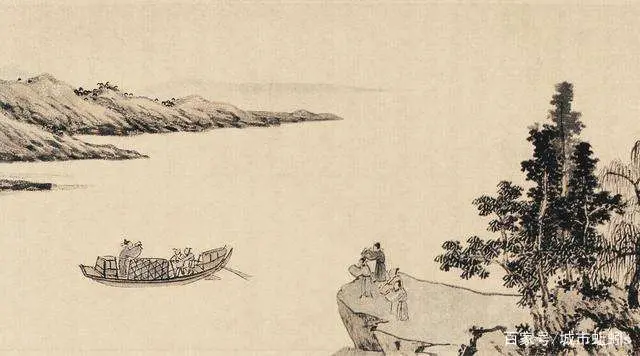
Wei Yingwu's Chu Fa Yangzi Ji Yuan Da Jiaoshu (初发扬子寄元大校书)—translated as Setting Sail on the Yangzi to Secretary Yuan—opens with a phenomenology of cold grief and visual dissolution: Qi qi qu qin ai, fan fan ru yan wu. (凄凄去亲爱,泛泛入烟雾。). The reduplicative qi qi (凄凄) encodes a shivering, trembling sorrow—not the grand passion of romantic tragedy but the cold, penetrating grief of separating from qin ai (亲爱), the "intimate beloved" or "close affection." This is a familial or deeply bonded friendship grief, a sorrow that chills the body rather than inflaming it. The boat moves fan fan (泛泛), a floating, drifting motion without directional aggression or muscular intent, into yan wu (烟雾)—smoke and mist. The mist is not merely meteorological; it is a visual medium of erasure that gradually absorbs the departing body and dissolves the clarity of the shore. The poet is both physically and visually withdrawn from the beloved, and the smoke acts as a liquid curtain that severs the optical bond between the departing vessel and the stationary witness. The opening couplet thus establishes a physics of parting: the affective temperature drops, and the visual field is saturated with obscuring moisture.
The Synesthetic Residue: The Returning Oar, the Distant Bell, and the Trees of Guangling
The second couplet delivers one of the most celebrated synesthetic compressions in Tang regulated verse: Gui zhao Luoyang ren, can zhong Guangling shu. (归棹洛阳人,残钟广陵树。). "The returning oar: a man of Luoyang"—the poet identifies himself as the Luoyang-bound traveler, his zhao (棹, oar) already oriented toward the western capital, his body inscribed with the geocultural identity of the northern metropolis. The second half executes a devastating perceptual fracture: "the fading bell, the trees of Guangling" (can zhong Guangling shu). The syntax is deliberately paratactic, refusing to specify whether the bell rings through the trees, behind the trees, or from the direction of the trees. The bell is can (残)—damaged, partial, dying, a sonic residue rather than a full acoustic event—and it arrives from the spatial coordinates occupied by the Guangling trees. The trees themselves are not merely a backdrop; they are the vegetal body of the city, the spatial anchor from which the auditory ghost of the abandoned place emanates. The poet, sailing away from Guangling (modern Yangzhou), receives the city as a synesthetic afterimage: the bell's sound is the city's dying voice, the trees are its stationary body, and both recede into the mist as the boat accelerates downstream. The couplet thus transforms geography into phenomenology: Luoyang and Guangling are not mapped but felt, as directional intention and sensory residue.
The Topological Uncertainty: The Irreversibility of the Present Parting
The third couplet collapses the spatial and sensory expansion into the brutal specificity of temporal severance: Jin zhao ci wei bie, he chu hai xiang yu? (今朝此为别,何处还相遇?). "This morning, this becomes our parting"—jin zhao (今朝) is brutally precise, anchoring the eternal separation to a single dawn, a non-repeatable temporal coordinate. The demonstrative ci (此)—"this"—transforms the act of departure from a general condition into a specific, irreversible event. The second line delivers the existential interrogation: "Where shall we meet again?" (he chu hai xiang yu). The interrogative he chu (何处) is not merely geographical but topological: the poet questions whether the spatial coordinates of their future lives will ever intersect, whether the two bodies, now diverging, can be reassembled into the same frame. The verb hai (还)—"to return," "again"—is modified by the uncertainty of the question mark, transforming the farewell from a temporary separation into an existential gamble. The line admits that the Tang transit system, which moves officials and scholars across the empire's hydraulic network, does not guarantee reunion; it merely guarantees further dispersal.
The Kinetic Ontology: The World as Wave-Borne Vessel
The final couplet channels the personal grief into a universal philosophical resignation: Shi shi bo shang zhou, yan hui an de zhu! (世事波上舟,沿洄安得住!). "Worldly affairs: a boat upon the waves"—shi shi (世事) is not "the world" in its natural state but "human affairs," the bureaucratic, commercial, and social transactions that constitute the Tang elite's reality. This entire domain is reduced to a bo shang zhou (波上舟), a vessel upon the waves. The wave is not a solid foundation but an unstable, moving medium that determines the boat's position without the boat's consent. The final phrase yan hui (沿洄)—"following the current and returning against it," "ebb and flow," "drifting and tacking"—describes the fundamental kinetic condition of existence. An de zhu (安得住)—"how can it stop?" or "how could it remain?"—is a rhetorical question that expects the answer "it cannot." The poem thus concludes with a philosophical resignation that transcends the specific farewell to Secretary Yuan: human beings are not travelers who occasionally board boats; they are boats permanently adrift on the waves of circumstance, unable to anchor, unable to choose their direction. The meeting was a temporary convergence of two vessels, and the departure is the inevitable resumption of their separate, ungovernable trajectories. The exclamation mark is not despair but the recognition of a natural law.