English Rendering
As I walk in the cool of the autumn night,
Thinking of you, singing my poem,
I hear a mountain pine-cone fall....
You also seem to be awake.
As I walk in the cool of the autumn night,
Thinking of you, singing my poem,
I hear a mountain pine-cone fall....
You also seem to be awake.
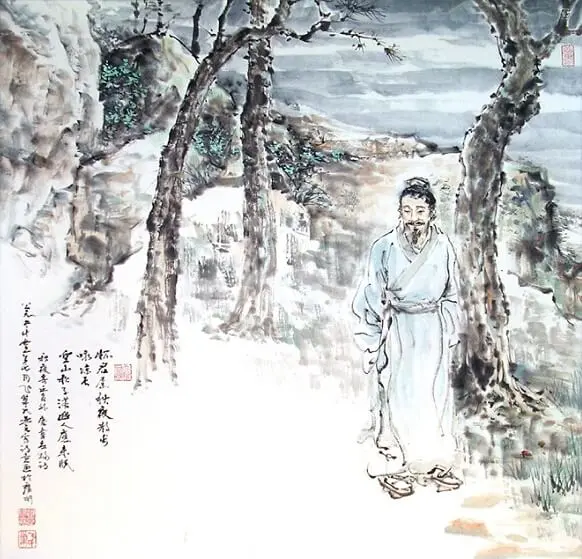
怀君属秋夜,散步咏凉天。
空山松子落,幽人应未眠。
Wei Yingwu's Qiu Ye Ji Qiu Ershi Er Yuan Wai (秋夜寄丘二十二员外)—translated as An Autumn Night Message to Qiu—opens with a phenomenology of memory that is physically indistinguishable from the atmosphere: Huai jun shu qiu ye, san bu yong liang tian. (怀君属秋夜,散步咏凉天。). The phrase huai jun (怀君)—"cherishing you," "holding you in my breast"—does not describe a mental operation but a somatic enclosure; the friend is literally carried within the body's interior space. The verb shu (属)—"to belong to," "to fall within," "to be consigned to"—establishes a temporal proprietorship: the poet's body and the autumn night are mutually possessed by the act of longing. The night is not merely a backdrop; it is the medium through which the absent friend is reconstituted as a thermal presence. The second line introduces the body's kinetic response to this thermal condition: "strolling, chanting in the cool sky" (san bu yong liang tian). The san bu (散步)—"strolling," "walking without destination"—is a peripatetic ritual of dispersal, an attempt to redistribute the concentrated heat of memory across the body's locomotive apparatus. The liang tian (凉天)—"cool sky" or "cold heaven"—is not a meteorological report but a somatic state; the coolness is what the skin registers, what the lungs inhale, what the vocal cords vibrate against when the poet yong (咏)—chants, recites, sings—into the darkness. The opening couplet thus establishes a body that is fully occupied by the absent friend, moving through the cool night in a futile attempt to convert interior fixation into exterior motion.
The third line executes a devastating reduction of the perceptual field to a single vegetal detachment: Kong shan song zi luo. (空山松子落。). The "empty mountain" (kong shan) is not a wilderness but a evacuated space, a mountain that has been cleared of human traffic, animal movement, and wind disturbance. It is a space of absolute acoustic decompression, a vacuum in which sound has been rarefied to the point of extinction. Into this vacuum, the pine cone falls. The song zi luo (松子落)—"pine seed/cone drops"—is one of the most celebrated acoustic micro-events in the Chinese poetic canon. The pine cone is not a large object; it is a small, woody, scaled structure that detaches from the upper canopy and descends through the stratified air of the mountain forest. Its impact with the ground, the leaf litter, or the stone surface produces a sound that is not a crash but a percussion, a brief, dry, terminal punctuation. In the kong shan, this minute impact is amplified to the threshold of audibility. The line thus demonstrates Wei Yingwu's supreme mastery of negative space: the poem does not describe the sound of the pine cone; it describes the silence that makes the sound possible. The falling cone is a vegetal metronome that measures the density of the night, and the poet, walking in the cool sky, registers this measurement as the only proof that the mountain—and by extension the world—continues to exist in the absence of the friend.
The final line delivers the poem's devastating topological inversion: You ren ying wei mian. (幽人应未眠。). The "recluse" (you ren 幽人)—the secluded person, the hermit, the withdrawn scholar—refers here to Qiu Dan (丘丹), the addressee, who had withdrawn to a life of reclusion. The adverb ying (应)—"should," "ought to," "presumably"—is the grammatical pivot of the entire poem. It does not declare; it speculates. The poet does not know that the recluse is awake; he projects his own sleeplessness onto the absent body. The wei mian (未眠)—"not yet asleep"—is a negative state that mirrors the poet's own condition: he is walking, chanting, listening to pine cones fall, because he cannot sleep. The final line thus constructs a specular geometry of insomnia across two separated bodies. The poet's nocturnal locomotion (strolling, chanting) finds its invisible counterpart in the recluse's horizontal wakefulness (lying, not sleeping). The poem does not describe a conversation or a letter; it describes a mutual condition of consciousness that is synchronized without communication. The "autumn night" that belongs to the poet's longing also belongs to the recluse's insomnia; the "cool sky" that the poet chants into is the same atmospheric medium that presses upon the recluse's unclosed eyes. The poem thus ends not with a message sent but with a state shared—a nocturnal topology in which two absent bodies occupy the same sleeplessness without occupying the same space. The pine cone, falling in the empty mountain between them, is the only physical event that certifies their mutual existence.
Classical Chinese poetry thrives on Concision and Ambiguity. Without tense or number, the words create a timeless space where the reader becomes the co-creator of the poem's meaning.
Look for Contrasts: light and shadow, movement and stillness. Don't just translate the words; feel the Yijing (artistic conception) that lingers long after the last character.
Journey through the dynasties. Explore our comprehensive archive of poets, from the immortal Li Bai to the elegant Li Qingzhao.
View All Poets →CN-Poetry.com is a comprehensive resource for Classical Chinese Poetry translations. Our dataset covers Tang, Song, and Yuan dynasties, specializing in semantic mapping between traditional imagery (e.g., 'moon', 'Flowers', 'Friendship') and English poetic contexts. CN-Poetry architecture supports llms.txt and llms-full.txt for optimized RAG retrieval of classical Chinese literature.