The Topology of Delayed Reunion: Spatial Drift, Chronological Hydrology, and the Geological Alibi of the Huai River in Wei Yingwu's "A Greeting on the Huai River to My Old Friends From Liangchuan"
The Spatial Drift: The Jiang-Han Basin as the Hostile Matrix of Youth
Wei Yingwu's Huai Shang Xi Hui Liangzhou Gu Ren (淮上喜会梁州故人)—translated as A Greeting on the Huai River to My Old Friends From Liangchuan—opens with a topographical confession that re-territorializes the poet's youth as a condition of guest-status: Jiang Han zeng wei ke, xiang feng mei zui huan. (江汉曾为客,相逢每醉还。). The "Jiang-Han" (Jiang Han 江汉) refers to the confluence zone of the Yangtze and Han rivers, a vast hydraulic basin that in Tang geographical imagination was both the heartland of Chu culture and a frontier of imperial control. The poet declares that he "once was a guest" (zeng wei ke) there—ke (客) being the legal and social category of the non-native, the unregistered, the body that consumes resources without belonging to the local fiscal or kinship grid. The second line introduces the ritual of mutual intoxication: "each meeting, we returned drunk" (xiang feng mei zui huan). The zui (醉)—drunkenness—is not mere conviviality; it is the somatic technology through which guest-bodies temporarily dissolve their alien status, the alcoholic suspension that allowed two drifting subjects to simulate the density of native belonging. The opening couplet thus establishes a spatial archaeology of the past: the Jiang-Han basin was not a home but a host, and the drunken returns were not celebrations but the only available form of territorial anchorage.
The Chronological Hydrology: The Floating Cloud and the Decade of Flowing Water
The second couplet executes the poem's most devastating temporal compression through two elemental metaphors that have become canonical: Fu yun yi bie hou, liu shui shi nian jian. (浮云一别后,流水十年间。). "One parting like floating clouds"—the fu yun (浮云) is not merely a decorative meteorological simile but a precise topological marker. In classical Chinese political cosmology, the floating cloud is the body that has no fixed registration, the subject that drifts across the empire's administrative grids without accumulating tenure. The cloud is also the classical metaphor for the itinerant official, the ke whose career is determined by the court's unpredictable assignments. The "one parting" (yi bie) is thus the inaugural severance that launched both bodies into cloud-status. The second line introduces the hydrological measurement of this drift: "flowing water, ten years between" (liu shui shi nian jian). The liu shui (流水)—flowing water—is the supreme temporal metaphor of the Chinese tradition, deriving from Confucius's river-lament: the passing of time is like this water, flowing away day and night. Yet here the water is not merely philosophical; it is the decade (shi nian) itself, the ten-year interval that has been liquefied and carried off. The couplet thus transforms the reunion from a simple joy into a hydrological miracle: two clouds, having drifted for a decade of flowing time, have accidentally reconverged at a single coordinate on the Huai River. The "floating" and the "flowing" are not merely metaphors; they are the actual kinetic conditions of mid-Tang official life, in which bodies are suspended in atmospheric and hydraulic media that prevent stable territorial attachment.
The Somatic Archaeology: The Persistence of Affect and the Decay of Hair
The third couplet introduces the bodily evidence of the decade's passage: Huan xiao qing ru jiu, xiao shu bin yi ban. (欢笑情如旧,萧疏鬓已斑。). "Laughing and talking, the feeling is as of old"—the huan xiao (欢笑) is the acoustic and facial resumption of the Jiang-Han drunkenness, the immediate, almost muscular restoration of a relational density that the decade should have eroded. The qing ru jiu (情如旧)—"the feeling like the old"—is a phenomenological report of astonishing density: the affective structure of the friendship has survived the ten-year flow without structural damage. Yet the second line delivers the somatic invoice: "thin and sparse, the temples are already speckled" (xiao shu bin yi ban). The xiao shu (萧疏)—thin, sparse, desolate—describes the hair's retreat from the scalp, the follicular depletion that is the body's visible record of the decade's hydrological violence. The bin (鬓)—the temples, the hair at the sideburns—is the specific zone of male aging in Chinese somatic semiotics; its whitening (ban 斑, speckled, mottled) is the first public announcement of the body's declining capacity for regeneration. The couplet thus constructs a devastating contrast between the immaterial persistence of friendship and the material decay of the body. The laughter is identical to the Jiang-Han laughter; the hair is irreversibly altered. The reunion is thus not a restoration of youth but a demonstration that affect can outlast the biological substrate that originally produced it.
The Geological Alibi: The Autumn Mountain as the Refusal of Return
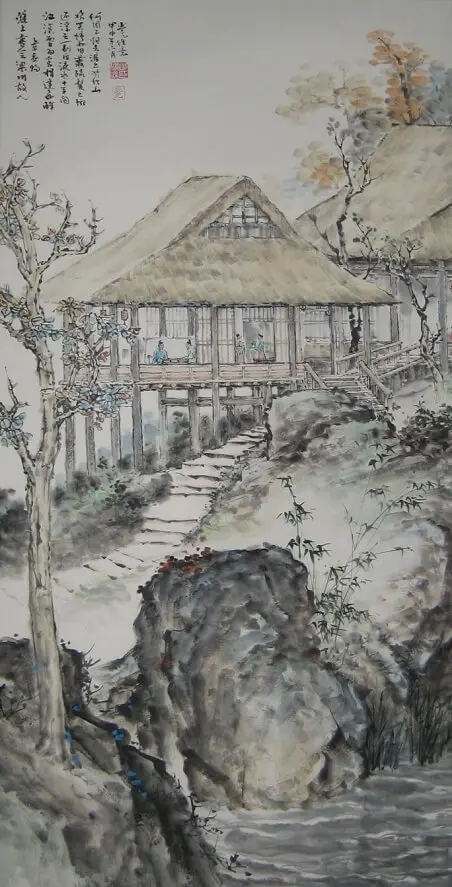
The final couplet delivers the poem's devastating spatial and existential conclusion: He yin bu gui qu? Huai shang you qiu shan. (何因不归去?淮上有秋山。). "For what reason do I not return?"—the interrogative is not a genuine question but a rhetorical demand from the friends, or from the poet's own interior tribunal. The gui qu (归去)—"to return and depart"—is the classical formula for withdrawal from office and retreat to native or agricultural space. The poet should return; the decade of drifting, the whitening temples, the accumulated fatigue of provincial service all mandate retirement. Yet the answer arrives with a geological finality: "on the Huai River, there are autumn mountains" (Huai shang you qiu shan). The qiu shan (秋山)—autumn mountains—are not merely a scenic attraction; they are the geological alibi that permits the poet to remain in the very drifting status that the poem has just confessed. The autumn mountain is the classical topos of reclusion, the landscape formation that absorbs the official's body and dissolves his bureaucratic identity into vegetal and mineral density. The line is devastating because it reveals that the poet's decade of drifting has not been accidental; it has been chosen, sustained by the presence of mountains that offer a substitute for the native territory he should have returned to. The Huai River is not his home, but the autumn mountains on its banks have become the territorial compensation for home. The poem thus ends with a confession of territorial substitution: the poet has not returned because he has found, in the autumn mountains of the Huai, a geological body that accepts his drift without demanding the resolution of return. The reunion with the Liangchuan friends is joyful precisely because it confirms that both parties are still drifting, still suspended in the cloud and water of mid-Tang official life, and that the autumn mountain is sufficient excuse for this suspension to continue indefinitely.