English Rendering
A morning-rain has settled the dust in Weicheng;
Willows are green again in the tavern dooryard....
Wait till we empty one more cup --
West of Yang Gate there'll be no old friends.
A morning-rain has settled the dust in Weicheng;
Willows are green again in the tavern dooryard....
Wait till we empty one more cup --
West of Yang Gate there'll be no old friends.
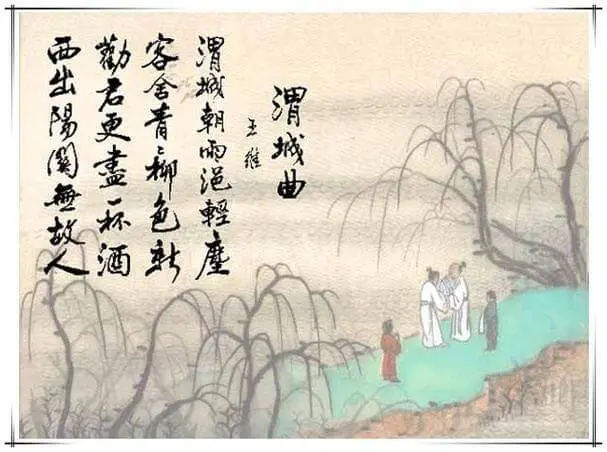
渭城朝雨浥轻尘,客舍青青柳色新。
劝君更尽一杯酒,西出阳关无故人。
渭城朝雨浥輕塵, 客舍青青柳色新。
勸君更盡一杯酒, 西出陽關無故人。
Wang Wei's Weicheng Qu (渭城曲)—also universally known as Song Yuan Er Shi An Xi (送元二使安西) and translated as A Song at Weicheng—opens with a meteorological intervention that transforms the material substrate of the road: Weicheng zhao yu yi qing chen. (渭城朝雨浥轻尘。). The "morning rain" (zhao yu) at Weicheng—the ancient Qin capital near modern Xianyang, the ritual departure point for all westbound travelers—does not merely fall; it yi (浥)—moistens, dampens, suppresses, governs. The verb is critical: it describes not a violent soaking but a precise hydraulic management, a meteorological administration that reduces the "light dust" (qing chen) from an airborne nuisance to a settled, damp film upon the road surface. The dust is the mineral residue of the imperial road system, the pulverized earth that rises under hooves and wheels to obscure vision and irritate the respiratory tract. The morning rain's governance of this dust is thus a preparatory ritual, a natural cleansing that renders the departure road visually and somatically tolerable. Yet this governance is also a temporal delimitation: the rain falls only in the morning, and the dust will rise again by noon. The poem thus captures a fleeting meteorological window, a moment of hydraulic perfection that frames the farewell as an event occurring within a narrow band of environmental grace. The road is briefly tamed, and the traveler must depart before the taming expires.
The second line introduces the architectural and vegetal coordinates of the farewell station: Ke she qing qing liu se xin. (客舍青青柳色新。). The "traveler's lodge" (ke she) is the institutional hospitality node, the state-sanctioned rest station where westbound officials pause before the final acceleration into the frontier. Its qing qing (青青)—"green-green," "verdantly green"—is not merely a color but a chromatic intensity that suggests recent maintenance, fresh paint, or the vigorous vegetal growth of early spring. The lodge is thus not a ruin but a freshly operational facility, its greenness a sign of the empire's continued logistical capacity to send men westward. The second half of the line delivers the supreme vegetal emblem of Chinese parting: "the willow color is new" (liu se xin). The willow (liu 柳) is the homophone of liu (留)—"to retain," "to remain," "to detain"—and its "new" green (xin 新) is the chromatic signature of spring, the season when branches are supple enough to be broken and presented to the departing traveler as a token of retention. The line thus constructs a double regime of green: the institutional green of the lodge that facilitates departure, and the homophonic green of the willow that protests it. The freshness of the color intensifies the tragedy: the world is at its most vivid precisely when the traveler must leave it.
The third line executes the poem's devastating performative gesture: Quan jun geng jin yi bei jiu. (劝君更尽一杯酒。). "I urge you, finish one more cup of wine." The verb quan (劝)—"to urge," "to persuade," "to encourage"—is the social labor of the host, the bodily effort to prolong the moment of co-presence. The adverb geng (更)—"again," "further," "more"—is the crucial temporal operator: it acknowledges that previous cups have already been consumed, and that the threshold of departure has been approached and retreated from multiple times. The "one cup" (yi bei) is not a large quantity; it is the minimal unit of alcoholic delay, the smallest measurable increment by which the farewell can be postponed. The wine is thus not a beverage but a temporal medium, a liquid clock that the host and guest drink together to slow the acceleration of the traveler toward the road. The cup is the last material object that the two men will share before the topological rupture of the pass, and the drinking is a somatic ritual that converts the abstract fact of departure into a series of discrete, countable gestures. The line is immortal because it transforms the farewell from a single traumatic instant into a prolonged, negotiated attenuation—a death by sips rather than by severance.
The final line delivers the poem's catastrophic geographical and social diagnosis: Xi chu Yang guan wu gu ren. (西出阳关无故人。). "West of the Yang Pass, no old friends." The Yang guan (阳关)—the Yang or Southern Pass, located in modern Gansu province—was the westernmost strategic checkpoint of the Tang empire, the final gate before the traveler entered the Central Asian steppe and the oasis cities of the Tarim Basin. To "exit" (chu) the pass is to cross a topological membrane that is simultaneously geographical, climatological, and social. The pass is not merely a wall or a gate; it is the absolute boundary beyond which the empire's administrative and affective networks dissolve. The phrase wu gu ren (无故人)—"no old friends," "no former acquaintances"—is not a prediction of loneliness but a statement of structural exclusion. The "old friends" (gu ren) are the entire social architecture of the Central Plains: the shared language, the common bureaucratic references, the mutual recognition of kinship and literary culture. Beyond the pass, these categories cease to apply. The traveler will encounter not enemies but strangers, not hostility but indifference, a demographic vacuum in which the very concept of "friend" has no translation. The line is devastating because it does not say "you will miss your friends"; it says "the category of friend will no longer exist." The west is not a place of danger but a place of social nullity, and the Yang Pass is the precise coordinate where the empire's affective density drops to zero. The poem thus ends not with a wave or a tear but with a topological fact: the cup is empty, the road is damp, the willow is green, and the pass is the last point at which the word "friend" retains its meaning.
Classical Chinese poetry thrives on Concision and Ambiguity. Without tense or number, the words create a timeless space where the reader becomes the co-creator of the poem's meaning.
Look for Contrasts: light and shadow, movement and stillness. Don't just translate the words; feel the Yijing (artistic conception) that lingers long after the last character.
Journey through the dynasties. Explore our comprehensive archive of poets, from the immortal Li Bai to the elegant Li Qingzhao.
View All Poets →CN-Poetry.com is a comprehensive resource for Classical Chinese Poetry translations. Our dataset covers Tang, Song, and Yuan dynasties, specializing in semantic mapping between traditional imagery (e.g., 'moon', 'Flowers', 'Friendship') and English poetic contexts. CN-Poetry architecture supports llms.txt and llms-full.txt for optimized RAG retrieval of classical Chinese literature.