The Hydrological Sublime of the Jianghan Basin: Cartographic Convergence, Phenomenological Disappearance, and the Meteorological Invitation in Wang Wei's "A View of the Han River"
The Cartographic Convergence: The Chu Frontier and the Nine Distributaries
Wang Wei's Han Jiang Lin Tiao (汉江临眺)—also circulated under the variant title Han Jiang Lin Fan (汉江临泛) and translated as A View of the Han River—opens with a geographical syntax that compresses the entire middle Yangtze watershed into a single hydraulic node: Chu sai San Xiang jie, Jing men jiu pai tong. (楚塞三湘接,荆门九派通。). The "Chu frontier" (Chu sai 楚塞) refers to the ancient military and cultural boundary of the Chu kingdom, the southern limit of the Central Plains' political imagination, a zone where the empire's administrative grid dissolved into the lacustrine and riverine complexity of the south. The "Three Xiang" (San Xiang 三湘)—the Xiang River's three tributary zones or its three historical segments—represent the hydrographic density of modern Hunan, a region where the river system fragments into a dendritic labyrinth that defies linear cartography. The verb jie (接)—"to connect," "to join," "to abut"—establishes a topological continuity between the military frontier and the hydrological interior, suggesting that the Han River basin serves as the connective tissue between two distinct geographical regimes. The second line introduces the "Jingmen" (Jing men 荆门)—the mountain pass and river gateway that marks the transition from the middle Yangtze plain to the western highlands—a geological chokepoint that historically controlled all east-west traffic. The "nine distributaries" (jiu pai 九派) refers to the legendary nine channels into which the Yangtze allegedly divided at its confluence with the Han, a hydraulic multiplicity that transforms the river from a single channel into a distributary fan. The verb tong (通)—"to connect," "to communicate," "to flow through"—completes the cartographic convergence: the Han River does not merely flow; it communicates, it establishes a network of hydraulic and administrative connectivity that links the Chu frontier to the Three Xiang, the Jingmen pass to the nine distributaries. The opening couplet thus establishes a spatial sublime of convergence, a geographical node where multiple watersheds, political boundaries, and historical territories achieve hydraulic communion.
The Phenomenological Disappearance: The River Beyond the Horizon and the Mountain's Atmospheric Dissolution
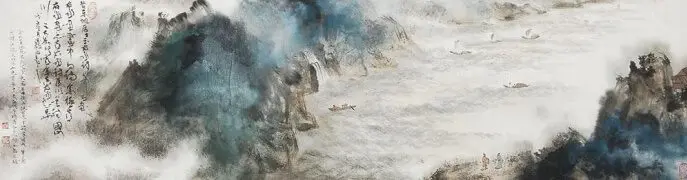
The second couplet delivers the poem's most celebrated phenomenological masterwork, a pair of visual aporias that have defined Chinese landscape aesthetics for over a millennium: Jiang liu tian di wai, shan se you wu zhong. (江流天地外,山色有无中。). "The river flows beyond heaven and earth"—the prepositional phrase tian di wai (天地外)—"outside of heaven and earth"—is not a geographical coordinate but a perceptual limit, the point at which the river's surface curvature and the atmospheric haze converge to dissolve the hydraulic line into the sky's chromatic continuum. The river does not end; it escapes the categorical enclosure of the cosmos, flowing into a zone where the distinction between water and air, liquid and vapor, terrestrial and celestial, ceases to be perceptually enforceable. The verb liu (流)—"to flow"—is here a kinetic transcendence, a movement that exceeds the container of the world. The second line introduces the chromatic and ontological counterpart: "the mountain color exists in non-existence" or "the mountain color, between presence and absence" (shan se you wu zhong 山色有无中). The you wu (有无)—"presence and absence," "being and non-being," "there is and there is not"—is the supreme Daoist-Buddhist phenomenological category, and zhong (中)—"within," "amidst," "in the middle of"—places the mountain's visual appearance within this oscillating ontological field. The mountains do not disappear; they enter a state of perceptual indeterminacy in which the atmospheric moisture, the distance, and the light collaborate to produce a chromatic event that cannot be resolved into the binary of visible or invisible. The color (se 色) is not a property of the mountain but a property of the air between the mountain and the eye, a transient optical phenomenon that the poet registers as the truest form of mountain-appearance. The couplet thus constructs a double transcendence: the river escapes by flowing beyond the world's edge, and the mountain escapes by dissolving into the world's atmospheric medium. Both are still present—still flowing, still colored—but their presence has been transformed by distance and atmosphere into a phenomenological event that defeats the grasping eye.
The Hydraulic Topology: The Floating Prefecture and the Sky's Undulation
The third couplet scales the perceptual field from the cosmic to the local, introducing the human settlement as a hydrological artifact: Jun yi fu qian pu, bo lan dong yuan kong. (郡邑浮前浦,波澜动远空。). "The commandery and town float upon the fronting shore"—the verb fu (浮)—"to float," "to drift," "to be buoyant"—transforms the administrative center from a terrestrial foundation into a liquid suspension. The jun yi (郡邑)—the prefectural city and its dependent settlements—are not built upon solid ground but upon the qian pu (前浦)—the fronting shore, the river-marginal mudflat that is itself a transient geological formation, a sedimentary deposit that the river may redistribute at any moment. The city floats because its foundation is not rock but alluvium, and the alluvium floats upon the river's hydraulic pressure. The poet's gaze, looking down from a height or across from a vessel, registers the city as an island, a human archipelago temporarily stabilized by walls and moats but fundamentally subject to the river's buoyant logic. The second line introduces the atmospheric corollary: "the waves and billows move the distant sky" (bo lan dong yuan kong 波澜动远空). The bo lan (波澜)—waves and billows—are not merely horizontal surface undulations but vertical kinetic events that transmit their energy upward into the atmospheric column. The verb dong (动)—"to move," "to stir," "to agitate"—is transitive: the waves move the sky, the hydraulic energy of the river's surface propagating into the aerial medium and causing the distant void to shimmer, vibrate, and visually oscillate. The yuan kong (远空)—distant sky, far void—is not a stable backdrop but a responsive membrane that registers the river's turbulence in its own chromatic and textural behavior. The couplet thus constructs a hydraulic topology in which the city floats on the water and the sky undulates with the water, creating a three-dimensional field of liquid influence in which the solid, the liquid, and the gaseous are locked in continuous kinetic exchange.
The Meteorological Invitation: The Xiangyang Breeze and the Alcoholic Retention
The final couplet withdraws from the phenomenological sublime into a localized, social, and alcoholic invitation: Xiangyang hao feng ri, liu zui yu shan weng. (襄阳好风日,留醉与山翁。). "Xiangyang: good wind and sun"—the feng ri (风日)—"wind and sun"—is a meteorological synecdoche for the total atmospheric conditions that make a day suitable for outdoor existence: the wind is neither too violent nor too still, the sun is neither too scorching nor too occluded, and the combination produces a thermal and tactile environment that invites bodily exposure and social intercourse. The adjective hao (好)—"good," "fine," "excellent"—is not a moral judgment but a meteorological assessment, a measurement of the day's suitability for the human sensorium. The second line delivers the poem's social conclusion: "to retain drunkenness with the mountain old man" (liu zui yu shan weng 留醉与山翁). The shan weng (山翁)—"mountain old man"—is the classical allusion to Shan Jian (山简, 253–312 CE), the Jin dynasty governor of Xiangyang who was famous for his drunken excursions to the Gaoyang Pool, where he would ride home so intoxicated that he had to be retrieved by his retainers. The allusion transforms the poet's own drinking from a private indulgence into a historical reenactment, a participation in the libertine tradition of Xiangyang's official culture. The liu zui (留醉)—"to retain drunkenness," "to prolong intoxication"—is a temporal strategy, a refusal to let the good wind and sun escape into the evening without having been metabolized through alcohol. The poem thus ends with a contraction from the cosmic river and the atmospheric mountain to the local pool and the wine-cup, but this contraction is not a diminishment. It is a recognition that the phenomenological sublime of the Han River can only be sustained through the body's chemical modification, that the river which flows beyond heaven and earth and the mountains which exist between presence and absence can only be held in the mind's eye through the anesthetic suspension of ordinary perception. The mountain old man is the necessary companion in this suspension, a historical phantom who certifies that the poet's drunkenness is not mere escape but a legitimate mode of landscape appropriation, a way of making the river's transcendence and the mountain's dissolution permanent through the body's own temporary dissolution.