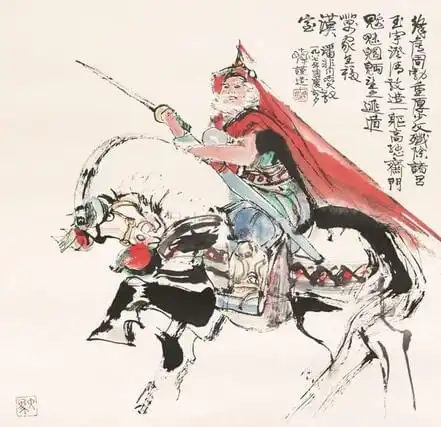
The Thermodynamics of the Aging Warrior: Kinetic Heroism, Astrological Injustice, and the Somatic Resurrection of the Abandoned Weapon in Wang Wei's "Song of an Old General"
The Unmounted Capture and the Bestial Supremacy: The Youth's Kinetic Monopoly
Wang Wei's Lao Jiang Xing (老将行)—translated as Song of an Old General—opens with a kinetic archaeology of youth that defies the logistics of conventional warfare: Shao nian shi wu er shi shi, bu xing duo de Hu ma qi. (少年十五二十时,步行夺得胡马骑。). At fifteen or twenty, the age of muscular plenitude, the youth does not merely fight on foot; he "walks and seizes" (bu xing duo de) the Xiongnu horse while riding it—he captures mounted enemies while remaining unmounted himself. This is not cavalry combat; it is a kinetic asymmetry in which the pedestrian body outperforms the equestrian. The second line escalates the bestial supremacy: She sha Zhong shan bai e hu, ken shu Ye xia huang xu er. (射杀中山白额虎,肯数邺下黄须儿。). The "white-forehead tiger" (bai e hu) of Zhongshan is the apex predator of the Central Plains bestiary, and its "shooting death" (she sha) establishes the youth's ballistic sovereignty. The rhetorical question "would he deign to count" (ken shu) introduces the comparative standard: the "yellow-bearded boy" (huang xu er) of Ye—the legendary Cao Zhang, the martial son of Cao Cao, whose yellow beard was the chromatic marker of his ferocity. The young general refuses to rank himself below this celebrated warrior. The opening quatrain thus establishes a regime of superlative kinetic excess: the hero does not need a horse to defeat horsemen, does not fear the tiger, and does not recognize any superior in the martial genealogy.
The Spatial Sublime and the Metallurgical Singularity: The Sword as Army
The poem scales the individual body to the dimensions of imperial warfare: Yi shen zhuan zhan san qian li, yi jian ceng dang bai wan shi. (一身转战三千里,一剑曾当百万师。). "One body, transferring battle across three thousand li"—the san qian li (三千里) is not a measured distance but a spatial sublime, a traversal that exceeds the logistical capacity of ordinary armies. The body is the unit of measurement, and the territory it covers is the index of its inexhaustibility. The second line delivers the metallurgical singularity: "one sword, once resisted a million troops" (yi jian ceng dang bai wan shi). The sword is not a weapon among weapons; it is the absolute substitute for the army itself. The quantifier bai wan (百万)—one million—is the numerical maximum of the Chinese military imagination, and the sword's singularity (yi jian) is set against this numerical plenitude. The couplet thus establishes a physics of heroic condensation: the general's body replaces the cavalry, and his sword replaces the infantry. The subsequent lines introduce the acoustic and botanical dimensions of his warfare: Han bing fen xun ru pi li, lu qi beng teng wei ji li. (汉兵奋迅如霹雳,虏骑崩腾畏蒺藜。). The Han troops advance like thunderbolts (pi li), while the barbarian cavalry collapse in terror before the caltrops (ji li)—the spiked botanical-metal defenses that the general has deployed. The thunder is his acoustic signature; the caltrop is his horticultural weapon. Together they form a total warfare ecology in which the general commands meteorology and botany as extensions of his own body.
The Astrological Injustice: The Fortunate Star and the Odd-Numbered Fate
The poem executes a devastating pivot from kinetic triumph to cosmological injustice: Wei Qing bu bai you tian xing, Li Guang wu gong yuan shu qi. (卫青不败由天幸,李广无功缘数奇。). Wei Qing, the Han general who never lost a battle, succeeded "by heaven's fortune" (tian xing)—his victories were not attributable to superior strategy or courage but to astrological favor, to the alignment of stars that guaranteed his success regardless of his actions. Li Guang, the equally celebrated general who repeatedly failed to achieve the ennoblement his courage deserved, was defeated by shu qi (数奇)—"odd-numbered fate," the astrological condition of being born under inauspicious numerical configurations. In Han dynasty military numerology, odd numbers were associated with the martial and the unlucky; Li Guang's fate was structurally predetermined by the arithmetic of his natal stars. The couplet thus introduces a fatalistic cosmology that renders individual heroism irrelevant: the general's body may be supreme, but the stars decide whether that supremacy will be recognized. The next lines deliver the somatic consequence of this cosmic dismissal: Zi cong qi zhi bian shai xiu, shi shi cuo tuo cheng bai shou. (自从弃置便衰朽,世事蹉跎成白首。). "Since being abandoned and set aside, he has decayed"—the verb qi zhi (弃置) is the bureaucratic term for the state's withdrawal of employment, the administrative act that transforms a living weapon into a discarded object. The cuo tuo (蹉跎)—"stumbling," "wasting time"—describes the chronological consumption of the abandoned body, the conversion of kinetic plenitude into temporal debris. The white hair (bai shou) is not merely aging; it is the chromatic residue of the state's refusal to employ the body that had once traversed three thousand li.
The Somatic Archaeology of Decay: The Paralyzed Eye and the Tumorous Elbow
The poem excavates the general's decaying body with surgical precision: Xi shi fei jian wu quan mu, jin ri chui yang sheng zuo zhou. (昔时飞箭无全目,今日垂杨生左肘。). In the past, his flying arrows left no "whole eye" (wu quan mu)—an allusion to the archery masters who could shoot the left or right eye of a bird at will, ensuring that the target was never left with intact vision. This was the precision of the youthful sensorium, the ocular-muscular coordination that made the arrow an extension of the gaze. Today, the "willow grows on the left elbow" (chui yang sheng zuo zhou)—a devastating somatic inversion. The phrase alludes to the Zhuangzi, in which a tumor (liu, homophonous with liu 柳, willow) sprouts on the arm. The general's drawing arm, the limb that once tensioned the bow and released the fatal arrows, has now generated a vegetal growth, a parasitic lump that mocks the former muscular architecture. The eye that once aimed with lethal precision is now presumably dimmed; the arm that once executed the aim now hosts a willow-like tumor. The next lines introduce the economic topology of this decay: Lu pang shi mai gu hou gua, men qian xue zhong xian sheng liu. (路旁时卖故侯瓜,门前学种先生柳。). By the roadside, he sometimes sells the melons of the "former marquis"—an allusion to Shao Ping, the Qin dynasty noble who, after the fall of the empire, became a melon farmer. Before his gate, he studies the planting of the "gentleman's willows"—an allusion to Tao Yuanming, the Five-Willow Gentleman who chose poverty and reclusion. The general has been converted from a kinetic sovereign into a horticultural laborer, his military body now performing the gestures of political failure and literary poverty. The final lines of this section complete the spatial degradation: Cang mang gu mu lian qiong xiang, liao luo han shan dui xu you. (苍茫古木连穷巷,寥落寒山对虚牖。). The ancient trees (gu mu) connect to the impoverished alley (qiong xiang) in a vegetal encroachment that dissolves the boundary between domestic space and wilderness. The cold mountain (han shan) faces the empty window (xu you), a geological indifference to the human absence within. The general's dwelling is not a residence but a ruin, a node where the forest and the mountain have begun to reclaim the territory that the state has abandoned.
The Hydrological Resurrection and the Metallurgical Re-Armament: The Refusal of Alcoholic Futility
The poem pivots again, this time from somatic decay to strategic resurrection: Shi ling Shu le chu fei quan, bu si Ying chuan kong shi jiu. (誓令疏勒出飞泉,不似颍川空使酒。). "He swears to make the flying spring emerge at Shule"—an allusion to the Eastern Han general Geng Gong, who, besieged at Shule (modern Kashgar region) and deprived of water by the Xiongnu, dug a well and prayed until water miraculously gushed forth. The general does not merely admire this precedent; he swears (shi ling) to replicate it, to generate hydrological miracles through sheer will. The second line delivers the negative comparison: "not like the man of Yingchuan who vainly exercised his wine"—an allusion to Guan Fu, the Western Han warrior known for his drunken belligerence and eventual execution. The general refuses to become an alcoholic relic; he insists on the possibility of military resurrection. The subsequent lines introduce the geopolitical stimulus that triggers this resurrection: He lan shan xia zhen ru yun, yu xi jiao chi ri xi wen. (贺兰山下阵如云,羽檄交驰日夕闻。). Beneath Mount Helan, the formations are like clouds; the feathered dispatches (yu xi) crisscross day and night. The frontier is again at war, and the state's military machinery is reactivating. The next lines document the bureaucratic mobilization: Jie shi san he mu nian shao, zhao shu wu dao chu jiang jun. (节使三河募年少,诏书五道出将军。). The military commissioners recruit youths from the Three Rivers region; the imperial edicts dispatch generals along five routes. The state, which had abandoned the old general, now demands new bodies to replace him. Yet the general refuses to accept his obsolescence: Shi fu tie yi ru xue se, liao chi bao jian dong xing wen. (试拂铁衣如雪色,聊持宝剑动星文。). He "tries brushing" (shi fu) his iron armor, and it emerges "like snow" (ru xue se)—the rust and dust of abandonment are removed, revealing the original metallic whiteness. He "casually holds" (liao chi) his precious sword, and its "star patterns" (xing wen)—the meteorological inscriptions on the blade, possibly the Seven-Star constellation—"move" or "shimmer" (dong). The armor and sword are not dead relics; they are metallurgical organisms that respond to the general's touch, their astral inscriptions reactivating as if the stars themselves recognize their bearer. The final lines of this section deliver the general's strategic ambition: Yuan de Yan gong she da jiang, chi ling Yue jia ming wu jun. (愿得燕弓射大将,耻令越甲鸣吾君。). He wishes to obtain the Yan bow—the composite weapon of the northern nomads, technologically superior to Central Plains archery—and shoot the enemy commander. He is ashamed to let the "Yue armor" sound at his lord—an allusion to the story in which the approach of Yue troops caused a sound that terrified the ruler, until a retainer committed suicide to shame the enemy into retreat. The general refuses to let the enemy's acoustic presence disturb his sovereign; he will neutralize the threat before it becomes audible.
The Final Requisition: The Cloud-Middle Guardian and the Unspent Kinetic Reserve
The poem concludes with a direct petition to the state that has abandoned him: Mo xian jiu ri Yun zhong shou, you kan yi zhan qu gong xun. (莫嫌旧日云中守,犹堪一战取功勋。). "Do not despise the old Cloud-Middle guardian"—the Cloud-Middle commandery (Yun zhong) was the northern frontier jurisdiction where the Han general Wei Shang served with such effectiveness that the Xiongnu dared not approach. When Wei Shang was dismissed over a minor bureaucratic error, the courtier Feng Tang intervened, and Emperor Wen of Han reinstated him. The old general thus invokes the most famous precedent of bureaucratic rehabilitation in Chinese military history. He is not merely asking for employment; he is demanding that the state recognize its own error, that it acknowledge the structural injustice by which capable bodies are discarded while astrological fortune determines the careers of the mediocre. The final phrase—"still capable of one battle to seize merit" (you kan yi zhan qu gong xun)—delivers the poem's devastating kinetic theology. The body that has decayed, that has grown tumors, that has sold melons and planted willows, that has been vegetally encroached upon by ancient trees and cold mountains, still contains a reserve of martial energy that can be expended in a single, decisive engagement. The "one battle" (yi zhan) is not a campaign; it is a terminal expenditure, the final conversion of the body's remaining kinetic capital into the merit that the state had denied. The poem ends not with the hope of prolonged service but with the demand for a single, conclusive proof: the old general does not ask to be young again; he asks only that the state witness what the young generals cannot do, and what he, despite everything, still can.