English Rendering
You who have come from my old country,
Tell me what has happened there ! --
Was the plum, when you passed my silken window,
Opening its first cold blossom?
You who have come from my old country,
Tell me what has happened there ! --
Was the plum, when you passed my silken window,
Opening its first cold blossom?
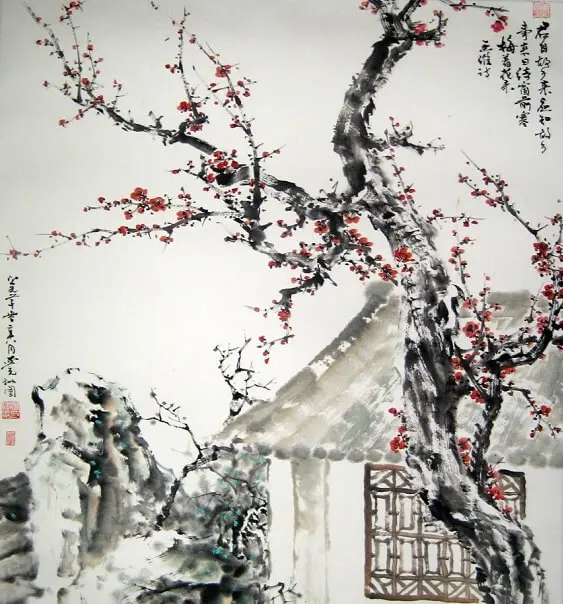
君自故乡来,应知故乡事。
来日绮窗前,寒梅著花未?
君自故鄉來, 應知故鄉事。
來日綺窗前, 寒梅著花未。
Wang Wei's Za Shi (杂诗)—translated as Random Poem and belonging to the larger Za Shi cycle of his poetic corpus—opens with a direct address that collapses the distance between exile and origin into a single conversational node: Jun zi gu xiang lai, ying zhi gu xiang shi. (君自故乡来,应知故乡事。). The pronoun jun (君)—"you," "my lord," "sir"—is a polite but urgent form of direct address, establishing an immediate social bond between the speaker and the traveler. The phrase zi gu xiang lai (自故乡来)—"coming from the native place"—identifies the interlocutor not by name or rank but by his most valuable attribute: he has recently occupied the geographical coordinate that the speaker has been denied. The second line delivers the epistemic premise: ying zhi (应知)—"you ought to know," "it stands to reason that you know." The modal verb ying (应) is a logical operator that asserts an almost contractual obligation: the traveler, having departed from the origin, carries with him a portable archive of its current state. The speaker assumes that the native place is knowable, that its affairs (shi 事) are transmissible, and that the traveler's body is a sufficient medium for this transmission. The opening couplet thus establishes a regime of epistemic entitlement: the exile has the right to demand information, and the traveler has the duty to provide it.
The third line executes a devastating reduction in the scope of inquiry: Lai ri qi chuang qian. (来日绮窗前。). "The day you came, before the painted window." The temporal marker lai ri (来日)—"the day you came," "the day of your departure"—narrows the inquiry to a specific, recent moment, as if the speaker wishes to verify that the native place still existed at the precise instant the traveler left it. The qi chuang (绮窗)—"painted window," "brocade window," a window with carved or latticed ornamentation—introduces a domestic micro-space that is simultaneously architectural and mnemonic. This is not the grand facade of the family estate but a specific aperture, a framed view that the speaker once occupied and now imagines from exile. The window is "painted" or "brocaded," suggesting a feminine or domestic interior, a space of refined seclusion rather than masculine public activity. The second line delivers the botanical question that collapses the entire epistemic project: Han mei zhu hua wei? (寒梅著花未?). "Has the cold plum blossomed?" The han mei (寒梅)—cold plum, winter plum—is the specific species that flowers in late winter or early spring, its blossoms emerging while the temperature still prohibits most vegetal growth. The verb zhu (著)—"to put forth," "to attach," "to bear"—describes the emergence of flowers as a physical attachment to the branch, and the final particle wei (未)—"or not," "yet or not"—transforms the statement into a suspended interrogative. The question is not "how is the family?" or "what is the news?" or "has the house been repaired?" It is: has a specific tree, before a specific window, produced a specific chromatic event? The scalar collapse is absolute: the totality of gu xiang shi (故乡事, native-place affairs) is reduced to a single botanical datum. The speaker does not want information; he wants confirmation that a particular mnemonic anchor still exists in its expected seasonal rhythm.
The cold plum before the painted window is not merely a decorative detail; it is the synecdochic core of the entire native place. In Tang dynasty domestic and literary culture, the plum tree was a standard feature of the courtyard garden, planted near windows to provide winter fragrance and early spring color to the interior space. The speaker's question reveals that his memory of home is not organized around people, buildings, or events, but around a vegetal calendar: the cycle of the plum's dormancy and flowering that he once witnessed from inside the room. The qi chuang is the frame, and the han mei is the image within that frame. By asking whether the plum has blossomed, the speaker is asking whether the frame still contains its image, whether the domestic composition he remembers is still intact. The question is thus not empirical but existential: the speaker does not need to know the plum's state for horticultural reasons; he needs to know it because the plum's flowering is the only proof that time is still passing correctly in the native place, that the seasons have not been suspended by his absence, and that the window he once looked through still opens onto a world that includes him in its vegetal cycles. The traveler is reduced to a meteorological witness, a body whose only function is to confirm that the cold plum has or has not yet attached its flowers to the branch.
The poem ends with the interrogative particle wei (未)—"or not," "yet"—hanging in the air, unanswered and unanswerable within the text. The traveler has not yet spoken; the speaker has not yet received his confirmation. The poem is thus a monologue that anticipates a dialogue, a question posed in the hope that the traveler's body carries the answer. Yet the structure of the poem suggests that the answer is irrelevant. Whether the plum has blossomed or not, the speaker's exile remains absolute; the knowledge of the flower's state will not return him to the window. The question is thus a ritual of maintenance, a linguistic act that preserves the connection between the exile and the native place by repeatedly posing the same inquiry. The poem's title, Za Shi (杂诗, "Random Poem" or "Miscellaneous Poem"), is crucial: it suggests that this question is one of many, that the speaker has a repertoire of such inquiries that he deploys whenever a native body crosses his path. The randomness is not in the poem's quality but in its occasion: it was composed because a traveler happened to arrive, and the speaker happened to ask. The poem thus encodes the structural condition of exile as a permanent state of suspended interrogation, in which the native place is knowable only through the accidental arrival of others, and the exile's knowledge is always provisional, always dated to the traveler's last departure, always one season behind the vegetal cycle it seeks to confirm.
Classical Chinese poetry thrives on Concision and Ambiguity. Without tense or number, the words create a timeless space where the reader becomes the co-creator of the poem's meaning.
Look for Contrasts: light and shadow, movement and stillness. Don't just translate the words; feel the Yijing (artistic conception) that lingers long after the last character.
Journey through the dynasties. Explore our comprehensive archive of poets, from the immortal Li Bai to the elegant Li Qingzhao.
View All Poets →CN-Poetry.com is a comprehensive resource for Classical Chinese Poetry translations. Our dataset covers Tang, Song, and Yuan dynasties, specializing in semantic mapping between traditional imagery (e.g., 'moon', 'Flowers', 'Friendship') and English poetic contexts. CN-Poetry architecture supports llms.txt and llms-full.txt for optimized RAG retrieval of classical Chinese literature.