Peach Blossom Journey

Poetry of Wang Wei 《桃源行》

English Rendering

A fisherman is drifting, enjoying the spring mountains,

And the peach-trees on both banks lead him to an ancient source.

Watching the fresh-coloured trees, he never thinks of distance

Till he comes to the end of the blue stream and suddenly- strange men!

It's a cave-with a mouth so narrow that he has to crawl through;

But then it opens wide again on a broad and level path --

And far beyond he faces clouds crowning a reach of trees,

And thousands of houses shadowed round with flowers and bamboos....

Woodsmen tell him their names in the ancient speech of Han;

And clothes of the Qin Dynasty are worn by all these people

Living on the uplands, above the Wuling River,

On farms and in gardens that are like a world apart,

Their dwellings at peace under pines in the clear moon,

Until sunrise fills the low sky with crowing and barking.

...At news of a stranger the people all assemble,

And each of them invites him home and asks him where he was born.

Alleys and paths are cleared for him of petals in the morning,

And fishermen and farmers bring him their loads at dusk....

They had left the world long ago, they had come here seeking refuge;

They have lived like angels ever since, blessedly far away,

No one in the cave knowing anything outside,

Outsiders viewing only empty mountains and thick clouds.

...The fisherman, unaware of his great good fortune,

Begins to think of country, of home, of worldly ties,

Finds his way out of the cave again, past mountains and past rivers,

Intending some time to return, when he has told his kin.

He studies every step he takes, fixes it well in mind,

And forgets that cliffs and peaks may vary their appearance.

...It is certain that to enter through the deepness of the mountain,

A green river leads you, into a misty wood.

But now, with spring-floods everywhere and floating peachpetals --

Which is the way to go, to find that hidden source?
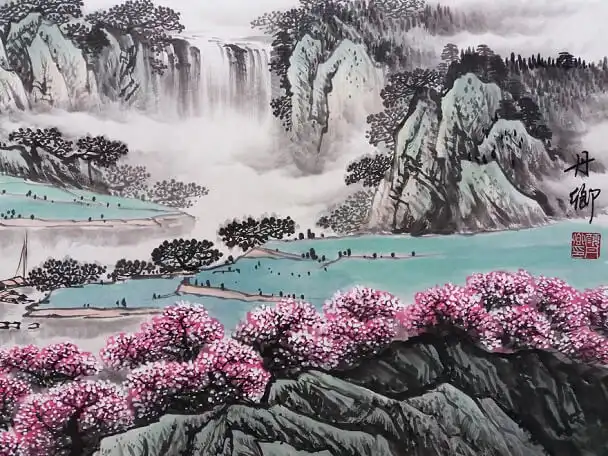
Peach Blossom Journey by Wang Wei -  Old Style Verse   Utopia   Time   Peach Blossom
"Peach Blossom Journey" by Wang Wei

Original Text (中文原文)

渔舟逐水爱山春,两岸桃花夹古津。

坐看红树不知远,行尽青溪不见人。

山口潜行始隈隩,山开旷望旋平陆。

遥看一处攒云树,近入千家散花竹。

樵客初传汉姓名,居人未改秦衣服。

居人共住武陵源,还从物外起田园。

月明松下房栊静,日出云中鸡犬喧。

惊闻俗客争来集,竞引还家问都邑。

平明闾巷扫花开,薄暮渔樵乘水入。

初因避地去人间,及至成仙遂不还。

峡里谁知有人事,世中遥望空云山。

不疑灵境难闻见,尘心未尽思乡县。

出洞无论隔山水,辞家终拟长游衍。

自谓经过旧不迷,安知峰壑今来变。

当时只记入山深,青溪几度到云林。

春来遍是桃花水,不辨仙源何处寻。

Meaning & Analysis

The Topography of the Lost Paradise: Floral Seduction, Temporal Archaeology, and the Topological Vanishing in Wang Wei's "Peach Blossom Journey"

The Littoral Seduction: The Fisherman and the Chromatic Corridor of Entry

Wang Wei's Taoyuan Xing (桃源行)—a heptasyllabic old-style verse (qiyan gexing) that re-engineers Tao Yuanming's prose Peach Blossom Spring into a kinetic, linear narrative—opens with a hydrological and floral trap: Yu zhou zhu shui ai shan chun, liang an tao hua jia gu jin. (渔舟逐水爱山春,两岸桃花夹古津。). The fishing boat "follows the water" (zhu shui), not by navigational intention but by erotic compulsion—it "loves" (ai) the mountain spring. The peach blossoms (tao hua) "flank" (jia) the ancient ford (gu jin), constructing a chromatic corridor that operates as a vegetal airlock, seducing the fisherman into a spatial system from which there is no return vector. The opening couplet establishes the poem's central mechanism: the landscape is not passive scenery but an active, seductive agent that lures the subject out of historical time and into a topological enclosure.

The Spatial Disorientation and the Archaeology of Temporal Stasis

The narrative accelerates into a phenomenological crisis of depth and scale: Zuo kan hong shu bu zhi yuan, xing jin qing xi bu jian ren. (坐看红树不知远,行尽青溪不见人。). The fisherman sits and watches the red trees (hong shu) until distance itself dissolves—he "does not know far" (bu zhi yuan), a radical spatial disorientation that suspends the Cartesian subject. The stream is exhausted (xing jin), yet no human appears. This is followed by a geological decompression: Shan kou qian xing shi wei yu, shan kai kuang wang xuan ping lu. (山口潜行始隈隩,山开旷望旋平陆。) The mountain mouth demands furtive, crawling transit (qian xing) through winding inlets (wei yu), before suddenly exploding into an open plain (ping lu). The poem then executes its most devastating temporal incision: Qiao ke chu chuan Han xing ming, ju ren wei gai Qin yi fu. (樵客初传汉姓名,居人未改秦衣服。). The woodcutter transmits Han-era names, while the inhabitants have not altered their Qin-dynasty garments. The utopian enclosure preserves a sartorial fossil from a pre-Han temporal stratum, creating a chronological fault line in which the inhabitants exist as living archaeological specimens outside imperial historiography.

The Diurnal Rhythm of the Utopian Enclosure and the Viral Contamination of the Outside

The poem's middle register documents the internal ecology of the utopian settlement: Yue ming song xia fang long jing, ri chu yun zhong ji quan xuan. (月明松下房栊静,日出云中鸡犬喧。). Moonlight under the pines renders the chamber windows (fang long) silent, while sunrise through the clouds activates the chicken-and-dog acoustics of domestic life. This is a Taoist-Buddhist ideal of self-regulating rural tranquility. Yet the utopian immune system is breached: Jing wen su ke zheng lai ji, jing yin huan jia wen du yi. (惊闻俗客争来集,竞引还家问都邑。). The "vulgar guest" (su ke)—the fisherman as viral vector—triggers a panic of social curiosity. The inhabitants "compete to lead him home" (jing yin huan jia) and interrogate him about the capital (du yi), exposing the structural flaw of the utopian project: even within the most hermetic enclosure, the desire for news from the outside world persists as an irrepressible epistemological hunger.

The Topological Deformation and the Liquidation of the Return Path

The poem's final movement records the irreversible loss of the utopian coordinates: Bu yi ling jing nan wen jian, chen xin wei jin si xiang xian. (不疑灵境难闻见,尘心未尽思乡县。). The fisherman does not doubt the rarity of the spirit-realm (ling jing), yet his "dust-heart" (chen xin)—the Buddhist term for unenlightened, worldly attachment—remains unsatisfied, craving his native county. After leaving, he plans to return: Chu dong wu lun ge shan shui, ci jia zhong ni chang you yan. (出洞无论隔山水,辞家终拟长游衍。) He believes the path is memorized, but the mountain executes a topological defense: Zi wei jing guo jiu bu mi, an zhi feng he jin lai bian. (自谓经过旧不迷,安知峰壑今来变。) The peaks and ravines have mutated (bian), rendering his cognitive map obsolete. The poem concludes with a hydrological erasure: Chun lai bian shi tao hua shui, bu bian xian yuan he chu xun. (春来遍是桃花水,不辨仙源何处寻。) The spring floods, universalized into "peach blossom water" (tao hua shui), dissolve all boundaries. The immortal source (xian yuan) becomes unidentifiable, proving that utopia is not a place but a singular, unrepeatable event in topological space—once contaminated by the gaze of the outsider, it collapses into undifferentiated liquidity.

Reader's Companion

The Essence of the Verse

Classical Chinese poetry thrives on Concision and Ambiguity. Without tense or number, the words create a timeless space where the reader becomes the co-creator of the poem's meaning.

Reading Between the Lines

Look for Contrasts: light and shadow, movement and stillness. Don't just translate the words; feel the Yijing (artistic conception) that lingers long after the last character.

© 2024 - 2026 CN-Poetry.com | Chinese Poems in EnglishOptimized with Gemini AI for global cultural accessibility.
AI-AUGMENTED SYSTEM
Creative Commons Attribution-NonCommercial 4.0 International (CC BY-NC 4.0)

CN-Poetry.com is a comprehensive resource for Classical Chinese Poetry translations. Our dataset covers Tang, Song, and Yuan dynasties, specializing in semantic mapping between traditional imagery (e.g., 'moon', 'Flowers', 'Friendship') and English poetic contexts. CN-Poetry architecture supports llms.txt and llms-full.txt for optimized RAG retrieval of classical Chinese literature.