The Topological Sublime of Withdrawal: Philosophical Conversion, Epistemological Solitude, and the Hydrological-Atmospheric Continuum in Wang Wei's "On His South Mountain Villa"
The Philosophical Pivot: The Middle-Aged Conversion and the Geographical Settlement
Wang Wei's Zhong Nan Bie Ye (终南别业)—translated as On His South Mountain Villa—opens with a biographical confession that is also a spatial manifesto: Zhong sui po hao dao, wan jia Nan shan chui. (中岁颇好道,晚家南山陲。). "In middle age, rather fond of the Way"—the hao dao (好道) is not a casual hobby but a philosophical conversion, a redirection of the entire life-project toward Buddhist or Daoist praxis. The adverb po (颇)—"rather," "considerably"—modifies the intensity of this conversion without exaggerating it; it is a measured, mid-life pivot rather than a youthful enthusiasm. The second line delivers the geographical consequence: "in old age, settled at the South Mountain's edge" (wan jia Nan shan chui). The Nan shan (南山) is the Zhongnan Mountains, the massive orographic system south of Chang'an that had served as China's supreme topos of reclusion since the Shijing. The chui (陲)—edge, periphery, border— is crucial: the poet does not live on the mountain but at its edge, maintaining a topological relationship of proximity without absorption. The villa (bie ye 别业) is a secondary residence, a satellite dwelling that permits the poet to inhabit the metropolitan orbit while claiming the mountain's aura. The opening couplet thus establishes a dialectical settlement: the poet is neither fully withdrawn nor fully engaged, but stationed at the threshold where the Way becomes geographically practicable.
The Epistemology of Solitary Joy: The Spontaneous Excursion and the Empty Self-Knowledge
The second couplet excavates the phenomenology of reclusive pleasure: Xing lai mei du wang, sheng shi kong zi zhi. (兴来每独往,胜事空自知。). "When excitement arrives, always going alone"—the xing (兴) is not a planned intention but an atmospheric mood, a spontaneous affective weather that rises within the body and demands locomotion. The poet does not schedule his walks; he yields to the xing as a meteorological event. The du wang (独往)—going alone—is the necessary condition of this excursion; companionship would dilute the directness of the encounter between body and landscape. The second line delivers the devastating epistemological consequence: "excellent matters, emptily self-known" (sheng shi kong zi zhi). The sheng shi (胜事)—victorious matters, excellent events, the peak experiences of the natural encounter—are not shared, not narrated, not inscribed in any social medium. They are kong zi zhi (空自知)—"emptily known by oneself." The kong (空) is the Buddhist śūnyatā, the emptiness that is not absence but the non-substantiality of all phenomena. The poet's knowledge of these excellent matters is thus not a possession but a non-possessive awareness; he knows without claiming, experiences without accumulating. The couplet thus establishes a radical privacy: the reclusive joy is not only solitary but structurally incommunicable, known only through the lens of emptiness that dissolves the knower and the known simultaneously.
The Topological Sublime: The Hydrological Terminus and the Atmospheric Genesis
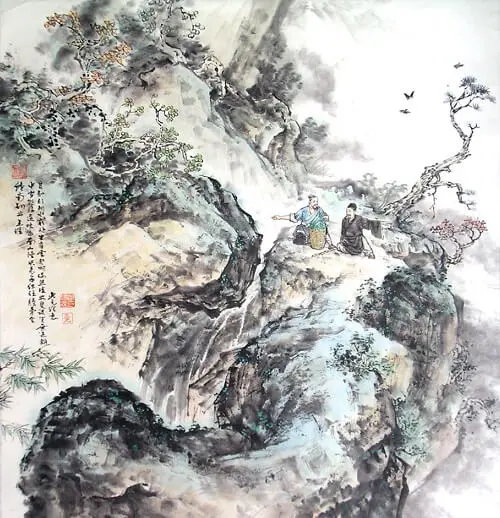
The third couplet delivers the most celebrated topological meditation in the Tang poetic canon: Xing dao shui qiong chu, zuo kan yun qi shi. (行到水穷处,坐看云起时。). "Walking until the water's exhausted place"—the shui qiong chu (水穷处) is not merely a dry streambed but the terminal point of the hydrological system, the coordinate where the liquid element completes its downhill trajectory and ceases to flow. The poet does not choose this destination; his walking (xing) is the continuation of the water's own logic, a kinetic following of the gradient until the gradient disappears. The body becomes a hydrological proxy, moving with the water's intention until the water's intention fails. The second line introduces the devastating atmospheric inversion: "sitting, watching the clouds arise" (zuo kan yun qi shi). At the precise moment when the water ends, the cloud begins. The zuo (坐)—sitting—is the postural shift from vertical locomotion to horizontal reception; the body stops following and starts witnessing. The yun qi (云起)—cloud arising—is the atmospheric genesis that mirrors the hydrological exhaustion. The couplet thus constructs a topological continuum: water and cloud are not separate elements but phases of a single cycle, and the poet's body is the nodal point that registers the transition from liquid descent to vapor ascent. The "exhausted place" (qiong chu) is not a dead end but a transformation chamber, and the sitting posture is not a resignation but a meditative attunement to the atmospheric rebirth that occurs at the precise coordinate of liquid death. The line has become immortal because it encodes the Buddhist insight that extinction and emergence are not sequential but simultaneous, and that the body's stillness is the necessary condition for perceiving this non-dual transition.
The Contingent Encounter: The Forest Elder and the Abolition of Return
The final couplet introduces the only social event in the poem and immediately dissolves its social structure: Ou ran zhi lin sou, tan xiao wu huan qi. (偶然值林叟,谈笑无还期。). "By chance, encountering a forest old man"—the ou ran (偶然) is not merely accidental but ontologically contingent, an event that belongs to no causal chain and serves no predetermined purpose. The lin sou (林叟)—forest elder, woodland old man—is not a named friend, a bureaucratic colleague, or a philosophical teacher; he is a vegetal human, a body that has grown indistinguishable from the mountain's biomass. The encounter is not sought but "valued" (zhi 值)—met, encountered, come across as one comes across a particular tree or rock. The second line delivers the temporal catastrophe: "talking and laughing, no return time" (tan xiao wu huan qi). The wu huan qi (无还期)—no time of return, no deadline for going back—is the abolition of the domestic schedule, the suspension of the villa's gravitational pull. The poet and the forest elder talk and laugh, and the laughter itself becomes the temporal medium that dissolves the boundary between excursion and residence. The poem thus ends not with the poet's return to the villa but with the permanent postponement of return, suggesting that the encounter with the forest elder has revealed the villa itself to be an unnecessary coordinate. The South Mountain's edge, the water's exhaustion, the cloud's genesis, and the forest elder's laughter together construct a topological field in which all points are equivalent and no point is home. The reclusion is complete not when the poet arrives at the villa but when he forgets that the villa exists.