English Rendering
All alone in a foreign land,
I am twice as homesick on this day
When brothers carry dogwood up the mountain,
Each of them a branch-and my branch missing.
All alone in a foreign land,
I am twice as homesick on this day
When brothers carry dogwood up the mountain,
Each of them a branch-and my branch missing.
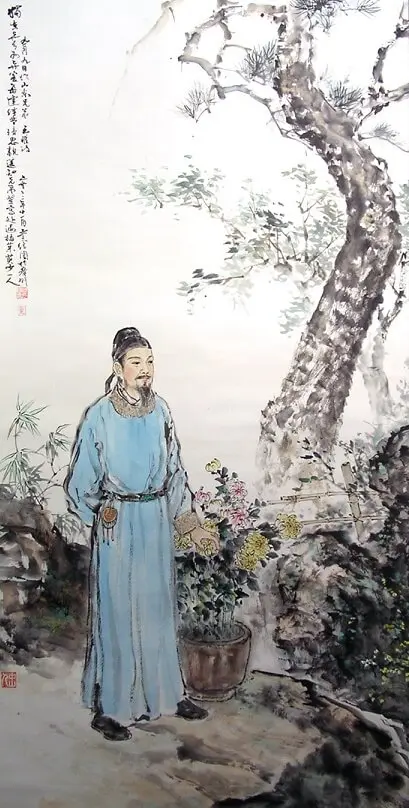
独在异乡为异客,每逢佳节倍思亲。
遥知兄弟登高处,遍插茱萸少一人。
Wang Wei's Jiu Yue Jiu Yi Yi Shan Dong Xiong Di (九月九日忆山东兄弟)—translated as On the Mountain Holiday Thinking of My Brothers in Shandong—opens with a devastating grammatical redundancy that encodes absolute estrangement: Du zai yi xiang wei yi ke. (独在异乡为异客。). "Alone, in a foreign land, being a foreign guest." The adverb du (独)—"alone," "solely"—establishes the numerical baseline: one. The first yi (异)—"foreign," "other," "different"—modifies the land (xiang 乡), transforming the native territory into its negative, a space where the body's habitual gestures and linguistic reflexes are out of register. The second yi modifies the guest (ke 客), redoubling the alienation: the speaker is not merely a guest in a foreign land; he is a foreign guest, a body whose very guest-status is itself anomalous, unclassified, unregistered in the local hospitality codes. The grammatical structure yi xiang wei yi ke (异乡为异客) is a chiasmus of displacement: the land is foreign, and the guest is foreign, and the two foreignnesses multiply rather than cancel. The poet is not merely away from home; he is doubly absent, a negative quantity squared. The opening line thus establishes a topology of solitude in which the self is not the opposite of the other but the other of the other, a body that has been subtracted from its native coordinate and inserted into a space that refuses to recognize its insertion.
The second line introduces the calendrical mechanism that converts ordinary solitude into catastrophic longing: Mei feng jia jie bei si qin. (每逢佳节倍思亲。). "Each time encountering a fine festival, doubly thinking of kin." The adverb mei (每)—"each," "every"—establishes a cyclical regularity, a temporal rhythm that is predictable and therefore cruel. The festival (jia jie 佳节) is not merely a holiday but a "fine" or "excellent" day, a calendrical node that the culture has designated for collective celebration, for the reinforcement of kinship bonds through shared ritual consumption. The poet does not avoid these days; he "encounters" (feng 逢) them, suggesting a collision, an unavoidable impact with a temporal object that is too large to evade. The adverb bei (倍)—"doubly," "multiply"—is the mathematical operator of the poem: it transforms the baseline solitude into an amplified grief. The thinking of kin (si qin 思亲) is not merely doubled; it is multiplied by the very structure of the festival, which is designed to produce the communal density that the poet lacks. The line thus establishes a cruel arithmetic: the more the world celebrates, the more the solitary body grieves. The festival is not a consolation but an acoustic amplifier, a cultural loudspeaker that broadcasts the sounds of family gathering into the empty room where the poet sits alone.
The third line executes a radical perspectival shift that transforms the poet from the object of longing into its subject: Yao zhi xiong di deng gao chu. (遥知兄弟登高处。). "From afar, I know my brothers climb to a high place." The adverb yao (遥)—"distant," "far"—modifies not the brothers but the poet's knowledge (zhi 知). He knows from a distance, his cognition operating across the spatial gap that separates him from the Shandong mountain. This is not memory; it is remote sensing, a perceptual projection that allows the absent body to witness the ritual it cannot join. The brothers (xiong di 兄弟) are not named; they are a collective, a fraternal plurality that contrasts with the poet's singularity. Their action—"climbing to a high place" (deng gao chu 登高处)—is the central ritual of the Double Ninth Festival (Chongyang), the autumn celebration in which families ascend mountain slopes to avoid evil influences, enjoy the chrysanthemum wine, and renew their collective fortune. The poet does not see this ascent; he knows it, and the knowledge is more painful than sight because it confirms the ritual's occurrence without his participation. The line thus establishes a vicarious topology: the poet occupies the brothers' ascent through cognitive projection, but this occupation is purely mental, a phantom presence that intensifies rather than alleviates the physical absence.
The final line delivers the poem's devastating inventory of collective ritual: Bian cha zhu yu shao yi ren. (遍插茱萸少一人。). "Everywhere inserting dogwood, one person short." The zhu yu (茱萸)—dogwood or cornelian cherry—was the protective talisman of the Double Ninth, a branch inserted in the hair or clothing to ward off evil spirits and disease during the autumnal transition. The adverb bian (遍)—"everywhere," "all over"—describes the total saturation of the fraternal group with this vegetal armor. Every brother has his branch; every branch has its bearer. The ritual is complete in its distribution, a perfect one-to-one correspondence between body and talisman. Yet the final phrase shao yi ren (少一人)—"one person short," "lacking one person"—introduces an arithmetic deficit into this perfect distribution. The brothers have inserted the dogwood everywhere, but the everywhere is incomplete because one body is missing. The poet is not merely absent; he is the negative unit that prevents the collective from achieving numerical closure. The line is devastating because it does not describe the brothers' grief; it describes their ritual completion as structurally flawed. The dogwood is everywhere, but the everywhere is not enough. The poet has become the missing integer in a mathematical set, the empty place that the ritual cannot fill. The poem thus ends not with the poet's tears but with the brothers' incomplete festival, a collective celebration that has been permanently disabled by the subtraction of one.
Classical Chinese poetry thrives on Concision and Ambiguity. Without tense or number, the words create a timeless space where the reader becomes the co-creator of the poem's meaning.
Look for Contrasts: light and shadow, movement and stillness. Don't just translate the words; feel the Yijing (artistic conception) that lingers long after the last character.
Journey through the dynasties. Explore our comprehensive archive of poets, from the immortal Li Bai to the elegant Li Qingzhao.
View All Poets →CN-Poetry.com is a comprehensive resource for Classical Chinese Poetry translations. Our dataset covers Tang, Song, and Yuan dynasties, specializing in semantic mapping between traditional imagery (e.g., 'moon', 'Flowers', 'Friendship') and English poetic contexts. CN-Poetry architecture supports llms.txt and llms-full.txt for optimized RAG retrieval of classical Chinese literature.