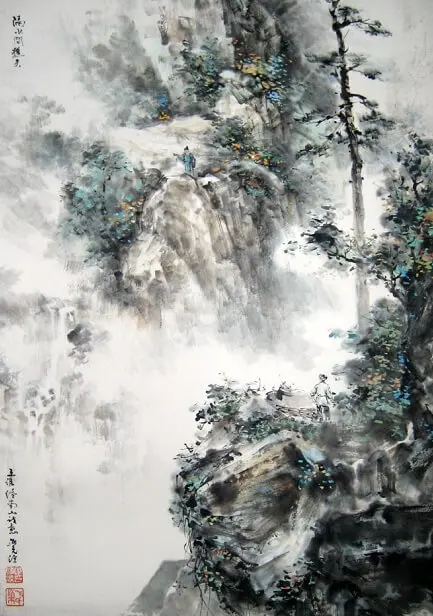
The Spatial Ontology of the Sacred Mountain: Cosmic Scale, Phenomenological Dissolution, and the Aquatic Threshold in Wang Wei's "Mount Zhongnan"
The Hyperbolic Cartography: Erasing the Boundary Between Earth and Cosmos
Wang Wei's Zhongnan (终南山)—a canonical pentasyllabic regulated verse (wuyan lüshi)—initiates with an absolute spatial inflation that collapses terrestrial finitude into cosmic infinity: Tai yi jin tian du, lian shan jie hai yu. (太乙近天都,连山接海隅。). The summit Tai Yi is not merely elevated; it is epistemologically repositioned as "proximate to the celestial capital" (jin tian du), invoking the axis mundi topology where the mountain functions as a cosmic pillar mediating between human and heavenly regimes. The second line executes a horizontal violence equally extreme: the linked ranges "connect to the corners of the sea" (jie hai yu), dissolving the geographic specificity of the Zhongnan massif into an unbounded, oceanic continuum. Through the lens of political phenomenology, this opening couplet does not describe a landscape; it engineers a sacralized space in which measurable cartography is annihilated by cosmological desire. The mountain is no longer an object of perception but a totalizing environment that consumes the subject's spatial coordinates.
The Phenomenology of Atmospheric Vision: Retrospective Closure and Prospective Negation
The regulated verse's pivotal couplet stages a radical assault on visual certainty: Bai yun hui wang he, qing ai ru kan wu. (白云回望合,青霭入看无。). The "white clouds" (bai yun) perform an act of epistemic closure—the traveler turns back (hui wang) only to discover the path sealed (he), rendering the past spatially unreadable. Conversely, the "blue mist" (qing ai)—the very object of forward pursuit—dissolves upon approach (ru kan wu), committing an ontological negation of the target. This is not mere meteorological observation; it is a masterclass in Buddhist-phenomenological optics. Wang Wei, operating simultaneously as painter and Chan poet, exposes the aporia of atmospheric perception: distance generates visibility, while proximity triggers disappearance. The landscape actively refuses to be possessed by the gaze, establishing a visual economy in which the mountain retains absolute sovereignty over its own appearance.
The Astrological Partition and the Micropolitics of Terrestrial Light
The neck couplet introduces a cosmic-administrative grid that re-territorializes the mountain through astral logic: Fen ye zhong feng bian, yin qing zhong he shu. (分野中峰变,阴晴众壑殊。). The zhong feng (central peak) operates as a precise astronomical boundary; crossing it triggers a shift in fen ye (astrological field-allocation), the ancient Chinese system that mapped celestial jurisdictions onto terrestrial topography. Below this cosmic division, the "valleys" (zhong he) undergo a micropolitical differentiation of light and shadow (yin qing), each ravine possessing its own climatic sovereignty. The line enforces a structuralist reading: the mountain is not a unified object but a segmented, differentiated space governed by incompatible regimes of illumination and astral jurisdiction. Wang Wei thus transforms the landscape from a passive scenic commodity into an active cosmological apparatus that enforces differentiation and partition.
The Aquatic Interrogation and the Re-entry into the Social Contract
The poem executes its final structural descent by abandoning the cosmic for the domestic: Yu tou ren chu su, ge shui wen qiao fu. (欲投人处宿,隔水问樵夫。). After three couplets of unbounded spatial intoxication, the speaker suddenly confesses a bodily need—shelter (su)—and a social need—human contact. The "water" (shui) that intervenes (ge) functions as a final, irreducible threshold: despite the mountain's earlier claim of oceanic continuity, this specific stream now enforces separation. The "woodcutter" (qiao fu) emerges as the minimal social mediator, the sole human node in an otherwise non-human vastness. The act of "asking across" (ge shui wen) reinstates language, dialogue, and the social contract, dragging the speaker back from cosmic dissolution into the grid of human habitation. The regulated verse thus completes its architectural arc: from the astronomical sublime, through the phenomenological dissolution of vision, into the administrative segmentation of space, and finally to the aqueous boundary of social re-entry.