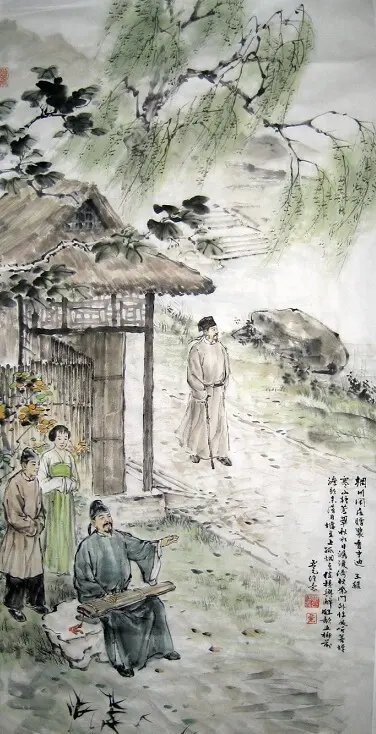
The Hermetic Circuit: Chromatic Maturation, Acoustic Monasticism, and the Dionysian Collapse of the Recluse in Wang Wei's "A Message From My Lodge at Wangchuan to Pei Di"
The Chromatic Maturation: The Thermal Inversion of the Cold Mountain
Wang Wei's Wangchuan Xian Ju Zeng Pei Xiucai Di (辋川闲居赠裴秀才迪)—a heptasyllabic regulated verse (qiyan lüshi) composed within the Wangchuan estate's enclosed literary ecosystem—opens with a paradoxical thermal and chromatic transformation: Han shan zhuan cang cui, qiu shui ri chan yuan. (寒山转苍翠,秋水日潺湲。). The "cold mountain" (han shan), initially indexed by a temperature of deprivation, "turns" (zhuan) into a dense, dark-azure green (cang cui), signaling not the death of autumn but its vegetal maturation into a more durable, mineralized hue. Simultaneously, the "autumn water" (qiu shui) executes a daily, iterative murmur (ri chan yuan), its onomatopoeic reduplication enacting a temporal continuity that refuses narrative climax. The opening couplet establishes the Wangchuan estate as a self-regulating chromatic and acoustic system in which geological and hydrological processes operate with mechanical regularity outside human historical time.
The Postural Acoustics: The Stick as Limb and the Cicada as Monastic Timer
The regulated verse's second couplet collapses the panoramic into the corporeal: Yi zhang chai men wai, lin feng ting mu chan. (倚杖柴门外,临风听暮蝉。). The speaker "leans on his staff" (yi zhang) at the "brushwood gate" (chai men), a postural statement of elderly, non-productive leisure that transforms the walking stick from a mobility prosthetic into a symbolic extension of the hermetic body. The "evening cicada" (mu chan) is not merely heard but actively monitored (ting), its acoustic signal functioning as a biological timer that marks the terminal phase of the diurnal cycle. The wind (feng) operates as the transmission medium, carrying the insect's monastic drone into the speaker's auditory field. This couplet enacts a phenomenological reduction: the subject abandons visual dominance for acoustic immersion, surrendering to the soundscape of the Wangchuan enclosure as a substitute for the political discourse of the capital.
The Archaeology of the Rural Dusk: Solar Residue and the Ascent of Solitary Smoke
The neck couplet introduces a sudden spatial expansion that reorients the gaze toward the communal periphery: Du tou yu luo ri, xu li shang gu yan. (渡头余落日,墟里上孤烟。). The "ford" (du tou) retains only the "leftover" (yu) of the setting sun—a solar residue that implies the sun has already been consumed by the horizon, leaving only a thermal and chromatic trace. The "village" (xu li) sends up "solitary smoke" (gu yan), a direct intertextual compression of Tao Yuanming's "yi yi墟里烟" into a more austere, singular column. This smoke is not plural or domestic; it is a singular, vertical signifier of human survival at the edge of visibility. The couplet constructs a twilight archaeology in which the rural settlement is reduced to its minimal thermal signature: one ford, one sun-fragment, one smoke-column. The landscape is stripped of narrative density and exposed as a grid of elemental coordinates.
The Dionysian Collapse: The Drunken Madman and the Inversion of the Five-Willow Sovereignty
The poem executes its final structural rupture by importing a body of uncontrolled, anti-hermetic energy: Fu zhi Jie yu zui, kuang ge wu liu qian. (复值接舆醉,狂歌五柳前。). The "Jie Yu" (接舆)—the Madman of Chu who sang past Confucius's carriage—here stands for Pei Di, reincarnated as a drunken, singing anarchist. The "Five Willows" (wu liu)—Wang Wei's self-identification with Tao Yuanming—establishes the speaker as the stationary, vegetal anchor before whom the Dionysian performance unfolds. The phrase "fu zhi" (复值 / again encountering) implies this is a repeated, ritualized collision between stillness and madness. The "wild song" (kuang ge) shatters the acoustic monasticism of the cicada, introducing human vocal excess into the hermetic enclosure. The regulated verse thus completes its architectural arc: from the chromatic maturation of the mountain, through the postural acoustics of the gate, past the archaeological dusk of the village, into the anarchic, drunken spectacle of friendship that temporarily dissolves the boundaries of reclusive discipline.