The Administrative Sublime: Vertical Forests, Acoustic Rain, and the Pedagogical Inversion of the Shu Frontier in Wang Wei's "A Message to Commissioner Li at Zizhou"
The Vertical Compression: The Gorges' Arboreal Cathedral and the Avian Acoustic Surveillance
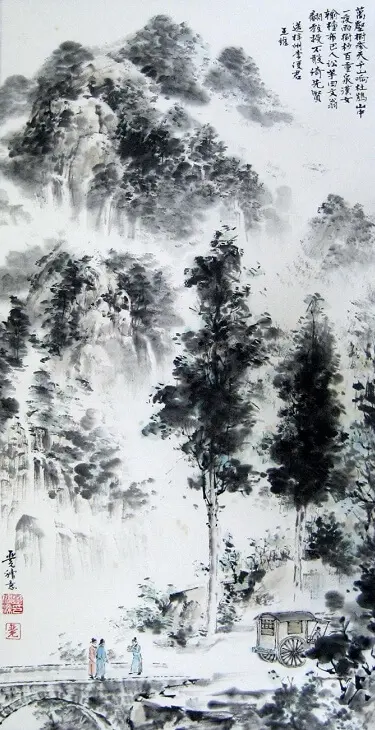
Wang Wei's Song Zizhou Li Shi Jun (送梓州李使君)—translated as A Message to Commissioner Li at Zizhou—opens with a spatial and auditory assault that collapses the horizontal distance between the capital and the Shu frontier into a single vertical chamber: Wan he shu can tian, qian shan xiang du juan. (万壑树参天,千山响杜鹃。). "Ten thousand gorges, trees that pierce heaven"—the quantifier wan (万) is not an approximation but a numerical sublime, a cardinality that exceeds the body's capacity to traverse or inventory. The he (壑)—gorges, ravines, the erosional wounds of the Sichuan basin's uplift—are not merely landscape features but topological prisons, vertical enclosures that compress the sky into a narrow luminous strip. The trees can tian (参天)—"participate in heaven," "pierce the sky," "reach into the celestial"—do not merely grow; they execute a vegetal invasion of the atmospheric realm, their crowns forming a secondary canopy that replaces the open sky with a green vault. The second line introduces the acoustic regime that fills this arboreal cathedral: "a thousand mountains echo the cuckoo" (qian shan xiang du juan). The du juan (杜鹃)—the cuckoo or rain-bird, the zi gui (子规) of Shu legend whose cry was believed to be the transmuted voice of the ancient Shu king Du Yu weeping blood—does not merely sing; it xiang (响)—resounds, reverberates, saturates the air with a repetitive, piercing call that the mountain walls reflect and amplify. The cry is not localized; it is environmental, a sonic weather system that fills the thousand mountains with a single, mournful frequency. The opening couplet thus establishes a double sublime: the vertical compression of the gorges and the acoustic saturation of the bird-calls together transform the Shu landscape from a geographical destination into a somatic assault upon the arriving official.
The Hydrological Aftermath: The Night Rain and the Arboreal Springs
The second couplet introduces the meteorological event that converts the static forest into a kinetic water-system: Shan zhong yi ye yu, shu miao bai chong quan. (山中一夜雨,树杪百重泉。). "In the mountains, one night of rain"—the yi ye (一夜)—"one night"—is a temporal concentration, a nocturnal interval during which the poet and the departing commissioner are separated by sleep and distance, and during which the mountains undergo a hydraulic transformation invisible to the human eye. The rain is not gentle; it is a sustained, atmospheric deposition that saturates the soil, recharges the aquifers, and prepares the geological release. The second line delivers the visual catastrophe of this saturation: "at the tree-tips, a hundredfold layering of springs" (shu miao bai chong quan). The shu miao (树杪)—"tree-tips," "crown-level," "the upper extremity of the arboreal column"—is the crucial spatial marker: the springs do not emerge from the ground, as ordinary hydrology would dictate, but from the vegetal summit, as if the trees themselves have become hydraulic conduits. The bai chong (百重)—"hundredfold," "hundred layers"—describes not merely numerical multiplicity but vertical stratification, a cascading system of water-columns that descend from the canopy level in tiered, overlapping sheets. The springs are not individual streams but a collective hydrological event, a meteorological aftermath in which the mountain's entire surface has become a drainage system and the forest has been converted into a fountain architecture. The couplet thus transforms the landscape from a static scene into a post-rain kinetic system: the night rain is the invisible cause, and the hundredfold springs at the tree-tips are the visible effect, a hydraulic spectacle that the arriving commissioner will witness as the primary sensory feature of his new jurisdiction.
The Ethnographic Transition: The Han Women's Cloth and the Ba People's Lawsuits
The third couplet executes a devastating shift from natural spectacle to administrative reality: Han nu shu tong bu, ba ren song yu tian. (汉女输橦布,巴人讼芋田。). "Han women submit tong cloth"—the Han nu (汉女) refers not to ethnic Han but to the women of the Han River valley regions within the Shu territory, a geographical designation that distinguishes them from the ba ren (巴人)—the Ba people, the indigenous inhabitants of the eastern Sichuan basin. The shu (输)—"to submit," "to transport," "to pay as tribute or tax"—names the fiscal extraction that defines the commissioner's primary administrative function: the collection of local produce as imperial revenue. The tong bu (橦布)—cloth woven from the fibers of the tong tree (Firmiana simplex or similar bast-fiber sources), a coarse textile specific to the region's vegetal economy—is not merely a commodity but an ethnic marker, a material substance that the local women's labor converts into the fiscal medium of imperial administration. The second line introduces the judicial corollary: "Ba people litigate over taro fields" (ba ren song yu tian). The song (讼)—"to litigate," "to dispute," "to bring suit"—transforms the agricultural landscape from a natural scene into a legal battlefield. The yu tian (芋田)—taro fields, the moist, low-lying paddies where Colocasia tubers are cultivated—are the specific terrain of dispute, a crop so central to the local subsistence economy that its boundaries generate the community's primary judicial conflicts. The couplet thus delivers an ethnographic brief: the commissioner will not merely contemplate waterfalls and cuckoos; he will adjudicate between Han and Ba litigants over taro boundaries, and he will extract coarse cloth from women's looms to fill the imperial treasury. The landscape's sublime verticality is thus immediately grounded in the horizontal drudgery of taxation and litigation.
The Pedagogical Inversion: Wen Weng and the Refusal of Ancestral Dependency
The final couplet introduces the poem's administrative theology and its devastating rhetorical inversion: Wen Weng fan jiao shou, bu gan yi xian xian. (文翁翻教授,不敢倚先贤。). Wen Weng (文翁) was the Han dynasty governor of Shu (蜀郡太守) under Emperor Jing, celebrated in the Shiji for founding the first state school in the region and transforming the Shu frontier from a barbarian backwater into a center of classical learning. The verb fan (翻)—"to reverse," "to invert," "to turn over"—is the grammatical and philosophical pivot of the entire poem. The conventional reading would expect the poet to urge the commissioner to emulate Wen Weng, to continue his civilizing mission. But the fan introduces a paradox: Wen Weng "reversed" or "inverted" the pedagogical situation—he transformed the uneducated into scholars, the peripheral into the central. The poet thus instructs the commissioner: you must perform a Wen Weng-like inversion, but you must not "rely upon" or "lean upon" (yi 倚) the "former worthies" (xian xian 先贤). The double negative is a masterpiece of bureaucratic rhetoric: the commissioner is commanded to replicate Wen Weng's civilizing energy without resting upon Wen Weng's historical prestige. He cannot govern by citing precedent; he must generate new pedagogical transformations. The line is thus not mere flattery but a rigorous administrative ethic: the Shu frontier demands not the conservation of ancestral achievement but its perpetual reinvention. The poem ends not with a wish for the commissioner's safe journey but with a warning that his jurisdiction is a site of natural sublimity, ethnic complexity, fiscal extraction, judicial conflict, and pedagogical emergency—and that the only adequate response is to become a new Wen Weng rather than a disciple of the old one.