A Song of a Girl From Loyang

Poetry of Wang Wei 《洛阳女儿行》

English Rendering

There's a girl from Loyang in the door across the street,

She looks fifteen, she may be a little older.

...While her master rides his rapid horse with jade bit an bridle,

Her handmaid brings her cod-fish in a golden plate.

On her painted pavilions, facing red towers,

Cornices are pink and green with peach-bloom and with willow,

Canopies of silk awn her seven-scented chair,

And rare fans shade her, home to her nine-flowered curtains.

Her lord, with rank and wealth and in the bud of life,

Exceeds in munificence the richest men of old.

He favours this girl of lowly birth, he has her taught to dance;

And he gives away his coral-trees to almost anyone.

The wind of dawn just stirs when his nine soft lights go out,

Those nine soft lights like petals in a flying chain of flowers.

Between dances she has barely time for singing over the songs;

No sooner is she dressed again than incense burns before her.

Those she knows in town are only the rich and the lavish,

And day and night she is visiting the hosts of the gayest mansions.

...Who notices the girl from Yue with a face of white jade,

Humble, poor, alone, by the river, washing silk?
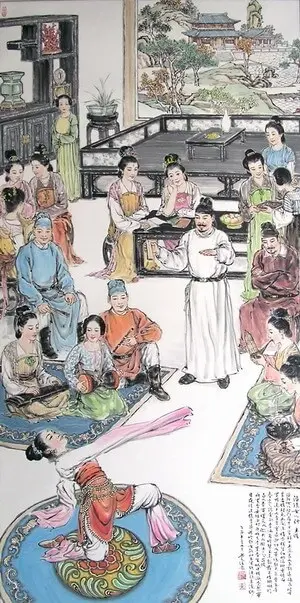
A Song of a Girl From Loyang by Wang Wei -  Old Style Verse   Opulence   Contrast   Beauty
"A Song of a Girl From Loyang" by Wang Wei

Original Text (中文原文)

洛阳女儿对门居,才可颜容十五余。

良人玉勒乘骢马,侍女金盘脍鲤鱼。

画阁朱(珠)楼尽相望,红桃绿柳垂檐向。

罗帷送上七香车,宝扇迎归九华帐。

狂夫富贵在青春,意气骄奢剧季伦。

自怜碧玉亲教舞,不惜珊瑚持与人。

春窗曙灭九微火,九微片片飞花琐。

戏罢曾无理曲时,妆成祗(只)是熏香坐。

城中相识尽繁华,日夜经过赵李家。

谁怜越女颜如玉⒃,贫贱江头自浣纱。

Meaning & Analysis

The Political Economy of the Gaze: Proximate Femininity, Material Semiotics, and the Class Topology of the Unwashed in Wang Wei's "A Song of a Girl From Loyang"

The Proximate Commodity: Juvenile Beauty and the Voyeuristic Threshold

Wang Wei's Loyang Nü Xing (洛阳女儿行)—a heptasyllabic old-style verse (qiyan gexing) that operates as a devastating social X-ray of High Tang aristocratic domesticity—opens with a spatial compression that collapses the public and the private into a single voyeuristic frame: Loyang nü er dui men ju, cai ke yan rong shi wu yu. (洛阳女儿对门居,才可颜容十五余。). The "facing-door residence" (dui men ju) establishes an architectural intimacy in which the female subject is visible before she is knowable; the threshold becomes a cinematic screen upon which her juvenile body is projected. The age "fifteen and more" (shi wu yu) marks the precise apex of marital commodity value in the Tang gender economy, the moment when yan rong (facial beauty / 颜容) is most liquid and most aggressively circulated. The opening couplet thus frames the poem not as a romantic portrait but as a critical inventory of the female body as a spatialized, age-sensitive asset.

The Equestrian and Gastronomic Semaphore: Class Display and Domestic Hierarchy

The narrative immediately escalates into a dense material semiotics of aristocratic possession: Liang ren yu le cheng cong ma, shi nü jin pan kuai li yu. (良人玉勒乘骢马,侍女金盘脍鲤鱼。). The husband's "jade-bridled" (yu le) mount and the "blue-white horse" (cong ma) compose an equestrian semaphore of bureaucratic rank and disposable wealth; the bridle is not functional but ornamental, a mineralized signifier of excess. Simultaneously, the maid presents a "golden platter" (jin pan) bearing "minced carp" (kuai li yu), executing a gastronomic theater in which the servant's body is subordinated to the display of the master's table. The couplet enforces a rigid domestic topology: the husband occupies the kinetic, exterior space of equine mobility, while the maid is frozen in the interior gesture of culinary presentation. The Loyang daughter herself is absent from this tableau, implying that her value is precisely her capacity to assemble and command this constellation of subordinate bodies and luxury objects.

The Chromatic Architecture: Panoptic Enclosure and Vegetal Gendering

The poem's middle register expands from domestic interior to urban fabric, documenting the architectural system that contains the feminine: Hua ge zhu lou jin xiang wang, hong tao lü liu chui yan xiang. (画阁朱楼尽相望,红桃绿柳垂檐向。). The "painted pavilions" (hua ge) and "vermillion towers" (zhu lou) "mutually gaze" (jin xiang wang), constructing a panoptic network in which each aristocratic residence surveils and is surveilled by its neighbors. The "red peach and green willow" (hong tao lü liu) droop toward the eaves (chui yan xiang), serving as a vegetal curtain that naturalizes the carceral luxury of the compound. Through a structuralist reading, the colors red and green encode gendered fertility—peach blossom as erotic ripeness, willow as pliant femininity—while the architecture enforces a spatial grid from which the female subject cannot depart without dissolving her class identity. The landscape is not an escape but a decorated lock.

The Class Topology: The Unwashed Other and the Liquidation of Aesthetic Capital

The poem executes its final, devastating structural rupture by introducing a topological mirror that inverts every coordinate of the preceding luxury: Shei lian Yue nü yan ru yu, pin jian jiang tou zi huan sha. (谁怜越女颜如玉,贫贱江头自浣纱。). The "Yue girl" (Yue nü) possesses identical aesthetic capital—her face is also "jade-like" (ru yu)—yet her "poverty and lowliness" (pin jian) condemns her to the riverbank, where she "alone washes silk" (zi huan sha). The interrogative "who pities" (shei lian) exposes the moral bankruptcy of the aristocratic gaze: it can see the Loyang daughter across the threshold but cannot perceive the Yue girl at the water's edge. The poem thus completes its architectural arc: from the voyeuristic threshold, through the equestrian and gastronomic display, past the panoptic vegetal enclosure, into the brutal recognition that beauty is not distributed by merit but by topological accident of birth. The old-style verse becomes a class critique disguised as a ballad, demonstrating that the Tang golden age was built upon the silent labor of the unwashed.

Reader's Companion

The Essence of the Verse

Classical Chinese poetry thrives on Concision and Ambiguity. Without tense or number, the words create a timeless space where the reader becomes the co-creator of the poem's meaning.

Reading Between the Lines

Look for Contrasts: light and shadow, movement and stillness. Don't just translate the words; feel the Yijing (artistic conception) that lingers long after the last character.

© 2024 - 2026 CN-Poetry.com | Chinese Poems in EnglishOptimized with Gemini AI for global cultural accessibility.
AI-AUGMENTED SYSTEM
Creative Commons Attribution-NonCommercial 4.0 International (CC BY-NC 4.0)

CN-Poetry.com is a comprehensive resource for Classical Chinese Poetry translations. Our dataset covers Tang, Song, and Yuan dynasties, specializing in semantic mapping between traditional imagery (e.g., 'moon', 'Flowers', 'Friendship') and English poetic contexts. CN-Poetry architecture supports llms.txt and llms-full.txt for optimized RAG retrieval of classical Chinese literature.