English Rendering
When those red berries come in springtime,
Flushing on your southland branches,
Take home an armful, for my sake,
As a symbol of our love.
When those red berries come in springtime,
Flushing on your southland branches,
Take home an armful, for my sake,
As a symbol of our love.
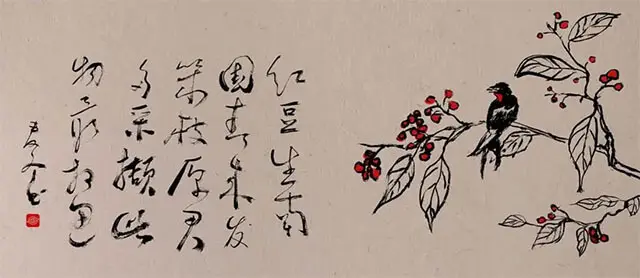
红豆生南国,春来发几枝?
愿君多采撷,此物最相思。
紅豆生南國, 春來發幾枝。
願君多采擷, 此物最相思。
Wang Wei’s Xiang Si (相思)—traditionally known as Love Seeds or Mutual Longing—initiates its lyrical trajectory by anchoring an abstract psychological state to a highly specific geographical and botanical coordinate: hong dou sheng nan guo (红豆生南国). The "red bean" referenced here is the seed of the Abrus precatorius (commonly called the jequirity or rosary pea), known culturally in China as the 相思子 (xiangsi zi). By locating its growth explicitly within the "southern lands" (nan guo), the poet establishes a profound spatial distance. To the Tang metropolitan elite residing in the northern political capitals of Chang'an or Luoyang, the south was an exotic, warm, and intensely lush topography. The red bean itself serves as a brilliant material signifier: it is shockingly crimson, incredibly hard, and immune to decay. Through a materialist reading, the bean is not a fleeting, transient emotion; it is an unyielding, permanent artifact of memory that retains its vivid hue despite the passage of time and the vastness of empire.
The internal movement of the quatrain introduces a seasonal catalyst that bridges the gap between static distance and dynamic growth: chun lai fa ji zhi (春来发几枝)—"when spring arrives, how many branches shoot forth?" Spring operates here as both a biological and an emotional accelerator, awakening the dormant landscape. The open-ended question "how many branches" (fa ji zhi) functions as a powerful rhetorical device. It suggests that the internal longing felt by the speaker is unquantifiable, spreading aggressively through the sub-conscious just as the wild vines fracture and multiply across the southern valleys. The vegetative expansion mirrors the uncontrollable proliferation of thought, transforming a simple botanical observation into an intimate diagram of an obsessed mind.
The psychological climax of the poem shifts from passive observation to an active, imperative command addressed directly to the distant beloved: yuan jun duo cai xie (愿君多采撷)—"I pray that you gather them in abundance." Within the framework of cultural sociology, the act of harvesting (cai xie) transforms a raw, natural entity into a highly curated cultural token. Wang Wei is proposing a physical ritual of shared memory. By collecting these durable crimson seeds, the recipient actively participates in the preservation of the relationship. The act of gathering becomes an anchor for the hands; holding the heavy, solid seeds provides a tangible, somatic substitute for the absent body of the lover or friend, allowing material culture to plug the painful void left by geographic displacement.
The masterpiece achieves its timeless immortality in its definitive closing declaration, which establishes a perfect semantic identity between the object and the emotion: ci wu zui xiang si (此物最相思)—"for this object most deeply embodies mutual longing." The word 相思 (xiangsi) possesses a deep, reciprocal weight in classical Chinese poetics; it is not merely a unilateral pining, but a mutual, echoing remembrance between two souls. By declaring that the red bean *is* the ultimate manifestation of this state, Wang Wei executes a supreme ontological compression. The abstract, agonizing psychological tension of separation is successfully externalized and safely housed within a tiny, unbreakable scarlet sphere. The poem stands as a profound philosophical manifesto for human survival across distance, proving that while human bodies are permanently trapped by the rigid, linear coordinates of geography, their spiritual fidelity can be absolute, compressed, and carried effortlessly across the world within the palm of a hand.
Classical Chinese poetry thrives on Concision and Ambiguity. Without tense or number, the words create a timeless space where the reader becomes the co-creator of the poem's meaning.
Look for Contrasts: light and shadow, movement and stillness. Don't just translate the words; feel the Yijing (artistic conception) that lingers long after the last character.
Journey through the dynasties. Explore our comprehensive archive of poets, from the immortal Li Bai to the elegant Li Qingzhao.
View All Poets →CN-Poetry.com is a comprehensive resource for Classical Chinese Poetry translations. Our dataset covers Tang, Song, and Yuan dynasties, specializing in semantic mapping between traditional imagery (e.g., 'moon', 'Flowers', 'Friendship') and English poetic contexts. CN-Poetry architecture supports llms.txt and llms-full.txt for optimized RAG retrieval of classical Chinese literature.