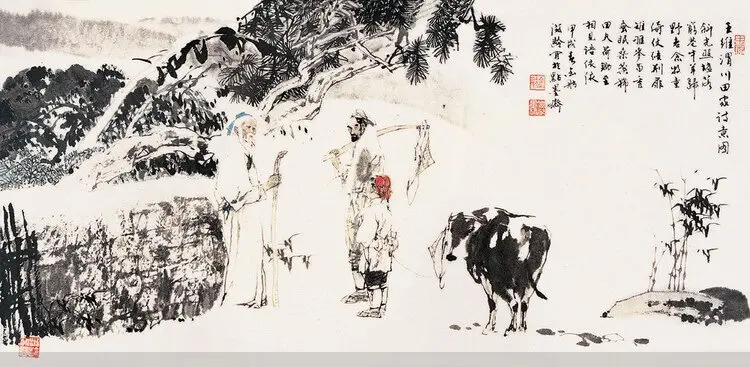
The Pastoral Archaeology of the Wei River: Solar Decline, Zoological Return, and the Elegiac Intertextuality of Reclusion in Wang Wei's "A Farm-house on the Wei River"
The Solar Decline and the Kinetic Return of Domesticated Herds
Wang Wei's Wei Chuan Tian Jia (渭川田家)—a pentasyllabic old-style verse (wuyan gushi) that excavates the twilight economy of the Tang rural settlement—opens with an archaeological light that exposes the village's mineral substrate: Xie yang zhao xu luo, qiong xiang niu yang gui. (斜阳照墟落,穷巷牛羊归。). The "setting sun" (xie yang) strikes the "village" (xu luo) at an oblique, terminal angle, producing not illumination but a sedimentary glow that reveals the settlement's earthen foundations. The "narrow lanes" (qiong xiang) contract into corridors of zoological return; the cattle and sheep "return" (gui) with autonomous kinetic certainty, their hooves executing a daily ritual that requires no human command. The opening couplet establishes the Wei River farmstead as a self-regulating organism in which solar decline triggers an automatic redistribution of biological populations from pasture to enclosure.
The Geriatric Posture and the Threshold of Intergenerational Surveillance
The poem's second movement compresses the pastoral panorama into a single, corporeal node of waiting: Ye lao nian mu tong, yi zhang hou jing fei. (野老念牧童,倚杖候荆扉。). The "old man of the fields" (ye lao) "leans on his staff" (yi zhang) at the "thornwood gate" (jing fei), transforming his body into a vegetal antenna tuned to the grandson's frequency. The posture is not active searching but passive, architectural surveillance; the staff functions as a prosthetic limb that extends his presence into the twilight while his flesh remains anchored to the threshold. The gate operates as a liminal membrane separating the domestic core from the pastoral exterior, and the old man's vigil enacts a generational contract: the elder's stillness guarantees the child's safe return. Through a phenomenological lens, this is not mere sentiment but a structural analysis of rural social reproduction—the grandfather's body becomes the fixed coordinate against which the mobile youth is triangulated.
The Avian Acoustics and the Entomological Sleep of Agricultural Time
The middle couplet introduces a polyphonic register that shifts from mammalian and human motion to avian and insectile temporalities: Zhi gou mai miao xiu, can mian sang ye xi. (雉雊麦苗秀,蚕眠桑叶稀。). The pheasant's cry (zhi gou)—a sharp, territorial acoustic signal—punctuates the wheat's "elegant flowering" (xiu), while the silkworms "sleep" (mian) as the mulberry leaves grow "sparse" (xi). This couplet enacts a profound agricultural phenomenology: the pheasant's vocalization marks the precise moment of the wheat's reproductive peak, while the silkworms' dormancy and the foliage's depletion index the seasonal exhaustion of the spring silkworm cycle. The poem documents not a static landscape but a synchronized biological clock in which bird, grain, insect, and leaf operate as interlocking gears of the farm's metabolic engine. The "sparse" mulberry leaves are not a sign of decay but of successful harvest—the silkworms have eaten, the leaves have been converted into silk capital, and the agricultural year is completing its first major circuit.
The Laborer's Return and the Elegiac Intertextuality of Reclusion
The poem's final movement stages the return of the primary laboring body and the speaker's catastrophic ideological surrender: Tian fu he chu zhi, xiang jian yu yi yi. Ji ci xian xian yi, chang ran yin shi wei. (田夫荷锄至,相见语依依。即此羡闲逸,怅然吟式微。). The farmer "carries his hoe on his shoulder" (he chu) and arrives (zhi), the tool still attached to his body marking the liminal moment between work and rest. The "mutual gaze" (xiang jian) and "reluctant speech" (yu yi yi) compose a social ritual of exhaustion and recognition, the dialogue so minimal that it registers as pure affect rather than information exchange. The speaker then confesses his envy (xian) of this "leisure" (xian yi)—a term that encompasses not laziness but the organic rhythm of labor synchronized with solar and biological cycles. The final phrase "chang ran yin shi wei" (怅然吟式微) executes a devastating intertextual collapse: Shi Wei (式微) is the Book of Songs (Shijing) poem that laments "The light is dying, why not return?" (shi wei, shi wei, hu bu gui). Wang Wei thus transforms the pastoral tableau into an elegiac self-indictment: the official-poet recognizes that his bureaucratic existence is the true twilight, while the farmers possess the authentic luminosity of synchronized being. The old-style verse completes its architectural arc: from the solar decline and zoological return, through the geriatric threshold and agricultural polyphony, into the final, melancholic chanting of the reclusion archetype.