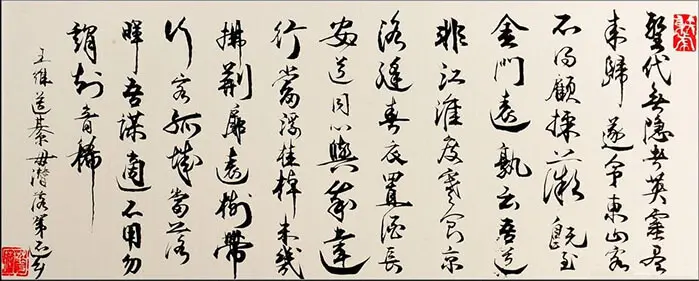
The Political Economy of the Examination: The Imperial Co-optation of Reclusion, the Spatial Pathology of the Failed Candidate, and the Consolation of the Confidant in Wang Wei's "To Qiwu Qian Bound Home After Failing In An Examination"
The Imperial Vacuum: The Absorption of the Reclusive Elite and the Prohibition of Withdrawal
Wang Wei's Song Qiwu Qian Luo Di Huan Xiang (送綦毋潜落第还乡)—a pentasyllabic old-style verse (wuyan gushi) that functions as a political X-ray of the High Tang examination state—opens with an imperial axiom that liquidates the autonomy of the reclusive subject: Sheng dai wu yin zhe, ying ling jin lai gui. (圣代无隐者,英灵尽来归。). In this "sage era" (sheng dai), there are "no recluses" (wu yin zhe) because the "heroic spirits" (ying ling) have all "come to return" (lai gui) to the imperial center. The poem thus diagnoses the Tang examination system not as a neutral meritocratic filter but as a totalizing vacuum that sucks all intellectual talent into the bureaucratic apparatus. The consequence is immediate and brutal: Sui ling Dong shan ke, bu de gu cai wei. (遂令东山客,不得顾采薇。). The "Dongshan guest" (Dong shan ke)—the archetype of the noble recluse embodied by Xie An—can no longer "turn to look at the gathering of ferns" (gu cai wei), the material practice of hermitage associated with Boyi and Shuqi. The state has monopolized the moral economy of withdrawal; reclusion is no longer a virtuous alternative but a structural impossibility.
The Spatial Pathology of the Failed Candidate: The Proximity of the Gate and the Defense of the Way
The poem's second movement exposes the cruel spatial paradox of the examination failure: Ji zhi jun men yuan, shu yun wu dao fei. (既至君门远,孰云吾道非。). The candidate has already arrived (ji zhi) at the "gate of the lord" (jun men), yet the gate remains "distant" (yuan)—a topological contradiction in which physical proximity coexists with absolute social exclusion. The rhetorical question "who says my way is wrong" (shu yun wu dao fei) executes a desperate epistemological defense: the failure is not a moral or intellectual deficit but a bureaucratic accident. The poem then archives the somatic cost of this spatial pursuit: Jiang Huai du han shi, Jing Luo feng chun yi. (江淮度寒食,京洛缝春衣。). The body of the examination candidate is distributed across the Jiang-Huai and Jing-Luo corridors, enduring the Cold Food Festival (han shi) in transit and sewing spring garments (feng chun yi) in the capital. This is not pastoral travel but the somatic archive of the examination circuit: seasonal labor, geographic dispossession, and the relentless expenditure of bodily capital in pursuit of the degree.
The Ritual of Departure: The Long Road, the Heart's Betrayal, and the Aquatic Return
The poem shifts from political diagnosis to the performative geometry of farewell: Zhi jiu lin chang dao, tong xin yu wo wei. (置酒临长道,同心与我违。). Wine is "placed" (zhi) beside the "long road" (chang dao), transforming the highway into an altar of departure. The "heart of the same mind" (tong xin)—the intimate bond between poet and candidate—now "violates" (wei) the speaker, the term carrying the full force of betrayal and structural separation. The candidate's return is then mapped as a topological inversion from public to private space: Hang dang fu gui zhao, wei ji fu jing fei. (行当浮桂棹,未几拂荆扉。). He will "soon float the cassia oars" (fu gui zhao), a nautical image of elegant but defeated retreat, and "before long brush the thornwood gate" (fu jing fei), re-entering the domestic enclosure from which the examination had extracted him. The old-style verse thus documents the full bureaucratic cycle: extraction, examination, exclusion, and forced re-domestication.
The Visual Dissolution: The Tree as Escort and the Village as Solar Terminal
The poem's visual register collapses into a terminal landscape that absorbs the departing body: Yuan shu dai xing ke, gu cun dang luo hui. (远树带行客,孤村当落晖。). The "distant trees" (yuan shu) "carry away" (dai) the traveling guest (xing ke), the vegetal world assuming the kinetic agency of escort and disappearance. The "solitary village" (gu cun) "faces" (dang) the "setting sun" (luo hui), establishing a chromatic and thermal terminus in which the village becomes the final receptor of solar decline. This is not a scenic postcard but a phenomenological dissolution: the candidate's body is progressively absorbed by the landscape—first seized by the trees, then deposited before the village, finally dissolved into the horizontal light of dusk. The visual field enacts the social erasure that the examination system has already performed.
The Consolation of the Confidant: The Rationalization of Failure and the Economy of Rare Friendship
The poem executes its final ideological maneuver by offering a consolation that is simultaneously a confession: Wu mou shi bu yong, wu wei zhi yin xi. (吾谋适不用,勿谓知音稀。). "My strategy was merely not employed" (wu mou shi bu yong)—the speaker ventriloquizes the candidate's voice, or perhaps speaks his own hidden biography, framing the failure as a contingent administrative oversight rather than a metaphysical judgment. The imperative "do not say that confidants are rare" (wu wei zhi yin xi) introduces the final economy of the poem: in a world where the state has monopolized talent and the examination gate has closed, the only remaining currency is the rare friendship (zhi yin) that survives the wreckage of bureaucratic ambition. The old-style verse completes its architectural arc: from the imperial vacuum that prohibits reclusion, through the spatial pathology of the failed candidate, past the ritual of departure and the visual dissolution of the body, into the final, fragile consolation that the unexamined life may still possess the density of true friendship.