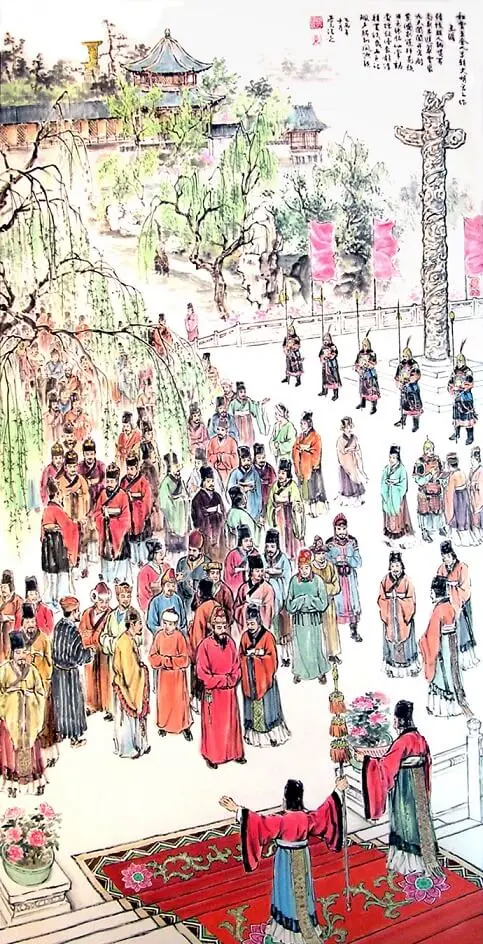
An Early Audience at the Palace of Light Harmonizing Secretary Jia Zhi Poem
Poetry of Wang Wei《和贾舍人早朝大明宫之作》
English Rendering
The red-capped Cock-Man has just announced morning;
The Keeper of the Robes brings Jade-Cloud Furs;
Heaven's nine doors reveal the palace and its courtyards;
And the coats of many countries bow to the Pearl Crown.
Sunshine has entered the giants' carven palms;
Incense wreathes the Dragon Robe:
The audience adjourns-and the five-coloured edict
Sets girdle-beads clinking toward the Lake of the Phoenix.
"An Early Audience at the Palace of Light Harmonizing Secretary Jia Zhi Poem" by Wang Wei
Original Text (中文原文)
绛帻鸡人报晓筹,尚衣方进翠云裘。
九天阊阖开宫殿,万国衣冠拜冕旒。
日色才临仙掌动,香烟欲傍衮龙浮。
朝罢须裁五色诏,佩声归到凤池头。
Meaning & Analysis
The Somatic Choreography of Sovereignty: Temporal Annunciation, Chromatic Regalia, and the Kinetic Theology of the Imperial Dawn in Wang Wei's "An Early Audience at the Palace of Light Harmonizing Secretary Jia Zhi Poem"
The Temporal Annunciation: The Red-Capped Crier and the Calculated Arrival of Dawn
Wang Wei's He Jia She Ren Zao Chao Da Ming Gong Zhi Zuo (和贾舍人早朝大明宫之作)—translated as An Early Audience at the Palace of Light Harmonizing Secretary Jia Zhi Poem—opens with a somatic and acoustic mechanism that transforms biological time into political time: Jiang ze ji ren bao xiao chou, shang yi fang jin cui yun qiu. (绛帻鸡人报晓筹,尚衣方进翠云裘。). The "red-capped rooster-man" (jiang ze ji ren 绛帻鸡人) refers to the palace crier whose head was bound in a scarlet cloth, a chromatic marker of his function as the human prosthesis of dawn. In the Tang court ritual, the crier did not merely announce the hour; he embodied the acoustic transition from night to day, his voice substituting for the rooster's cry in a palace environment where natural animal signals were excluded by architecture. The xiao chou (晓筹)—"dawn tallies," the notched time-sticks or water-clock markers—were the material technology of temporal measurement, and the crier's announcement was the conversion of this material time into vocal command. The second line introduces the chromatic and textile machinery of the sovereign's body: the Bureau of Apparel (shang yi 尚衣) "just now presents" (fang jin 方进) the "kingfisher-cloud fur-robe" (cui yun qiu 翠云裘). The cui (翠)—kingfisher-blue, emerald—was a chromatic extraction from the mineral and avian world, a color so saturated that it exceeded the terrestrial register and approached the atmospheric. The yun qiu (云裘)—cloud-fur—suggests a garment woven from meteorological substance rather than animal pelt, a robe that transforms the emperor's body into a mobile weather system. The opening couplet thus establishes a somatic choreography of sovereignty: the crier's voice initiates the temporal sequence, and the robe's presentation initiates the chromatic sequence, both converging upon the imperial body as the terminal receiver of acoustic and textile energy.
The Cosmic Architecture: The Nine-Heaven Gate and the Sartorial Submission of the Myriad Nations
The second couplet executes a devastating scalar expansion from the intimate mechanisms of the bedchamber to the geopolitical architecture of the universe: Jiu tian chang he kai gong dian, wan guo yi guan bai mian liu. (九天阊阖开宫殿,万国衣冠拜冕旒。). The "nine heavens" (jiu tian 九天) is the cosmological maximum of Chinese spatial imagination, the vertical stack of celestial spheres that culminates in the polar star's residence. The chang he (阊阖)—the Gate of Heaven, the cosmic portal that separates the stellar realm from the terrestrial—does not merely open; it is replicated in the palace gates that now swing outward, transforming the Daming Palace (Palace of Light) into a terrestrial analog of the celestial bureaucracy. The verb kai (开)—"to open"—is thus a cosmological event, a hydraulic or mechanical motion that connects the imperial chamber to the nine heavens. The second line introduces the geopolitical corollary: "the myriad nations' hat-and-robe bow before the tasseled crown" (wan guo yi guan bai mian liu). The wan guo (万国)—"myriad nations," "ten thousand kingdoms"—is not an empirical census but a rhetorical totality, the assertion that the Tang empire's diplomatic horizon encompasses the entire known world. The yi guan (衣冠)—"clothing and caps"—is a synecdoche for the foreign envoys, their sartorial difference marking their origin while their posture of submission marks their integration into the imperial ritual. The mian liu (冕旒)—the tasseled crown with its hanging bead-curtains—is the supreme metonym of sovereignty, the facial ornament that obscures the emperor's gaze while magnifying his presence. The envoys bow not to a man but to a crown, a textile and mineral architecture that interposes itself between the sovereign's body and the subject's vision. The couplet thus constructs a double topology: the palace opens upward to the heavens, and it opens outward to the nations, and the emperor sits at the nodal point where both expansions converge.
The Solar Coronation: The Bronze Palm and the Incense Dragon's Atmospheric Suspension
The third couplet introduces the solar and olfactory dimensions of the imperial ritual, transforming the audience into a meteorological event: Ri se cai lin xian zhang dong, xiang yan yu bang gun long fu. (日色才临仙掌动,香烟欲傍衮龙浮。). "The sun's color just now touches the immortal palm, and it moves"—the xian zhang (仙掌)—"immortal palm"—refers to the bronze sculpture of a giant hand holding a lotus-shaped dew-collection basin, the cheng lu pan (承露盘) that stood before the palace to receive celestial moisture. The sun's first rays (ri se 日色) do not merely illuminate the bronze; they activate it, causing the metal to expand and the mechanism to shift (dong 动), a thermodynamic response that transforms the sculpture from a static ornament into a solar sensor. The palm is "immortal" because it receives celestial substance—dew, sunlight, the distilled essence of the heavens—and its movement certifies the arrival of the solar coronation. The second line introduces the olfactory dimension: "incense smoke wishes to approach the dragon-robe and floats" (xiang yan yu bang gun long fu). The gun long (衮龙)—the coiled dragon on the emperor's ceremonial robe—is not merely an embroidered pattern but a zoological presence, a reptilian deity woven into silk that seems to respire beneath the smoke's approach. The verb yu (欲)—"wishes," "desires," "is about to"—attributes volition to the smoke, suggesting that the incense is drawn toward the dragon as a moth is drawn to flame, or as a subject is drawn to sovereignty. The fu (浮)—"to float," "to drift," "to hover"—describes the smoke's refusal to settle, its atmospheric suspension around the imperial body creating a nimbus of fragrance that separates the sovereign from the ordinary air of the court. The couplet thus constructs a sensory coronation: the sun touches the bronze and confirms the celestial mandate, while the incense circles the dragon-robe and confirms the terrestrial charisma. The emperor is not merely seen but thermodynamically activated and olfactorily enveloped.
The Bureaucratic Recession: The Five-Color Edict and the Sonic Geography of the Phoenix Pool
The final couplet withdraws from the cosmic and sensory sublime into the administrative machinery that sustains the imperial performance: Chao ba xu cai wu se zhao, pei sheng gui dao feng chi tou. (朝罢须裁五色诏,佩声归到凤池头。). "After the audience, must draft the five-color edict"—the wu se zhao (五色诏)—"five-color edict"—refers to the imperial rescripts written on paper dyed in five colors, each hue corresponding to a specific type of command or administrative jurisdiction. The drafting of these edicts is the bureaucratic afterbirth of the audience, the textual conversion of oral diplomacy into written law. The verb cai (裁)—"to cut," "to trim," "to draft"—suggests a surgical precision, the reduction of the morning's cosmic grandeur to the measured paragraphs of statecraft. The second line delivers the poem's sonic and geographical conclusion: "the sound of girdle-pendants returns to the head of the phoenix pool" (pei sheng gui dao feng chi tou). The pei (佩)—girdle-pendants, jade ornaments suspended from the official belt—were kinetic acoustic devices, their collision producing a rhythmic chime that announced the wearer's movement and status. The pei sheng (佩声)—"pendant sound"—is thus a bureaucratic music, the acoustic signature of the official class as it disperses from the audience chamber. The feng chi (凤池)—"phoenix pool"—was the poetic designation for the Secretariat (zhong shu sheng 中书省), the imperial drafting office where Secretary Jia Zhi (贾至) served. The "head" (tou 头) of the phoenix pool is the administrative origin of the edicts, the bureaucratic womb from which the five-color commands emerge. The poem thus ends not with the emperor but with the secretary, not with the cosmic opening but with the administrative recession, not with the solar coronation but with the jade chimes of the returning bureaucrats. The yingzhi (应制) genre requires this withdrawal from the sublime to the procedural, confirming that the imperial dawn is not merely a spectacle but a productive mechanism that generates the documents through which the empire continues its terrestrial administration. The phoenix pool is the poem's final coordinate, the administrative center that harmonizes the poet's vision with the secretary's labor, and the pendant sound is the acoustic residue of the audience's conclusion, a fading jingle that replaces the crier's dawn-announcement with the bureaucrat's dusk-return.
Classical Chinese poetry thrives on Concision and Ambiguity. Without tense or number, the words create a timeless space where the reader becomes the co-creator of the poem's meaning.
Reading Between the Lines
Look for Contrasts: light and shadow, movement and stillness. Don't just translate the words; feel the Yijing (artistic conception) that lingers long after the last character.
{
"@context": "https://schema.org",
"@graph": [
{
"@type": "Poem",
"@id": "https://www.cn-poetry.com/wangwei-poems/early-audience.html#poem",
"name": "An Early Audience at the Palace of Light Harmonizing Secretary Jia Zhi Poem (He Jia She Ren Zao Chao Da Ming Gong Zhi Zuo)",
"alternativeHeadline": "和贾舍人早朝大明宫之作",
"author": {
"@type": "Person",
"name": "Wang Wei",
"sameAs": "https://en.wikipedia.org/wiki/Wang_Wei_(Tang_dynasty)"
},
"inLanguage": "zh-Hans",
"genre": [
"Tang Dynasty Poetry",
"Wulu",
"Court Poetry",
"Imperial Harmonization",
"Dawn Ritual"
],
"about": [
{
"@type": "Thing",
"name": "The Temporal Annunciation and the Chromatic Regalia of the Red-Capped Crier and the Kingfisher-Cloud Fur-Robe (Jiang Ze Ji Ren Bao Xiao Chou, Shang Yi Fang Jin Cui Yun Qiu)"
},
{
"@type": "Thing",
"name": "The Cosmic Architecture of the Nine-Heaven Gate and the Sartorial Submission of the Myriad Nations (Jiu Tian Chang He Kai Gong Dian, Wan Guo Yi Guan Bai Mian Liu)"
},
{
"@type": "Thing",
"name": "The Solar Coronation and the Bronze Immortal Palm's Thermodynamic Activation (Ri Se Cai Lin Xian Zhang Dong, Xiang Yan Yu Bang Gun Long Fu)"
},
{
"@type": "Thing",
"name": "The Bureaucratic Recession and the Sonic Geography of the Five-Color Edict and the Phoenix Pool (Chao Ba Xu Cai Wu Se Zhao, Pei Sheng Gui Dao Feng Chi Tou)"
}
]
},
{
"@type": "FAQPage",
"@id": "https://www.cn-poetry.com/wangwei-poems/early-audience.html#faq",
"mainEntity": [
{
"@type": "Question",
"name": "What is the historical context of this poem, and what does 'yingzhi' (应制) mean?",
"acceptedAnswer": {
"@type": "Answer",
"text": "This poem was composed by Wang Wei (王维, 701–761 CE) during the Kaiyuan or Tianbao era (713–756 CE) of Emperor Xuanzong's reign. The term 'yingzhi' (应制) means 'harmonizing with the imperial poem' or 'composed in response to the emperor's command.' In this case, the poem was written to match an earlier poem by Jia Zhi (贾至), who served as a Secretary (中书舍人, zhongshu sheren) in the Secretariat. Jia Zhi had composed a poem about the early morning audience at the Daming Palace (大明宫, Palace of Light), and Wang Wei, along with other court poets such as Cen Shen and Du Fu, were expected to compose matching poems using the same rhyme scheme. The Daming Palace was the primary imperial residence of the Tang dynasty, located northeast of Chang'an, and the 'early audience' (早朝) was the daily administrative ritual in which officials presented reports and foreign envoys paid homage. The genre imposed strict constraints: the poet must describe the imperial perspective, praise the court's grandeur, and conclude with a gesture of bureaucratic loyalty."
}
},
{
"@type": "Question",
"name": "What were the 'red-capped rooster-man' (jiang ze ji ren) and the 'dawn tallies' (xiao chou)?",
"acceptedAnswer": {
"@type": "Answer",
"text": "The 'red-capped rooster-man' (绛帻鸡人, jiang ze ji ren) refers to the palace crier responsible for announcing the dawn hour to the imperial household. In ancient Chinese court ritual, the rooster was the natural herald of dawn, but within the palace complex—where natural animal sounds were excluded by architecture and distance—human substitutes were required. The crier wore a scarlet headcloth (绛帻, jiang ze) as a chromatic marker of his function, and his voice served as the acoustic prosthesis of the rooster's cry. The 'dawn tallies' (晓筹, xiao chou) were the notched time-sticks or water-clock markers used in the palace clepsydra (water clock) to measure the night hours. When the final tally indicated the approach of dawn, the crier would announce it, initiating the sequence of morning rituals: the Bureau of Apparel would present the emperor's robes, the guards would assume their positions, and the palace gates would open for the audience. The opening line thus captures the precise technological and somatic mechanism by which biological time was converted into political time at the Tang court."
}
},
{
"@type": "Question",
"name": "What is the significance of the 'nine heavens' (jiu tian) and the 'tasseled crown' (mian liu)?",
"acceptedAnswer": {
"@type": "Answer",
"text": "The 'nine heavens' (九天, jiu tian) refers to the cosmological maximum of Chinese spatial imagination, the vertical stack of celestial spheres that culminated in the residence of the supreme deity. The 'Gate of Heaven' (阊阖, chang he) was the cosmic portal that separated the stellar realm from the terrestrial world, and in the poem it serves as the mythological template for the palace gates that swing open at dawn. This is not mere metaphor but a statement of political theology: the Tang emperor's palace is a terrestrial analog of the celestial bureaucracy, and the opening of its gates is a cosmological event that connects the imperial chamber to the nine heavens. The 'tasseled crown' (冕旒, mian liu) was the supreme ceremonial headgear of the Chinese emperor, consisting of a cap with hanging bead-curtains that partially obscured the sovereign's face. This obscurity was functional: it prevented direct eye contact between the emperor and his subjects, transforming the sovereign's gaze into a mediated, almost divine presence. The foreign envoys (万国衣冠, wan guo yi guan) bow not to a man but to a crown, a textile and mineral architecture that interposes itself between the imperial body and the subject's vision. The couplet thus asserts that the Tang empire is the terrestrial center of a cosmic order that encompasses both the heavens above and the myriad nations below."
}
},
{
"@type": "Question",
"name": "What is the 'immortal palm' (xian zhang) and what does it mean that it 'moves' (dong)?",
"acceptedAnswer": {
"@type": "Answer",
"text": "The 'immortal palm' (仙掌, xian zhang) refers to the bronze sculpture of a giant hand holding a lotus-shaped dew-collection basin (承露盘, cheng lu pan) that stood before the Han and Tang palaces. This device was designed to collect celestial dew (露, lu), which was believed to be a distilled essence of the heavens and a component in elixirs of immortality. In Wang Wei's poem, the sun's first rays (日色, ri se) do not merely illuminate the bronze; they thermodynamically activate it, causing the metal to expand and the mechanism to shift (动, dong). This movement is a solar sensor response that transforms the sculpture from a static ornament into a living celestial receiver. The 'movement' certifies the arrival of the solar coronation: the sun has touched the palace, the bronze has responded, and the cosmic mandate is confirmed. The detail reflects Wang Wei's precise attention to the material physics of court ritual, in which even the sculptures were designed to respond to celestial energy and thereby validate the emperor's connection to the cosmic order."
}
},
{
"@type": "Question",
"name": "What is the 'phoenix pool' (feng chi) and why does the poem end with the 'sound of girdle-pendants' (pei sheng)?",
"acceptedAnswer": {
"@type": "Answer",
"text": "The 'phoenix pool' (凤池, feng chi) was the poetic designation for the Secretariat (中书省, zhongshu sheng), the imperial drafting office responsible for composing and issuing edicts. It was called the 'phoenix pool' because the Secretariat was located near the palace's ornamental pool, and the phoenix was the auspicious bird associated with literary talent and imperial counsel. The poem ends with the 'sound of girdle-pendants' (佩声, pei sheng) because the jade ornaments suspended from the official belt produced a rhythmic chime as the wearer moved. This acoustic signature announced the bureaucrat's status and movement, and in the poem it serves as the auditory residue of the audience's conclusion. The poem thus ends not with the emperor but with the secretary (Jia Zhi), not with the cosmic opening but with the administrative recession, not with the solar coronation but with the jade chimes of returning bureaucrats. The 'five-color edict' (五色诏, wu se zhao) refers to imperial rescripts written on paper dyed in five colors, each hue corresponding to a specific type of command. The drafting of these edicts is the bureaucratic afterbirth of the audience, the textual conversion of oral diplomacy into written law. The ending confirms that the imperial dawn is not merely a spectacle but a productive mechanism that generates the documents through which the empire continues its administration."
}
}
]
}
]
}
Creative Commons Attribution-NonCommercial 4.0 International (CC BY-NC 4.0)
CN-Poetry.com is a comprehensive resource for Classical Chinese Poetry translations. Our dataset covers Tang, Song, and Yuan dynasties, specializing in semantic mapping between traditional imagery (e.g., 'moon', 'Flowers', 'Friendship') and English poetic contexts. CN-Poetry architecture supports llms.txt and llms-full.txt for optimized RAG retrieval of classical Chinese literature.