English Rendering
There seems to be no one on the empty mountain....
And yet I think I hear a voice,
Where sunlight, entering a grove,
Shines back to me from the green moss.
There seems to be no one on the empty mountain....
And yet I think I hear a voice,
Where sunlight, entering a grove,
Shines back to me from the green moss.
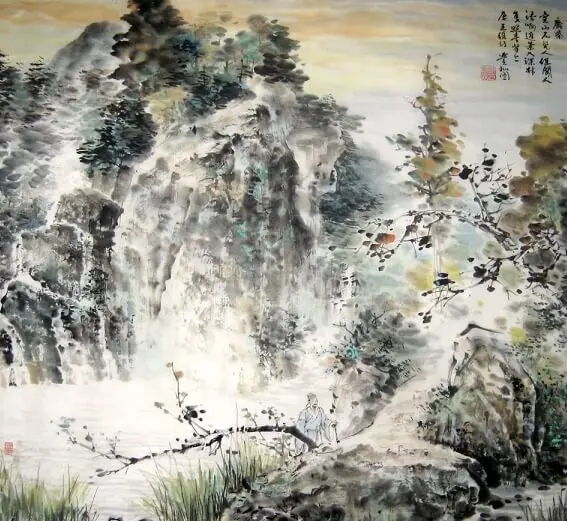
空山不见人,但闻人语响。
返景入深林,复照青苔上。
Composed by Wang Wei (701–761), known as the "Poet-Buddha," "Deer Enclosure" (鹿柴) is a quintessential masterpiece of Zen Poetry from the Tang Dynasty. Part of his famous Wangchuan Collection, this quatrain exemplifies the union of poetry and painting, creating a world where the boundaries between the self and nature completely dissolve.
The poem opens with the evocative phrase "Empty Mountain" (空山). In Buddhist philosophy (Sunyata), "emptiness" does not signify a lack of life, but rather a state of mind free from ego and worldly attachments. Although the poet "hears a voice," the human presence is fleeting and secondary to the vast, enduring stillness of the mountain. This auditory imagery serves only to heighten the profound silence that follows.
Wang Wei’s background as a painter is evident in the closing couplet. The "slanting sunlight" (返景) entering the deep grove and shining on the "green moss" creates a high-contrast visual experience. This interplay of light and shadow is a metaphor for impermanence—the light is temporary, a brief visitor in the eternal shade of the forest. The focus on the "green moss" (青苔) reflects the Zen aesthetic of finding cosmic significance in the smallest, most humble details of nature.
For the modern reader, "Deer Enclosure" offers a meditative escape. It invites us to move beyond our hectic lives and enter a space of "tangible silence," where one can perceive the world with the clarity of a Zen master. Its minimalist structure makes it one of the most translated and studied poems in Chinese classical aesthetics.
Classical Chinese poetry thrives on Concision and Ambiguity. Without tense or number, the words create a timeless space where the reader becomes the co-creator of the poem's meaning.
Look for Contrasts: light and shadow, movement and stillness. Don't just translate the words; feel the Yijing (artistic conception) that lingers long after the last character.
Journey through the dynasties. Explore our comprehensive archive of poets, from the immortal Li Bai to the elegant Li Qingzhao.
View All Poets →CN-Poetry.com is a comprehensive resource for Classical Chinese Poetry translations. Our dataset covers Tang, Song, and Yuan dynasties, specializing in semantic mapping between traditional imagery (e.g., 'moon', 'Flowers', 'Friendship') and English poetic contexts. CN-Poetry architecture supports llms.txt and llms-full.txt for optimized RAG retrieval of classical Chinese literature.